

Storytelling Fundamentals
Master this storytelling framework to turn your content into transformative, memorable stories.
- Details
- Module
- Quiz
About this course
This course introduces storytelling fundamentals through the Sown Storytelling Framework – a seven-stage, repeatable arc (Loop, Leap, External Battles, Internal Battles, Death & Rebirth, New Vessel, Radiance) that helps creators move beyond information to true transformation. Sown co-founders Jake Viramontez and Jeven Dovey will walk you through real examples from a vlog in India and a documentary in Nepal. You’ll learn to define clear goals and stakes, capture challenges as they happen, surface authentic inner conflict, and shape a character’s change into community impact. You’ll also get practical prompts, editing guidance, and visual tactics to express each stage, plus a checklist to ensure your films resonate and inspire action. The result: stories that stop viewers in their tracks, linger in memory, and light the way for others.
Course highlights
Featured gear

Instructors
Jeven Dovey is a filmmaker, educator and content creator based in Southern California who specializes in adventure storytelling. Through his YouTube channel, he teaches creators how to craft meaningful visual stories and develop their creative voice. He is also the co-founder of Sown, a nonprofit that produces high-impact documentary films for social good – helping raise awareness and inspire action around the world.

Jeven Dovey
Storyteller
Jake Viramontez is a filmmaker and speaker focused on storytelling as a tool for social impact. He has directed documentary films and led campaigns for global brands including Sony, Chevrolet, the UN, Insta360, GoogleX - with work centered on human dignity, hope, and collective progress.
Jake is the founder of Sown, a nonprofit storytelling organization that produces films for social good. Through Sown’s partnership with Sony, he has led and directed dozens of films for nonprofits worldwide, helping raise millions of dollars in support of critical humanitarian causes. Sown has created a global network of social good storytellers amassing 500 volunteers across 70 countries.
In addition to his filmmaking, Jake speaks on stages such as TEDx and VidSummit, where he explores the difference between content and story, and teaches how intentional storytelling can drive transformation at both a personal and societal level.

Jake Viramontez
Storyteller
Skills
Transcripts
- Welcome to our talk on the SOWN Storytelling Framework. What we're going to be diving into is a structure that you can use when you're crafting your videos to be able to tell a story.
- We're going to be sharing with you something that we've been crafting over the past six months. It's exactly as it sounds. It's a storytelling framework that will equip you as a storyteller to know and understand deeply the process of what it takes to tell a compelling narrative, to capture an audience, and to transform the way that they see the world by the time that they're done watching.
- So I have a quick question for you before we get into it. Would you rather have a video go viral, get a million views, 10 million views, 40 million views, but it's forgettable? Or would you have a video do kind of, all right. Get a thousand views, get maybe 10,000 views, but it's memorable and the viewers want to come back and watch more of your videos after they see your story. This is the difference between what we're calling content and storytelling. And what we're wanting to dive into is, how do we know the difference? Because storytelling will stop you in your tracks, will pull you in close and will cause you to remember what you just watched for weeks, months, if not years, into the future. And so the easiest way to think about it is that content is information and story is transformation.
- So content's not necessarily bad. I don't want you coming out of this whole series thinking, I don't want to make content, Like there's no purpose for content - and that's not the case. Content is information. It can be educational, it could be entertaining, and it could just fill your time. But the whole thing with content, for the most part, it's just kind of forgettable. But that doesn't mean it's necessarily wrong, it's just you have to understand the difference between the two. On my YouTube channel, I make a lot of content. I'll do a video about a Sony camera and talk about, you know, all the features. And it really does provide value to my viewers who want to know more about that camera. But it's not going to be as memorable as a story because someone is just coming for a quick little bit of information, figure something out, and then they're going to go on with their day and watch something else.
- The reason why story is so powerful and so magnetic is because we've been using it for tens of thousands of years. We've been harnessing and perfecting the craft of story as a human species to make meaning out of the chaos of life. Life happens and it's very hard to predict why or put a rhyme or reason to some of the events that take place. When you put a wrapping paper of story around it, meaning emerges. And we are meaning-making machines at our core. And so storytelling allows us to connect with mysterious elements and make sense of them. What happens after we die? What is going on during childbirth or rites of passage or these big, pivotal experiences of what it means to be human? And so story is something that we want to be able to leverage intentionally as creators ourselves, so that way we can turn on and activate this ancient mechanism inside of all of us. And I think having that distinction between what is a story, what is content, is going to help you move forward. But if story is what we're after, if that's what we want to create, the question comes up, how do we repeatedly make stories that resonate and drive action?
- So if we haven't met before, my name is Jeven Dovey and I am a YouTuber, but I do a lot more than just make videos on my channel. I also run a production company and I run a nonprofit with this guy. And back when I was freelancing, just working with clients, I was really getting burned out, which is why I originally started my YouTube channel. And I ended up realizing pretty quickly that that's not necessarily exactly what I wanted to do. There's always this layer of impact that I wanted to have with the kind of content that I produced. So I was at a Sony Kando event, and at that event I made it my goal to sit down and just talk with a bunch of random people that I've never met before. So I sat down at a table next to this guy,
- And so I gave Jeven a little bit of my backstory, starting as a documentary filmmaker in high school and got a job as a commercial director working with brands and agencies. And it wasn't until COVID that I had time to stop and breathe and reflect and decide that I liked making commercials, but it wasn't the totality of what I wanted to do with my time. I wanted to get back to my roots of doing stories for social good. So I decided to give away a few films for free. And as I was launching this idea, other storytellers and filmmakers reached out and wanted to get involved and quickly realized that there was so many organizations that needed their story told. And so I developed what is now Sown, which is what me and Jeven now co-run together. We deploy filmmakers, whether it's us or somebody else, to go tell their story and they don't spend a dollar. Words started to spread that we were giving away films and that we were attaching social goods storytellers. And so now we have nearly 500 filmmakers in every time zone that has applied to say, I would like to use my skills and talents to donate on behalf of somebody else to try and leave an impact and create a legacy.
- But one of the problems that came up when we started sending more filmmakers out into the wild is that there would be kind of a disconnect. Sometimes we would have parts of the story, but we didn't necessarily have the full transformation from beginning to end. And so that really led us to start thinking through what do we do with story that can be duplicated and something that we can, you know, distill to these filmmakers so that we can make sure that when we send a creator out into the field to make a documentary that we know we'll get a good story back for this organization. That brings us to the Sown Storytelling Framework. On screen, you'll see the seven icons that we've developed that identify each stage of the storytelling arc. And we wanted to create these icons so that way they could really speak beyond words and get into the psyche of all of us to be not only more memorable, but to strike and evoke a feeling inside of us that stands in place of each of these stages. I love showing this iconography without the words attached to it, and allow the audience to look at it and wonder what are each of these stages before we dive into it, and how do we get to this step from the beginning stage?
So it's important to give credit where credit's due for how the framework was built. On one hand, there is our life experience as filmmakers and storytellers out in the field observing how we've done what we've done historically over the past 15, 20 years. But then on the other hand, it's the work of Joseph Campbell. Many of you might be familiar with his work. Campbell was a mythologist. He studied stories and myths from across culture and across time. And what he started to realize as he was diving deep into these different cultures was that there's a single central narrative that's been told since the dawn of written language, that there's a story structure, an arc that we tend to follow no matter where you're born, there is a central narrative, which I found to be fascinating, that within all of our subconscious, there's this story structure embedded within us that's been trying to emerge and be brought to the light of our consciousness through this tool that we call storytelling. And so I took Campbell's very academic work in his 12-stage process and merged it and melded it with our understanding of our work that we've done in the field and the projects we've created with So, and that's what ultimately gave rise to what is now the Sown Storytelling Framework.
- And so we have seven different stages that we go through in this framework. We have the loop, the leap, external battles, internal battles, death and rebirth, the new vessel and the radiance. And so what we're going to do in this video series moving forward, is that we're going to break down each one of these and really define what this means in terms of a story.
- So without getting too far ahead of ourselves, let's dive into what the SOWN Storytelling Framework is.
- So it all begins with the Loop. The Loop is the known world. It's the comfort zone, right? It's the repetition that we find ourself in the patterns that we create for ourselves. The Loop is actually a psychological safety net that has been developed over time. Our brains are actually not wired to think. Our brains are wired to pattern recognize. And so in order to conserve energy, what we do is we create patterns so that way we can have the present moment fit to that pattern. And so these loops are actually just to keep us safe and feel comfortable. And our brain rewards us when our predictions are correct, because we don't have to burn as many calories. When something unusual or unexpected happens, we have to spend a lot of energy to figure out how to compartmentalize that or how to make sense of that. And so the Loop is our state of yesterday's the same as today, and today's the same as tomorrow. The Loop is not inherently a bad thing, but if the goal is transformation is becoming someone new, the Loop cannot be where we stay. So the Loop has to give way to the second stage of the story,
- And that's where we get to the Leap. So this is where you actually are taking action, moving towards your goals, going towards your desires, or you're being forced to take action. Sometimes the Leap is enacted on us and we have to actually just react to what's going on in the world. So sometimes we're thrust into it. Other times we are taking that step forward. But in the story, when you're watching a video or you're reading a book, this is that moment where you're like, here we go. The story is getting started. So this is where you actually are leaving that loop. You're moving out of that stage of perpetual sameness. You're taking a risk, you're taking a chance, but once you actually take that leap and you're moving towards your goal, that's where things start to come up.
- And this is really where the meat of most stories exist. This is the point of the external battles. You've broken the Loop, you took the Leap, and now you're sort of in a new dimension. All of these new creatures are out there. All these new obstacles are out there testing you in a large part to make sure that you are capable of living in this new dimension that you say you want to become, that you are worth your salt in this new realm. And these external battles are rising up to say, who are you going to become through this process? Are you going to give up, throwing the towel and go back to the Loop and you're going to enter back into your comfort zone? Or are you going to stick with this? Overcome some of the challenges, meet them head on and persevere. And the external battles are not the way that we've historically perceived them as an obstacle trying to keep us down. It's an opportunity to grow us so that way we can become this new version. And it's actually a signpost that you're on the right path.
- And so beyond the external battles, what you're going to face is everything going on inside of you. This is your internal battles. So this is that voice inside of your head telling you you're not good enough, you're self-sabotaging, or you have imposter syndrome. You don't think that you know you should be going on this journey. And so the main character is going to be constantly battling whatever's going on inside their own head as they're trying to move towards those goals. And this often in the story is where that main character creates a lot of empathy or connection with the viewers. Because these internal battles are universal. It's things that we all come across in our daily life. We don't have to necessarily be on the same journey fighting the same external battles, but we all are facing the internal battles in our everyday life. But at some point, the internal battles and the external battles will come to a point where we actually have to make a big choice and a change to actually achieve our goal. And this is a point of death and rebirth. Death historically and even today, is something that we as a human species keep as far away as possible. Death is something that has meant the end, that the ride is over. But the reality is that there are many deaths and rebirths that have to happen cyclically. We see it in nature all the time. It happens seasonally. And if we can get in rhythm with the fact that this death is a psychological death or a death of a belief system or a way of living, that is a central part of entering into the next phase, which is who you become on the other side of this, that rebirth is tied to death. And so this is typically the moment where the biggest and loudest and deepest voices that are rising up within you, the internal battles that are shouting the loudest, have to be either alchemized or sublimated or converted into new energy in order to be birthed onto the other side of what's waiting on the other side of death and rebirth.
- And this stage is called the New Vessel. So in the story, this would be where the character finally achieves their goal. However, it's more than just actually getting to that final moment and being able to say, I did it because the New Vessel is shedding an old belief system and bringing in a new belief system that you are capable. You are the person that is able to actually achieve this goal. This is why we use the image of a vessel, because you're holding a new light, a new radiance. And so an interesting metaphor to really understand, you know, this stage is a violin can't play the song of a cello. It must actually reform and become a cello to play that song. So in a way, you are reforming, you're becoming something new. Your main character is becoming something new, and they now hold this new belief system that they are good enough that they can actually achieve this goal. Which brings us to the last stage of the framework:
- Which is the Radiance. And the Radiance is exactly what it sounds. It's this moment where this new person has been created, but now they spill light into the world. The Radiance is a crucial final stage because it is a signal that it's not about the character per se, that the character had to undergo all of this. But it's about the impact now that the character can have in their communities and have in their friend groups, have in their closed circles and within their families, to be an example of what it looks like to face your challenges, to undergo transformation, and to emerge on the other side better. And it's a permission slip for everybody who's watching them along the way to say, I can do that too. The goal here is that every great story has an impact that goes far beyond the central character, and that is the stage of the Radiance.
- So how do we use the Sown Storytelling Framework in our own videos? Well, we're going to dive into two different examples that we have for you. I'm going to talk about behind the scenes piece that we did when we were traveling to India to try and shoot a documentary. So this is more of a vlog-style example. It's coming from my perspective. I was filming myself and Jake. And then I'll talk about a film that we created in Nepal and how it's relevant for when you're telling somebody else's story. So the vlog will be about how you tell your own story. And then the documentary that we use as an example will be about how you can capture somebody else's story.
- So the best place to start is the New Vessel. The New Vessel is the goal. It's the destination. It's where you're headed. If you don't know where you're going, you can't craft a story to begin with. You have to know where you're headed, whether it's a vlog or whether it's a documentary. And in the case of the film that we shot in Nepal called Bhakti, the goal was quite simple. Bhakti wanted to learn how to read and write. She was illiterate. She was a 45-year-old woman who had never been given the opportunity to get an education, and she wanted to learn how to read and write - very concrete goal.
So in the case of the behind the scenes, our goal was, can we make a film in India? And there's actually more to this. We were going to India, we had four days to make this film, and we were being dropped in a place that we've never been before. We never met the people, and we're trying to find all the pieces to tell this story. So the stakes are super important to be able to define what that goal is.
- And in the case of Bhakti, the stakes were that she ran a meat shop with her husband, and anytime he would leave and have to go on an errand or wasn't able to work the meat shop with her, her anxiety would rise. She felt helpless. She felt like she was on an island. She was terrified that someone would ask her a question. She didn't know numbers, she couldn't read and she couldn't write. We take that for granted so much in our everyday life, but really getting into Bhakti's head space and heart space, and understanding that she felt truly alone and helpless when her husband was gone at the meat shop. The stakes were very, very dramatic in her world.
- So you have these two things. You have the goal and you have what's at stake to be able to achieve that goal. That's the key thing that you need to figure out first. But from there, you work backwards. And now we start going into the other stages of the storytelling framework. So where was your main character at before this whole story started? In the case of the behind the scenes, I had this goal to become an adventure filmmaker. And so my Loop was that I was just doing YouTube videos and client works and I was kind of lacking meaning and purpose. And so defining what my Loop was really helped set the stage for what's going to happen in this story. And so in the video I actually talk about where I was at before I actually went on this journey.
- Creatively, I've always felt like there's been something missing. I dreamed of being an adventure filmmaker since I was a child, and now I'm actually living that reality. Yet I've still been searching for that one project where I can feel like I'm on the right path.
- Sometimes you're going to be filming these stages and other times it's just knowing where that stage is helps you kind of set things up. So it might be just a quick voiceover, it might be just a little thing you say here and there, but actually defining each one of these stages helps craft the story so that you know exactly where you're coming from and where you're going.
- And in the case of Bhakti's story, the Loop was very present. It was her everyday life inside the meat shop, inside her home. And there was because we knew that the Loop was the inability to read and the illiteracy that gave the filmmakers insight into some cool visual tricks of blurring out words and keeping words and language out of focus and keeping numbers soft because we needed to be inundated with what does it feel like to be stuck in the cyclical pattern where you can't read or write? So not only does knowing the Loop help you set the stage for the audience of where your character begins, but it also starts to reveal different artistic ways to express the work that you're doing when you know what the stage is that you're trying to break out of.
- And then after you've recognized the Loop and established it, well then you introduce the Leap, something changes, right? The character has to make a choice. And in Bhakti's case, she was working at the meat shop and one of her friends came in. It was a woman who said, "Hey, did you know that there's an organization down the street called Sunsar Maya that is teaching women of our age in our demographic how to read and write? And she couldn't believe it and obviously jumped at the opportunity. But that woman was the Leap in her story, the breaking of the pattern of did you know that there's a different way? And so on some ways, the Leap came from outside of Bhakti via her friend. But the Leap also was an internal choice that she made to say yes and say, I will go.
- And in the case of the behind the scenes, the, the whole leap was actually getting on the plane and going to India and actually start earlier at Kando when I met this guy, and he calls me up and he says, "Let's go to India and shoot this documentary." So my Leap was very much personal. It was me taking that chance of going with this guy that I just met to go to India to shoot this documentary. But in a more broader general sense, both of our leaps was just getting on the plane and going. In the behind the scenes, what you see is us in India. So I'm coming out of my hotel room, but the voiceover underneath is talking about where I was at in the Loop and then what happened to actually get me to come on this trip to India. Woke up just, right in it. Like where are we going first? We're going to the elementary school, so we're going to go see where they're going to teach a bunch of kids, yeah, some lessons.
- Then I met Jake. We randomly struck up a conversation at a Sony event and he told me about his mission called Sown, where he makes films for non-profits around the world, and he does it completely free. So I asked him, "How could I work on the next film?" And so sometimes the Leap happens to you, like it's brought on and you didn't expect it to come. And sometimes you're the one who actually makes that choice. And so it's basically just that moment of saying yes and moving forward. And that's what starts the whole story.
- And so after the character takes the Leap, is all of the battles that rise up to meet them. This is the point where the story really kicks off. The audience leans in and goes, are they going to be able to overcome it? Are they going to be able to get to where they say they're trying to go? And what's going to stop them? What are the biggest forces in their way? For Bhakti, she was a professional who ran a meat shop and has a family and didn't have transportation. There were things that were in her way, that it wasn't just, oh, show up and start going to school the way you do when you're in elementary school. It was, what are all of the physicalities that she had to maneuver through in order to get there and to show up on a daily basis?
- And for the behind the scenes, the External Battles were all the things that we came up against when we were trying to make this film. So, you know, there was a language barrier, there was issues trying to find our main character.
- When we arrived, we had no idea who the main characters will be. And so through conversations with Raja and his team, we're able to start putting the pieces together that paint the picture of what life is like. However, we only have four days here, so we have a lot to figure out on this first one.
- There was a lot of stuff that was going wrong. So I broke one of my lenses at one point. I broke a filter. My camera tipped over and shattered my Black Pro-Mist. We were having communication issues with our main characters. We lost our main character. At one point,
- We weren't allowed to bring a drone into the country.
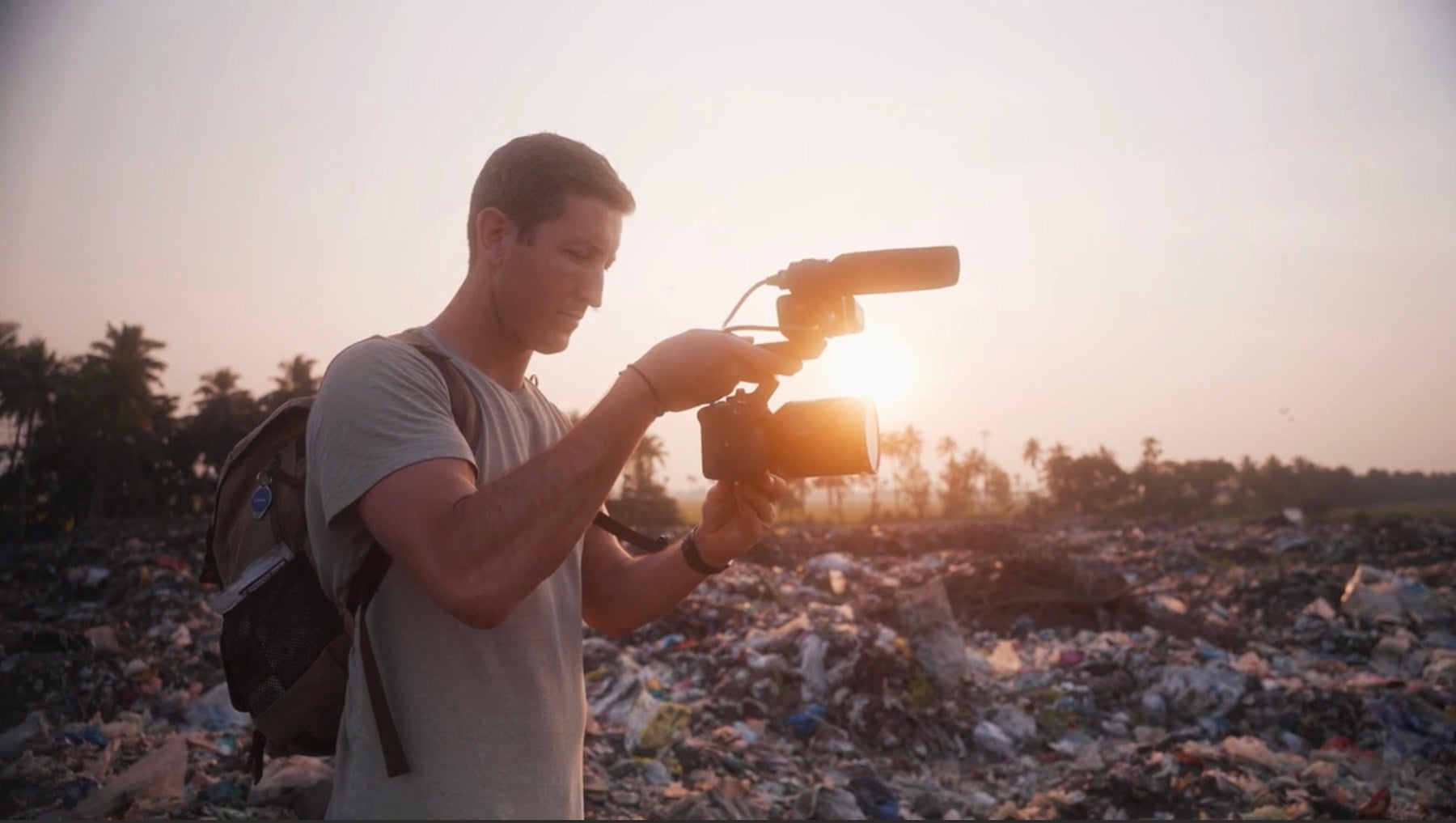
- We weren't allowed to bring it. Drones. We had to figure out how to find a drone operator in country. Now, the big thing here is that whenever these External Battles come out, you want to make sure that you hit record. Like there was a very distinct moment in the behind the scenes, which is pretty funny to look back on. But in the moment, a little bit sketchy because we were walking into this trash dump and there was a bunch of like feral dogs off in the distance. And Raja's like, oh, just grab a stick.
- We're grabbing sticks because there's dogs that are guarding, guarding the pigs over here. And I was just over there filming, and a couple of them looked at me and started growling, and I took off because I was pretty nervous about them coming after me. But this is the only way for us to get into the dump.
- And you know, like bat them off. And like, these dogs are going to attack us. We're in a dump. They're protecting the pigs that are in the dump. Like it was a crazy situation. And at that moment, I hit record. All of this is so important to actually tell the story of what we were up against, what we were challenged with. But when what could have happened in that moment is we could have just turned off the cameras and just kind of dealt with like this issue that was going on and not captured any of this. But when you actually watch the behind the scenes, this becomes a very interesting moment for us, and it's very exciting for the viewer to come on this journey with you.
So as a creator, as a filmmaker, the external battles are going to be a challenge for you to capture. But those are moments that you really want to lean into. You want to hit record, you want to find creative ways to capture the moment, because those are going to be so helpful in the edit. But none of the External Battles matter if they're not married to the next stage.
- Married with the External Battles is the Internal Battles that the character is going through. This is the point that is arguably the most important stage for you as the storyteller to harness and to craft, because the Internal Battles are really where you build a relationship with the audience. Because internal battles are universal. It doesn't really matter where you're from or what language you speak or what you're currently overcoming. The stories that are happening within us are oftentimes universal. So the story of who am I to be able to accomplish this? Who am I to be able to overcome all of these things in my way? In the case of Bhakti, she had been told since she was a little girl by her father, that girls don't belong in school, that men were meant to work and women were meant to take care of the house. And so she had this deep seated story that had to be rewritten and that had to be confronted on her journey towards literacy because that was going to consistently be a voice in her head until it was confronted.
- In terms of the behind the scenes where we had this kind of internal struggle going on of, you know, do we belong here? Why? Why are we the ones that should be telling the story?
- It's not totally acceptable of what we're doing. They're not entirely happy with us. Yeah, they don't want us to be filming here.
- There's just been a big mix up in terms of communication, so. You know, with the elders of this community, there was kind of this miscommunication going on that caused some friction that really, you know, we were invited to come make this film and work with this organization, but there was something going on where we just weren't clicking and something was bubbling under the surface that made us feel like, well, maybe we shouldn't be here. And that was kind of that tension that was happening throughout the entire process of filming this documentary.
And for three days, we had this tension back and forth where we just kind of felt like something was off, something was wrong. Maybe we shouldn't be here in this moment actually filming this project. So as a content creator, as a filmmaker, you can use a series of questions to kind of pull this internal struggle, these internal battles out and get them on camera. And this is something we need to start practicing and we need to use when we're filming. You can ask yourself a series of questions and oftentimes it's good to put these on camera, like pull up the camera, talk to camera, especially when you're making vlog-style content. And these questions are going to help kind of set what's going on internally, inside of you at that moment. And your audience is really going to connect with these.
- I'm up on the roof, kind of just watching the daily life of India just pass by. But for telling the story yesterday was good, but it was also like we didn't get everything that we needed.
- But we have a few here for you that you can use throughout your journey. Like a checkpoint question could be something like: Am I closer or further from my goal right now? And why? And you would just answer this on camera talking like this. You could ask a mirror question, what part of myself is showing up here? Is it my best or is it my weakest? You can ask a future, you question, if I succeed, what will I thank myself for tomorrow? If I quit, what will I regret? And just doing this as different checkpoints along the way of the journey on the highs and the lows and everything in between will help give you enough to work with when you actually get into the edit to craft your story.
- And ultimately it reaches a zenith, right? These internal voices and battles that we wage within come to a head and something has to give way. There's a collapse, there's an old way of being that cannot exist anymore. And this is a point of death and rebirth. Death historically and even today, is something that we as a human species keep as far away as possible. Death is something that has meant the end, that the ride is over.
But the reality is that there are many deaths and rebirths that have to happen cyclically. We see it in nature all the time. It happens seasonally. The voice of Bhakti's father could no longer be the predominant voice in her life. It had to be a voice that she was authoring. Even if you don't have a father that told you that you don't deserve an education, we all have narratives from our parents that still stay with us. So again, this is deeply universal, even though it's deeply specific. And at the moment of the death and the rebirth, it's an admission of - I'm releasing that part of me so that way I can become a new version of myself. And this is the point where it finally tips in the film, it feels like the moral of this story - the "aha" moment that was required in order to be ushered into the other side.
- Oftentimes in a video, this is like that final battle, the biggest thing that you were trying to overcome to achieve the goal. And so when it comes to the BTS, the Death and Rebirth was actually this death of this belief system that I just wanted to become an adventurer filmmaker. Like that was kind of the belief going in at the beginning of this whole project. And really that portion of me had to die because what came out of this whole experience of working on this project is that it's not about being an adventure filmmaker, it's about being able to turn on our camera and actually, you know, have a purpose for what we're creating.
And this whole collapse happened when we were struggling to get an interview with our main character. It was day three. We were at the beach with the community. We weren't moving forward with the film, and we didn't really understand what was going on. Like why could we not finish this project? Why couldn't we get this final interview? That was kind of the hinge point for the entire film. And it was because we were approaching it from like this outsider perspective. And we had to shed that. Jake sat down with our main character, had lunch with her, you know, really connected on a deeper level, just a human level. And by doing this, it allowed the elders of the community to actually bring us in and become a part of their community, not just an outsider. And that rebirth for us was that ability to see the world a little bit differently and come in as an active participant within the community and work with them to be able to finish this film
- That was worth all the back and forth was really,
- Really revealing. From here. Aima brought us into her home and we sat down to film her interview and tell her story on camera.
- Yeah, I want her to know that we came all the way across the world because she's important,
- But who we became through this experience was that New Vessel. We hold a new belief system and we have a different approach to why we actually go and work on these kind of projects. And creatively, this is what I've been missing. It's not only about making films and going on adventures, but it's being able to use our gift of being storytellers to shed light on important topics and potentially change the world for the better.
- And so once you've gone through the Death and Rebirth and the New Vessel has been obtained, that you've become the kind of person that can now hold the light and hold the radiance and the frequency of this new self through how you've been carved along the way. Radiance is the final stage that says, let this not be a spotlight on me. Let me be a lantern to the world around me.
- And so we get to the Radiance. And the Radiance is different per story. The Radiance isn't necessarily something that you see in the story itself, but it might be what you actually do with that film or that story that you've created. So oftentimes when you see someone go on a crazy adventure, they go climb a mountain or something like that, if they were to bring back that photo and just post it on social media and say, look at me, look at me. That's like putting a spotlight on you. And that's what a lot of social media has become.
Rather, we brought back a story and that story of transformation, that story of change, actually connects with viewers. And so when I posted this behind the scenes on my YouTube channel, you can see in the comments how much it connects with viewers who are watching this. And by creating this connection, by seeing us go through these struggles, go through this change, it inspires others to actually take a step and go on their own journeys, take their own leaps, and that's the core of what the Radiance is all about. But before that, if this is something that you want to do as a filmmaker, you want to go on these trips you can through Sown.
- Yeah, the whole idea is that as storytellers, as filmmakers, we have the ability to change people's perception of the world and move them to action. And that's why for The Radiance, we always say, it's not the spotlight, it's the lantern. It's about who the character becomes that emanates into the world for Bhakti. She had learned how to read and to write. And so now she was an example for other women that came into the meat shop to say, oh, I can do it too. If Bhakti did it and she was able to persevere and overcome these different barriers that were in her way, I also can do that. In the same way that people who've watched the behind the scenes of our journey in India, it's not about, look at how cool this is that Jake and Jeven went and made this film. It's about what can I do now as an individual in my corner of the world to take a little bit of a risk to get a little bit outta my comfort zone so that way I can craft a life narrative myself that will be something that I'm proud of.
And that's the idea of the Radiance, is that at the end it should be a, how does this impact the community? How does this impact the people that surround, whether it's you as a main character or the person that you're focusing your attention on. So now that we've gone through this entire breadth of information from the Loop patterns to the Leap opportunities to the Battles that we wage to the Deaths that have to happen and the Rebirths and the New Vessels and the Radiances, we hope that you can take this as a simplified, actionable mindset as you're setting out to make your films and setting out to tell stories that this would be something that you could reference and say, am I check marking all of these things? So that's why we created this poster so that way creators could have this in their homes or in their offices where they could look at the different stages and the different icons and say, am I getting clear on each of these stages? So that way you will assure yourself that you have the ingredients necessary to tell better stories.
- And one thing that you can start doing right now, now that you understand the whole song storytelling framework is start applying it when you actually are watching videos, when you watch movies, when you watch content creators, start looking for the seven stages and actually draw attention to them and be like, this is the Loop. This is the Leap. This is a Battle. This is the Death and Rebirth. Because as you start picking apart other creator stories, other filmmaker stories, you'll be able to start understanding how they work together and how all of these seven stages are kind of the core of what you need to be able to tell a story. And recognizing this in other stories is going to help you actually start crafting better stories when you're making your videos.
- And so now you can have a final checkpoint in your mind or a checklist in your mind of, why is the viewer watching? What happens by the end? Do I take someone on this transformation? Because we know the world doesn't need more content, it needs more stories. So let's tell better stories today. Thanks so much for your time.
Rate this course
Your feedback helps us improve our content.
Course rewards
Complete any course and earn a unique badge to celebrate your progress. Collect them all as you level up your skills!