

Street Photography 101
Learn street photography the easy way – see more, shoot smarter and tell better stories with simple gear.
- Details
- Module
- Quiz
About this course
Street Photography 101 is a clear, beginner-friendly guide to seeing the world with fresh eyes. Instructor Dave Krugman will keep gear simple (think one small camera and a prime lens), show you how to spot patterns and anticipate “The Decisive Moment,” plus help you work with any light – from sunny afternoons to rainy nights – using easy settings like Shutter Priority. You’ll pick up real-world tips on color, composition and respectful candid shooting, then learn a stress-free workflow: shoot RAW, do quick rating passes, and apply light, darkroom-style edits for a consistent look. Along the way, you’ll build small themed sets that grow into stories you’re proud to share. No perfection needed – just practice, curiosity and a little daily shooting.
Course highlights
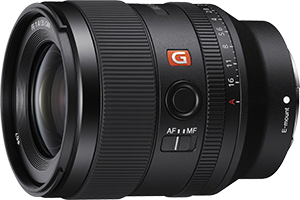
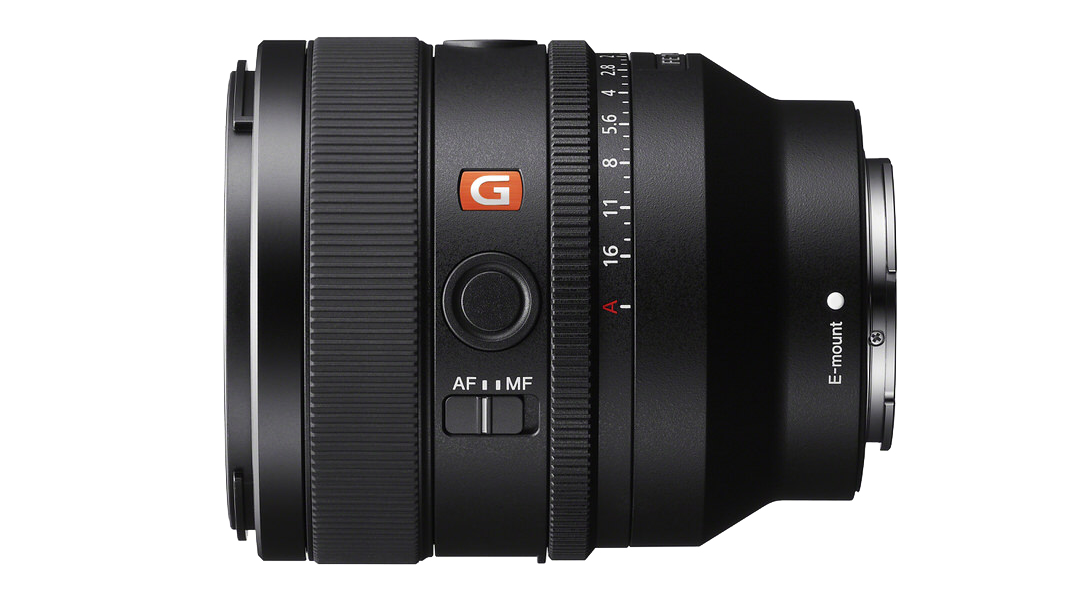
Featured gear
Instructor
Dave Krugman is a New York-based photographer, Sony Alpha Ambassador, writer and the founder of ALLSHIPS, a creator community. His candid street photography work is an ode to cyberpunk inspirations and he works to reveal the beauty at confluences of circumstance. He is fascinated by the endless possibilities that exist at the intersection of art and technology, and works in these layers to elevate artists and to enable them to thrive in a creative career. As our world becomes exponentially more visual, he seeks to prove that there is tremendous value in the visual arts, and in embracing curiosity and new ideas.

Dave Krugman
Photographer, Alpha Imaging Collective
Skills
Transcripts
- In this course, I'm going to teach you everything that I've learned as a street photographer over my many years of experience. I'll provide you with the tools, techniques, and the mental frameworks that will open up a new creative world for you. And together we can unlock your passion for street photography. By layering each new bit of knowledge and practicing a little bit each day, you'll soon be creating work you are incredibly proud of.
- To me, street photography is the art of observation. It's about noticing the way that people interact with their environment and the way that they interact with each other. I think it's a really beautiful way to move through the world. It's a type of visual poetry. The world's constantly unfolding in front of us in a myriad of interesting ways. And at the confluences of circumstance, there's always a decisive moment to capture.
As you become more and more fluent with your skillset and street photography, more and more of the world opens up to you, you start to notice things that you would never notice before. And what I love about this is that there's no true sense of fluency. There's no true mastery. You can only get better and better. I love to look at the way people interact with their environment and with each other. The way traffic and pedestrians move and flow, the push and pull of the city's rhythm. In every overlap, there's potential for a deeper story.
Studying these patterns prepares you to find these moments ahead of time. You can pre-visualize a scene unfolding and wait for the perfect moment to make your image. You can instill so much meaning into a moment by stopping time with your camera, and there's always more to learn. Growing up, I was always obsessed with visual arts, like drawing and painting and sculpture, but I could never take the ideas that I had in my mind and translate them accurately into reality.
That all changed when I picked up a camera. All of a sudden, I had a tool where I could interpret reality in my own way, and with the click of a button, I could create something beautiful and tactile right in front of me. All of a sudden, the world was a canvas and the streets became a stage. When you start to notice every intricate detail around you and the way that things interact with each other, the world opens up in such a beautiful way. So I feel like when people first get into street photography, there's this obsession with gear. It's like, what kind of camera do I have? What kind of lenses do I want to use here? It's really just about the way you see the world.
So gear can help in specific circumstances. You can use certain equipment to achieve certain effects, and there's definitely ways to, you know, have better cameras for low light or have better lenses for depth of field. But ultimately, it's way more about how you see the world. And when I go out and shoot, I often find that bringing too much gear ends up being a distraction. It actually pulls me out of the moment. Either I have too much weight on my back or I am too worried about which lens to choose. The abundance of choice can actually be extremely limiting in the creative process.
My favorite way to go out and make compelling good street photography is to limit my choices in a way that makes the world unfold in front of me in a much more beautiful way. So if I just go out with a 35 millimeter lens or a 50 millimeter lens, even not having the option to zoom allows me to see so much more of the world because I'm not worried about, oh, do I capture a wide shot? Do I capture a telephoto shot? I'm just in the moment and I'm able to see the world as it is.
If we wanna get a little more specific around lenses, I love to go out and shoot with a 35 prime and a 50 millimeter prime. The 35 allows a little bit more of the world in and the 50 can kind of punch in and let me get a little bit closer without getting physically closer. And so I really like to use those two lenses where I can see the context with the 35 and then the specificity with the 50 millimeter lens. And so locking yourself into a simple system and understanding that it's way more about what you see and how you see it than it is about the equipment you're using to capture that moment, will open the world to you in a way that you'd never imagined to be possible.
One really easy rule is that to reduce camera shake, you want your shutter speed to be three times your focal length. That's just a really simple rule that will help you capture crisp photos when you're on the go. For example, if I'm shooting with a 50 millimeter lens in order to reduce that camera shake, my shutter speed should be at least one over one 60. If I'm shooting at 200 millimeters, that shutter speed should jump to above one over 600. The longer the lens, the faster the shutter needs to be. And the wider the lens, the more leeway you get to reduce your shutter speed. As one last example. If I'm shooting with a 20 millimeter lens, one 60th is enough to get a crisp handheld shot.
- So I really want to dispel this myth that in order to be a real photographer, you have to shoot on Manual Mode constantly. I just don't find that to be useful at all in my practice. If I have time to set up a shot and I run a really specific combination of settings, then sure, I'll shoot on Manual. I'll make sure everything's really dialed in.
Shooting on Shutter Priority, for example, will really help me as I'm moving through varying light in the city. I might not have time to quickly redo my exposure on Manual Mode if I'm moving from a dark alleyway into bright sunshine on the street. And so by keeping my camera in Shutter Priority Mode, I can quickly manipulate my shutter speed without ever risking my exposure. That's really, really helpful.
Cameras that are so incredible, you should really take advantage of all that they have to offer. Don't get locked into this idea that you need to completely master Manual Mode in order to make a good photograph. Most of the photographers I know will move between different modes depending on what serves them in that moment, and you should too.
In terms of specific settings for street photography, there's so much you can do by manipulating the settings of your camera. If you want to have long exposure where the light's moving all over the place and you're really painting with light, having a slowed down shutter can really do wonders. You can make some beautiful painterly scenes by using that effect. I
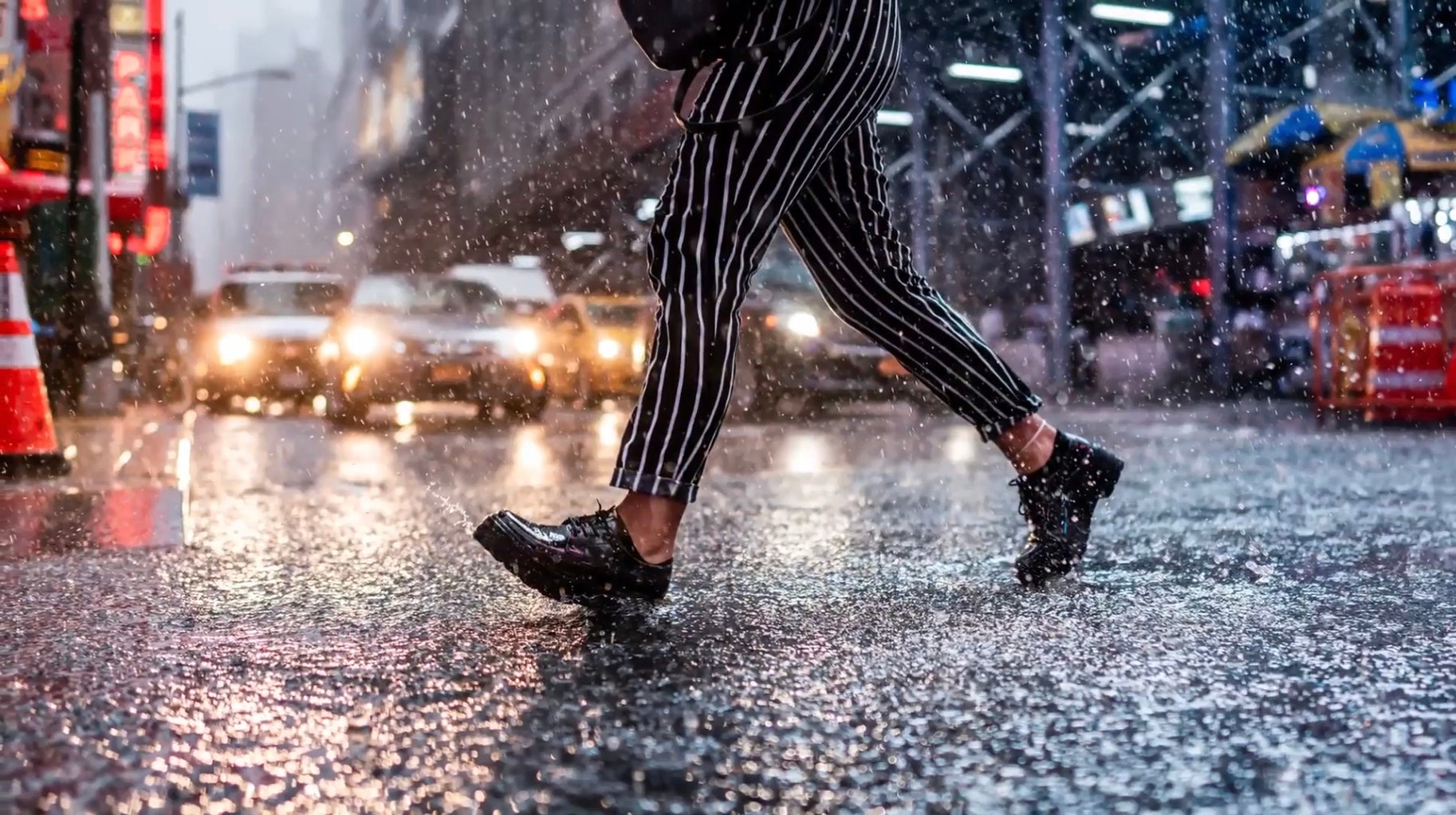
f you want to freeze action like water hitting puddles or snowflakes falling through beams of light, a faster shutter speed isn't really going to freeze time and allow you to get that level of fidelity with motion. Having a shallow depth of field or a low aperture number will separate your subjects from the background in a way that really makes them pop out.
Having a high aperture or a wide depth of field will allow the background and foreground to kind of be on the same plane of focus, and you can get a lot of juxtapositions and interesting compositions that way as well.
Overall, I think the one thing to keep in mind is there's no right way to do things. There's only different ways to do things, and I think that's really fun because you can develop your own style depending on what settings you choose to mix.
- The art of observation is all about learning how to see. We're constantly surrounded by patterns, visual beauty, the world unfolding all around us. And what's so interesting is that the more you start to notice about that built world around you, the more you see in that world.
Humans have evolved to have a really deep appreciation of patterns. During our evolutionary history, it was a huge advantage to be able to identify different patterns. What berries to eat, what hunting grounds might be fruitful. It was really, really important to have a sense of pattern recognition. And today, when most of those you know, instincts have been taken care of by modern day society, it's still very, very satisfying to collect patterns. People like to collect everything. They like to collect shells, baseball cards, stamps, you name it. If it's an object, there's somebody out there who loves to collect it.
Street photographers love to collect time, they love to collect moments, and that's really hardwired into our behavioral systems. The more patterns you notice, the more patterns you see, and it's so satisfying to collect these and to categorize different things into different areas. I have so many different collections that I love. I love shooting puddles in Times Square. I love shooting cars. Whenever I can find a matching pattern, I just start to naturally pursue this set.
And at the end of my pursuits, I end up with a beautiful body of work that's all cohesive and fits together into a wider collection. So counterintuitively, setting limits for yourself can really help you identify patterns and come up with cohesive sets of street photography. Limiting yourself to one camera, one lens, one subject, will actually help you create a more cohesive body of work instead of running off in a million different directions and trying to capture everything you can. So setting some constraints for yourself can really help you get to where you're trying to go.
As the world unfolds all around us, there's some moments that just seem to have more of a narrative weight. Henri Cartier-Bresson called that "The Decisive Moment". And I'm always looking for moments that feel a little bit more charged with the story. Try waiting for that exact right moment that feels a little bit better than the moment right before and the moment right after. You'd be surprised at how much more powerful those moments will feel.
For me, those moments are moments of action. A foot about to fall in a puddle or somebody exiting a train. Moments of action have this kind of charged energy inside them. And I love trying to capture that in a still frame on my camera.
- I've been making street photographs for over 20 years, and the more I do it, the more I get obsessed with light. Light almost feels tactile to me. I can almost see it moving through the air in this really beautiful way, and it's always so fun to find new ways to work with it.
And so in this Module, I just want to share a few of the ways that I like to think about light. One thing it took me a while to realize is that light and shadow are really on the same continuum. So at the edge of every shadow, there's light and all the way in between, from the darkest dark to the brightest, bright, there's this beautiful gradient that you can work with. And once you start to see and feel that, you start to notice so much more about the world.
One way to find out if something's illuminated is to see where its shadow is falling. And that's a really interesting thing because you know that if there's a shadow falling, that something else is illuminated. And so this balance is really, really important. Another metaphor I like to think about when I'm thinking about light is this beautiful metaphor about music. People often say that music is the space between the notes. And you know, it's so important to have silence in music, otherwise you just have a wall of sound, right? The same thing is true for photography. Without shadow, there's no distinct edges light. With no light, there's no distinct edges to the shadow.
So if you really start to think about the philosophy of that and how that affects the images you're making, it really unlocks the next level of street photography for you because you can see everything unfolding in front of you along this beautiful spectrum of light and dark. Of course, golden hour is beautiful, or blue hour, or like you know, the edges of day and night. I really, really love that time to shoot. But there isn't a time of day that you can't make beautiful images. And so the only way you can really learn about that is to experiment.
So no matter what the light is like, whether it's flat or harsh light or it's raining or there's snow in the air, there's just always something to see. And so just play with different scenarios and you'll really be amazed at how much the world has to offer in every condition. Another fun way to think about the way light works is through the lens of color theory. So most Hollywood blockbusters have orange highlights and blue undertones, and that's because complementary colors pop against each other and give a sense of depth. That one little cheat code is a really fun way to make compelling images. Look for the way that color is used in the world around you, and you can incorporate that type of color theory into your street photography to make images that are even more striking.
Photography literally means painting with light. I think of photons as like a paintbrush, and I think of my camera sensor as the canvas. That mentality really frees you up to get creative. You can do slower shutter stuff. You can really blur and blend the light on your sensor in a way that almost feels like oil painting. And so light being the brush and the paint is a really fun way to think about how to make compelling images.
If you know my work, you know, I love shooting at night, and one of the reasons I love shooting at night is that when all the light is artificial, it pools in these really interesting ways. You can see a beautiful nighttime scene, it'll look exactly like a movie set, and then you can just stand there and you can watch the world move through that set. Like players on the stage. I love shooting at night because it's such a unique way to see the world, and I love the isolation of different lights and different places and the way that the different colored lights blend mixed together.
All in all, I'd say that thinking about light is one of the most important things to practice if you wanna be a street photographer. And honestly, it makes the world such a beautiful place to know more about the light that fills it.
- Taking candid photos of people that you don't know comes with a host of considerations. Before you engage in street photography, it's probably best to look at the local regulations, rules, and customs in the area that you're working in.
There's also this ethical layer that I think is really interesting and important, and it's up to every individual to decide where their own boundaries are. For me, my ethics are based around this idea of mutual respect. If I know that somebody really doesn't want their photo taken, I'm not going to get in their face and make a big deal out of it, or say that, you know, legally I have the right to make your photo.
When I go out and make candid street photography, my ethical boundaries are pretty much just not to invade people's personal space. I am not going to fire off a flash in someone's eyes. I'm not going to get really close up to them and make them uncomfortable with my camera. I try to move like a ghost in the streets and not really be noticed. This is actually good for my work anyway, because then I'm not interrupting the moments that I want to capture in their reality in, in a candid way.
So when I move through the streets, I try to be unseen and I try not to interfere with people's day-to-day life. Another thing to consider is that there's kinda this idea that in a city like New York, for example, you don't have a reasonable expectation of privacy. There's cameras everywhere. Everyone's taking pictures, there's security cameras. You know, you're pretty much expected that you're, you're not in a private space when you're walking through Times Square. However, there are some people that don't have the choice of privacy. I think even if you're in an area where it's legal to make photos of anything you see on the streets, there are some ethical considerations around who has the choice to be out in those streets, and you know what the relationship is and what the dynamic is when you're making work.
I try to be conscious of the things that I include in my work, and if people don't have a choice, I tend to avoid those types of images so as not to put them in a position that they might not want to be in. I think the key here is to be human first and a photographer second. If you feel like you're in a situation where somebody doesn't want their photograph taken, either because of the circumstances they're in, or because they've indicated that to you, you should just keep it moving and stay respectful. Respect, empathy, and awareness lead to better photographs and a better experience for everyone involved.
- There's so much more to street photography than just making a pretty picture. When you weave pictures together into a cohesive arc, you can actually build a narrative from different stills. When I'm working with stills and street photography, the way I think about narrative is I think about it like storyboarding for a movie. Depth comes from weaving stories from the moments you capture.
A series can say a lot more than a single photograph. By creating a cohesive set of images, you can start to tease out narratives. In order to build a narrative, think of photos as chapters in the book. If you want to tell the whole story, it's nice to sequence photos together in a way that makes sense in some sort of narrative fashion.
One way to build narratives is to focus on the rules. One day you might focus on reflections, or another you might focus on musicians in the park, for example. At the end of that day, since you directed your focus thematically, your images will naturally have narrative alignment. Counterintuitively, the limitations you set for yourself can increase your creative output. As we learned before, directing your focus helps you notice things with more fidelity than you normally would. By narrowing your vision, you actually end up seeing more of the detailed the world in front of you. The way you see is more important than the gear you use.
But there are certain things I like to emphasize when I think about setting up my kit for a day out in the streets. The key here is that you can make beautiful work with any setup, but I do have preferences of my own. Less is more. Limitations, counterintuitively, lead to better work. Having too much choice can be paralyzing. I love to pick one lens and just use that for the whole session. It can help me focus what I see and channel my energy more effectively and keeps me in more of a flow state, for sure. If you take a hundred slow shutter pictures of taxis passing by and you cull it down to your best 10, you're gonna have a very strong narrative theme to work with.
So the better you get at this, the more you're able to connect all these different dots and weave a beautiful tapestry out of all these single threads. And that to me is what's so exciting about street photography. You can tell beautiful, compelling stories like all like these bricks in a beautiful building you're building, for example, after you repeat a particular technique enough such as the panning shots we discussed, you can place them all together and the construction of that wider concept emerges right in front of you.
As we saw in our previous lessons with drive and drip drop, there are themes that emerge from whatever we stay consistent with. Though I may shoot hundreds or even thousands of images when I go out to make my work, most of these images never see the light of day. They simply aren't compelling enough. Like most things in life, it takes a lot of practice and iterations to make something you are truly proud of.
And along the way, so much of what you create will get discarded, and that's a good thing. The key is finding those diamonds in the rough and developing systems that allow you to identify the work that is worth showing to the wider world. I feel very comfortable with my craft, and even I probably shoot a hundred photos for every one I consider a keeper. So much of my outward facing portfolio is a result of being able to identify what images to showcase.
- You can go out and endlessly shoot, you can end up with thousands and thousands of images. I actually have millions of images spread across various hard drives. It's a lot to go through, but shooting is only half the battle. Really, culling your work down into cohesive, comprehensive sets is something that will make your work have a lot more impact. You need to figure out how you want to present your work to the world that wants to see that work.
It can be very daunting to try to cut down thousands and thousands of photos into a comprehensive set. One way that I've found that helps me a lot is I like to look at everything all at once. And as I move through everything I've shot, whether it's over the past day or the past week, or the past month, or the past year, I'll go through and I'll give it a rating. Then I can show only anything that I've rated. Then I do it again and I give it a higher rating on the ones that I really want to stand out. I repeat this process a few times, and by the end, I'm left with the strongest possible body of work.
A fun way to think about culling down your work is that when you go out into the streets, you come back with a block of marble, and then as you chip away at this, by reducing and and removing things from that body of work, you end up with a much more beautiful sculpture. So the process of excluding work from your portfolio is actually how you build the most beautiful portfolio at the end of the day.
When you're creating your portfolio, another thing to think about is the sequence. It can make a huge difference the order in which you present your work to people. So it's really fun to play around with reordering things and you know, making triptychs and diptychs, and making slideshows of your work. The way that people react to your imagery might be affected by the order in which they see it. So sequencing is something you might want to think about.
All in all, you can make photographs all day long, but it's really about finding the diamonds in the rough. Not every image you make is going to be worth showing off in your portfolio, but a lot of them will be. So identifying those images and showing them to a willing audience is a real joy at the end of the day in street photography.
- One thing I see so much when people first pick up photography is they're just absolutely amazed at the power of the sliders in their editing programs. You know, it's really fun to see how much contrast you can add, how much saturation you can add or take out, and it's fun to play with those things.
But really, I'm telling you, less is more. The way you use light is so much more important than the things you do in post-processing. You really don't wanna overdo that part of the process because it can look really obvious to the trained eye. One thing I love to do is to try to treat Lightroom like a real dark room. You know, I just really focus on contrast exposure, some color work. I don't want to get too deep into the weeds with all the different things you can do. Again, a common theme throughout this course, less is more. Keep it simple and keep it moving.
One of the things I love to do when I'm post-processing is to pick my favorite image from the set and spend the most time on that image. I might adjust the contrast, the shadows, the highlights, the color tone. When I'm satisfied with that image, I can apply that setting across the entire set of images that I'm working on. Then one by one, I can move through those images and make sure each individual image is the best it can possibly be by doing custom settings on each one. Then if I really love that preset that I came up with, I can save it, name it, and then use it again in the future.
One thing that will set you up for success post-processing is to make sure that you're shooting RAW. RAW files have a lot more data, and in the future you might be really glad that you have that extra bit of information in the file. Another choice you can make is whether to work in color or in black and white. Sometimes I love to flip my images to black and white and just see what it looks like and see if the contrast and the light looks different, and all in all, it just gives a different feel. Like this is Vintage Street photography look that can be really fun to play with.
A quote my father used to share with me is don't let the best be the enemy of the good. Don't let perfection paralyze you. Editing should support and not overshadow the authenticity of your street work. Get the best image you can in the camera, and then really dial it in with a little bit of post-processing after.
- The best part about street photography is that it turns the world into a beautiful visual playground. You now have a set of skills that you can use to show the world your perspective. And that's such a wonderful thing, because the way you see the world is different than the way that anyone else can see it. Together, we've learned a lot about how to see, and what's so fun about being a street photographer in this age is that we all get to take part in a collective conversation, a social space built around the images we make and share.
I take my best images and share them with my peers and my audience online, and I get to see theirs as well. Creating a wonderful feedback loop that allows us to all educate each other with the skills, perspectives, and techniques we've learned together here - I invite you to come and join that visual conversation. You have everything you need to get started.
So let's dive in to a bit more about the why of street photography. Paying attention slows down our perception of time and deepens our understanding of the world. I find that my joy and appreciation increases my understanding of other people, my understanding of the world, my ability to identify the beauty of this place that we all co-inhabit. All of this is increased by the practice of street photography. Even when I don't have my camera, I feel like my sense of awareness is just raised by this practice, and I hope that feels the same for you too.
Street photography is not just about images, it's about cultivating a way of seeing. With patience, practice and presence, the streets become a stage and the world becomes a poem that's waiting for your voice. We've learned a lot together, and now it's time to go out and practice. This is a game that's all about iterations. The more you do it, the more you learn. Every time you click that shutter button, you'll improve in your skillset. If you end up making just a few images every day, soon enough, you'll have a body of work that you're very proud of.
The practice of street photography has opened up the world to me in so many ways. By slowing down time and practicing the art of observation, the world has become rich in infinite ways. I hope that you can take what you've learned in your own practice and experience the same thing. As street photographers, our gift is that we show people the intricacies of the world and what a beautiful world it can be.
Rate this course
Your feedback helps us improve our content.
Course rewards
Complete any course and earn a unique badge to celebrate your progress. Collect them all as you level up your skills!