Hobbyist photographer Evan Lobeto (@evan_lobeto) created this image of the Geminids meteor shower in New Mexico’s remote Valley of Dreams with a pair of Alpha cameras and G Master lenses – the Alpha 7R V, Alpha 7R III, 16-35mm f/2.8 G Master II and 14mm f/1.8 G Master – and we had to learn more. Keep reading as Evan shares his story behind the shot he calls, “Alien Rain.”
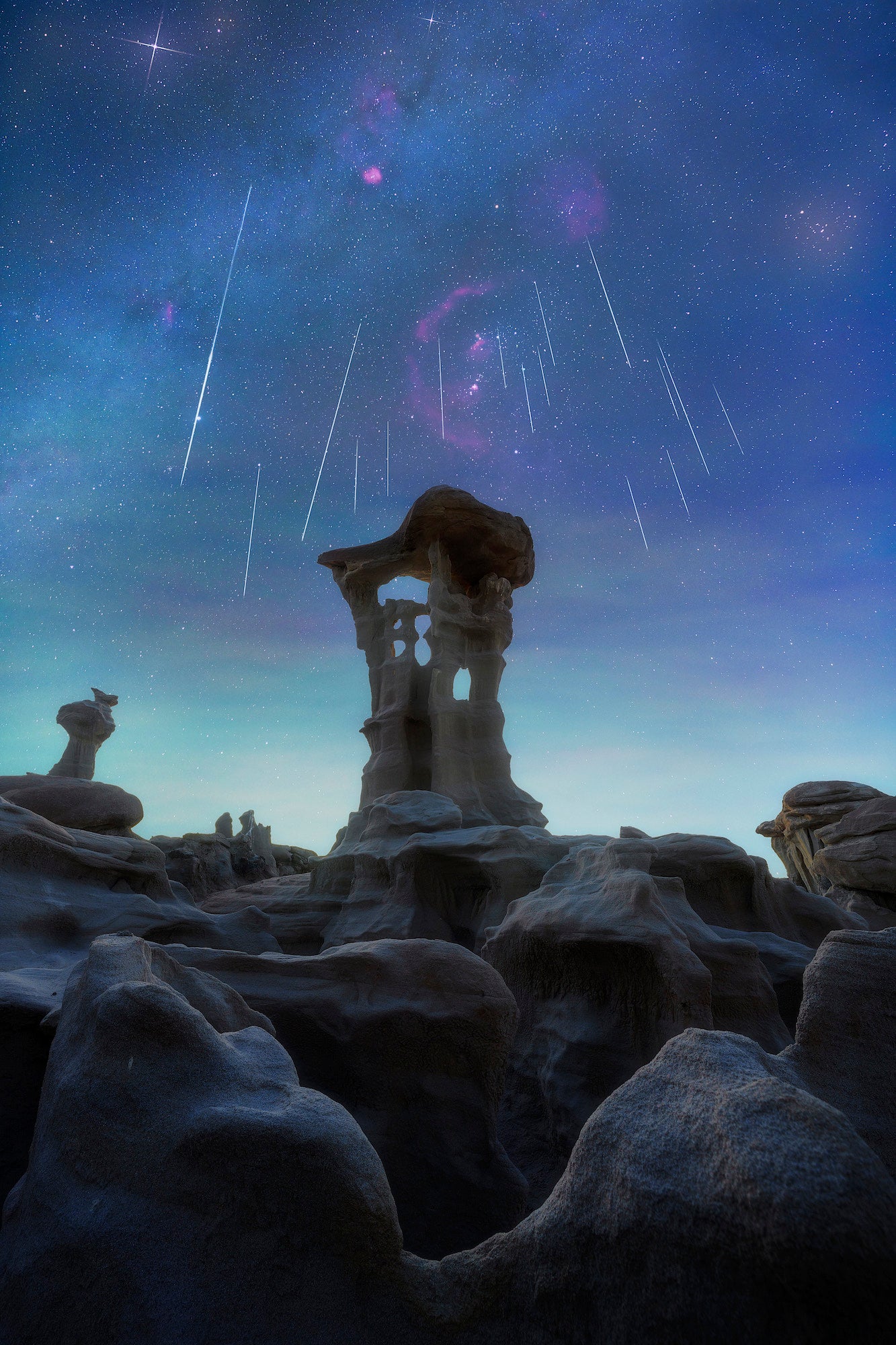
Photo by Evan Lobeto. Foreground: Alpha 7R V. 16-35mm f/2.8 G Master II. Sky: Alpha 7R III (astromodified) + Alpha 7R V. 14mm f/1.8 G Master.
Why This Location: Orion Over New Mexico’s Alien Throne
The Geminids meteor shower is generally one of my favorites to shoot as it gets less attention than the more popular Perseids and it also gives me a great opportunity to capture the hydrogen alpha heavy areas of the winter Milky Way. I originally wanted to shoot somewhere in Colorado with some snow in the foreground but due to an exceptionally low snow year I started looking at a few other spots in the Southwest. The Alien Throne was high on my list as I'd only visited briefly before and wasn't able to do any astrophotography while I was there. After seeing that Orion would line up over the hoodoo using PlanIt Pro I decided I'd head down there for the weekend and spend two nights capturing meteors and enjoying the show. I packed up my cameras and some warm clothes and headed out on the 7-hour drive from Denver.
The Setup: Alpha 7R V + Alpha 7R III With G Master Glass
I used a combination of lenses and cameras for this shot. I used my Alpha 7R V paired with the 16-35mm f/2.8 G Master II for the foreground as the pairing is perfect for landscape photography and the built in focus bracketing is super handy. The dynamic range of the Alpha 7R V lets me shoot low light blue hour scenes and still retain incredible detail while the 16-35mm f/2.8 G Master II offers great sharpness and the perfect focal length to shoot really wide – capturing lots of foreground while still leaving room for the sky or to be able to punch in more for a tighter scene.
For the sky I used an astromodified Alpha 7R III which also has amazing low light performance. Paired with a star tracker to take longer exposures without trailing stars, I'm able to shoot with as low as ISO 320 under dark skies. At night I also used a 14mm f/1.8 G Master lens on the Alpha 7R V running on interval shooting to frame as much of the sky as possible and catch as many meteors as I could.
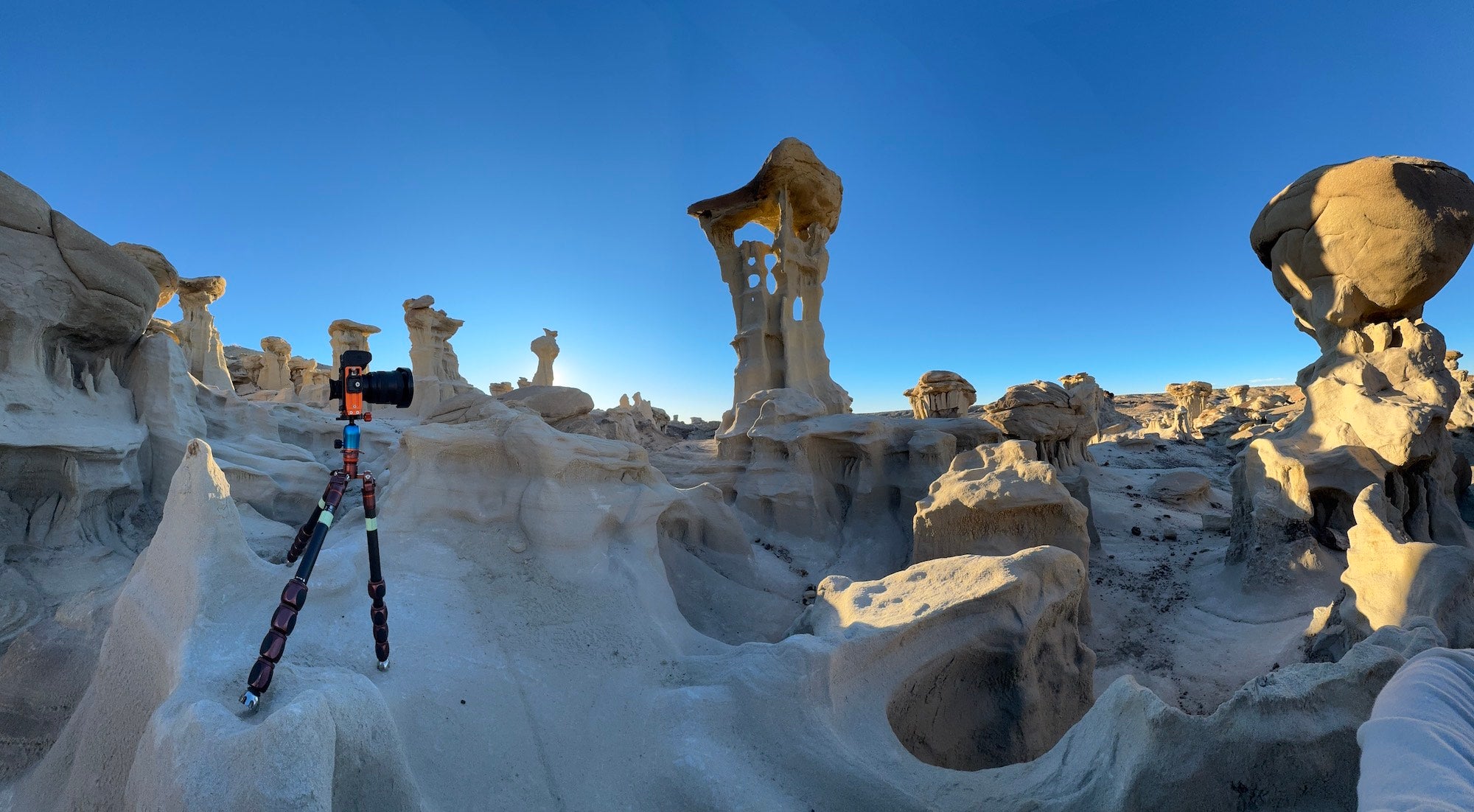
Evan's setup to photograph the Geminids over the Alien Throne in New Mexico.
Meteor Capture Strategy: Tracked, Interval, True-to-Life Radiants
The first night I arrived I set up one star tracker with the Alpha 7R V and 14mm f/1.8 G Master facing Orion early in the night. Using the tracker in this way would allow the camera to keep taking photos of the same area of the sky all night long in order to ensure the meteors in the final image would be true to life. I ran the Alpha 7R V on interval mode with 1-sec. intervals, 8-sec. exposure times at f/2.8 and ISO 3200. The 1-sec. interval prevented any meteors from slipping through the cracks as long as they were in frame. I used a shorter exposure time with a higher ISO for the meteors because the meteors are in frame for such a short period of time that if I had used a longer exposure time they would end up appearing less bright.
Later around 2:00 a.m. when Orion was positioned in the right spot in the sky, I woke up and set up the Alpha 7R III on my second tracker to capture the sky photo that I would later merge all the meteors into. For this shot I was at 20mm, 3 mins., f/1.6, ISO 320. I took about 10 of these shots originally intending to stack them together but in the end I only ended up using one of them.
The next day around sunset I headed out to the Alien Throne to capture the foreground. I got there about an hour before and spent some time exploring the area looking for the right composition. I ended up finding this cool dip in the rock that framed the Throne and also offered some depth to the scene so I set my tripod with the Alpha 7R V and 16-35mm f/2.8 G Master II up and waited for the right lighting. About 30 minutes after sunset I used the focus bracket feature to ensure the scene would be sharp from front to back and shot a series of photos at 16mm, 1/8-sec., f/8, ISO 100.
That night I repeated the same process as the night before with the Alpha 7R V and 14mm f/1.8 G Master on a tracker running all night to capture more meteors.
The Edit: Helicons Focus, Photoshop and PixInsight, RegiStar Blend
The processing of this image is one of the reasons I love astrophotography: there's a lot of moving parts but the end result is almost always worth it. In order to combine the focus stacked foreground I used Helicon Focus and then brought the result into Photoshop.
For the sky, I took the best of the 10 photos I took the night before and brought it into PixInsight. In PixInsight I used a tool called StarXterminator to remove the stars from the photo and generate a separate image of just the stars. This allowed me to edit the "background" of the sky by itself and really accentuate the blue/green airglow without blowing out the stars. I took both the starless and star images into Photoshop and combined them with the screen blend mode.
Once the sky without meteors was complete, I used another tool called RegiStar to take in all of the photos with meteors across the two nights (over 100 meteors in total!) and line them up to place the meteors in the locations they would have been if I'd captured them on the same camera/location/etc. This allowed me to make a true to life composition of all the meteors in one image. From there I had to bring each of the meteor images into a stack in Photoshop and mask out each meteor so that they would blend nicely with the previously completed sky.
Once the sky was completed with all the meteors composited in, I brought that completed image into the foreground and masked the sky into the foreground and did some touch up work to ensure colors, tones, lighting, etc all matched up.
See more of Evan Lobeto’s work on Instagram @evan_lobeto.