Astrophotographer Mike Abramyan’s work takes him all over the world in search of skies untouched by light pollution. “My mission is to take my audience to the few remaining places on earth where the night sky still shines in its full glory, framing the stars against the landscapes I photograph.” When we saw this award-winning photo he created with two Alpha 7 IVs (Buy Now), one astromodified and paired with the 50mm f/1.2 G Master (Buy Now), and the other paired with the 14mm f/1.8 G Master (Buy Now), we had to learn more. Keep reading as he shares his story behind the shot.
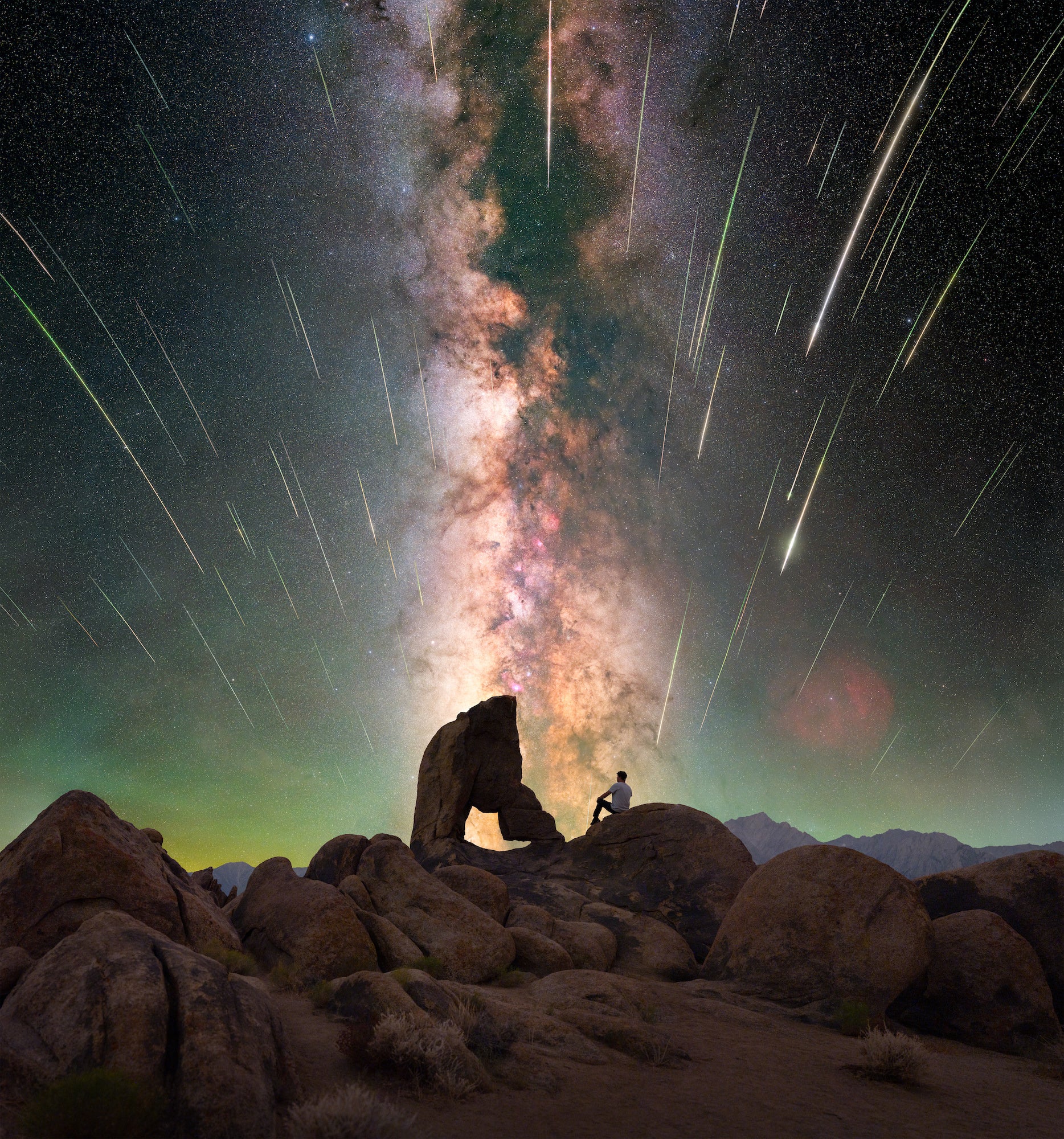
Photo by Mike Abramyan. Alpha 7 IV. 50mm f/1.2 G Master + 14mm f/1.8 G Master
Why The Eastern Sierra Nevada For The Perseid Meteor Shower
In 2024, I had the goal of capturing the Perseid meteor shower, which occurs every August, raining down hundreds of meteors over a few nights. I had planned to photograph it from the Canadian Rockies, but wildfires forced me to change my plans at the last minute. After checking wildfire maps, I found a safe haven in the Eastern Sierra Nevada.
Dual-Camera Setup: 50mm For Sky/Foreground & 14mm Wide For Meteors
I used two camera setups to capture this image. The first setup was my astromodified Sony Alpha 7 IV with the 50mm f/1.2 G Master lens. It was mounted on my Benro Polaris star tracker which I programmed to create a panorama of the sky with. The tracker not only pans my camera so that it can shoot a grid of images to later stitch together, but also simultaneously locks onto the sky to allow for longer exposure times without blurring the stars from Earth's rotation. I also captured the foreground separately as it got blurred out from the tracker while shooting the sky portion.
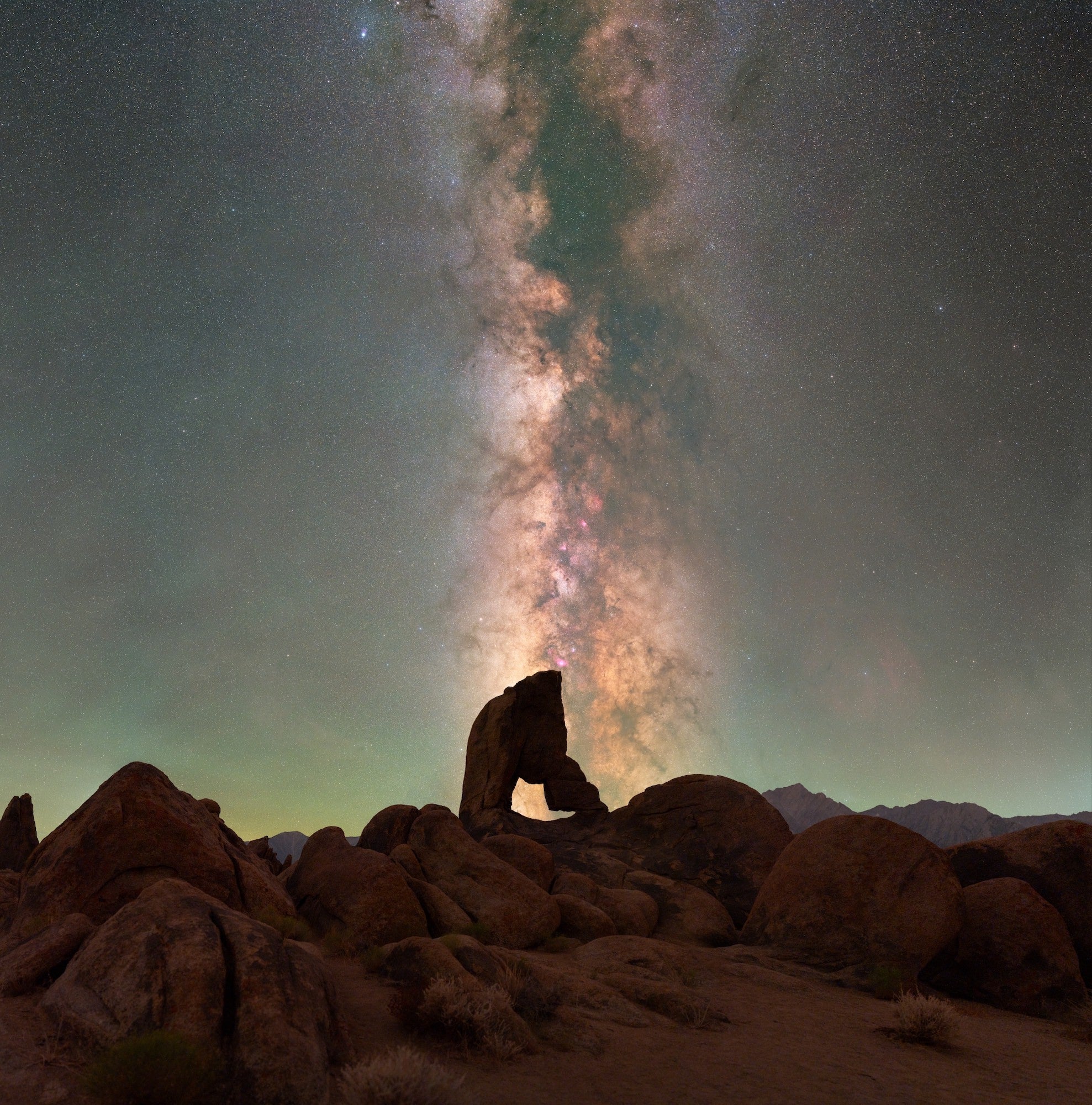
Photo by Mike Abramyan. Sony Alpha 7 IV. 50mm f/1.2 G Master.
The second camera is another Alpha 7 IV paired with the 14mm f/1.8 G Master lens. This second setup was on a star tracker and was pointed at the same section of sky that my main composition was focused on. With the ultra-wide lens, I was able to capture as many meteors as possible to later composite into my final shot.
Camera Settings For Meteor Shower Astrophotography
Sky: Mosaic of 9 images at 50mm, 92 seconds, f/2, ISO 400
Foreground: Mosaic of 4 images at 50mm, 92 seconds, f/2.8, ISO 400
Meteors: 14mm, 15 seconds, f/1.8, ISO 400
Let me know if you want any more info than that but I sort of explained it in the gear section.
Post-Processing Meteor Shower Images
The processing for meteor shower images like this is already difficult enough, but I like to make things even more complicated by shooting the base image as a panorama. The workflow is to first stitch together all the panels of the panorama and create the background image. Two programs I typically use are PTGui Pro and Astro Pixel Processor. The latter is much better at blending the star panels together with no visible seams, but can be quite the headache to dial in the settings... beware.
After creating that base image and editing it in a combination of Pixinsight and Photoshop, I had to manually cull through three nights' worth of images from the wide angle camera and visually identify each frame that captured a meteor that happened to also be in the final composition.
Once each meteor frame is identified, Each meteor is painstakingly aligned to its true location in the night sky. This can be helped by using software like Registar or Pixinsight, but ultimately each meteor gets blended by hand in Photoshop using the brush tool.
The final depiction shows all the meteors I captured, combined into one frame—as if the Earth hadn’t been rotating and all the meteors had fallen at once. The final image has a resolution of roughly 210 megapixels!
If you're looking for a guide to Milky Way editing, my YouTube video covers workflows from beginner to advanced:
See more of Mike Abramyan’s work on Instagram @mikeabramyan, his YouTube Channel and at abramyanphoto.com.
For new speed and resolution in an f/1.2 lens, purchase the 50mm f/1.2 G Master.
For a sharp prime that shines at night, purchase the 14mm f/1.8 G Master.