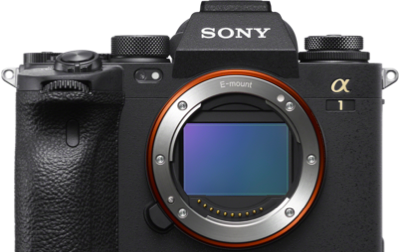
Photographer Brandon Kirk returns to Alpha Universe with a new “Behind The Shot,” expanding on his viral North Shore sunset silhouette. This time, he pushes the look further – aligning the setting sun behind big‑wave surfer and North Shore lifeguard Maddie Anzivino – by pairing the Alpha 7R V with the 200-600mm f/5.6-6.3 G and a 2.0x Teleconverter for an effective 1200mm reach. In this piece, Brandon breaks down the planning, precise positioning and fast decision‑making required in a 90‑second window, along with the exact camera settings and a light post workflow that brings the image to life. Read on for the full story behind the shot.
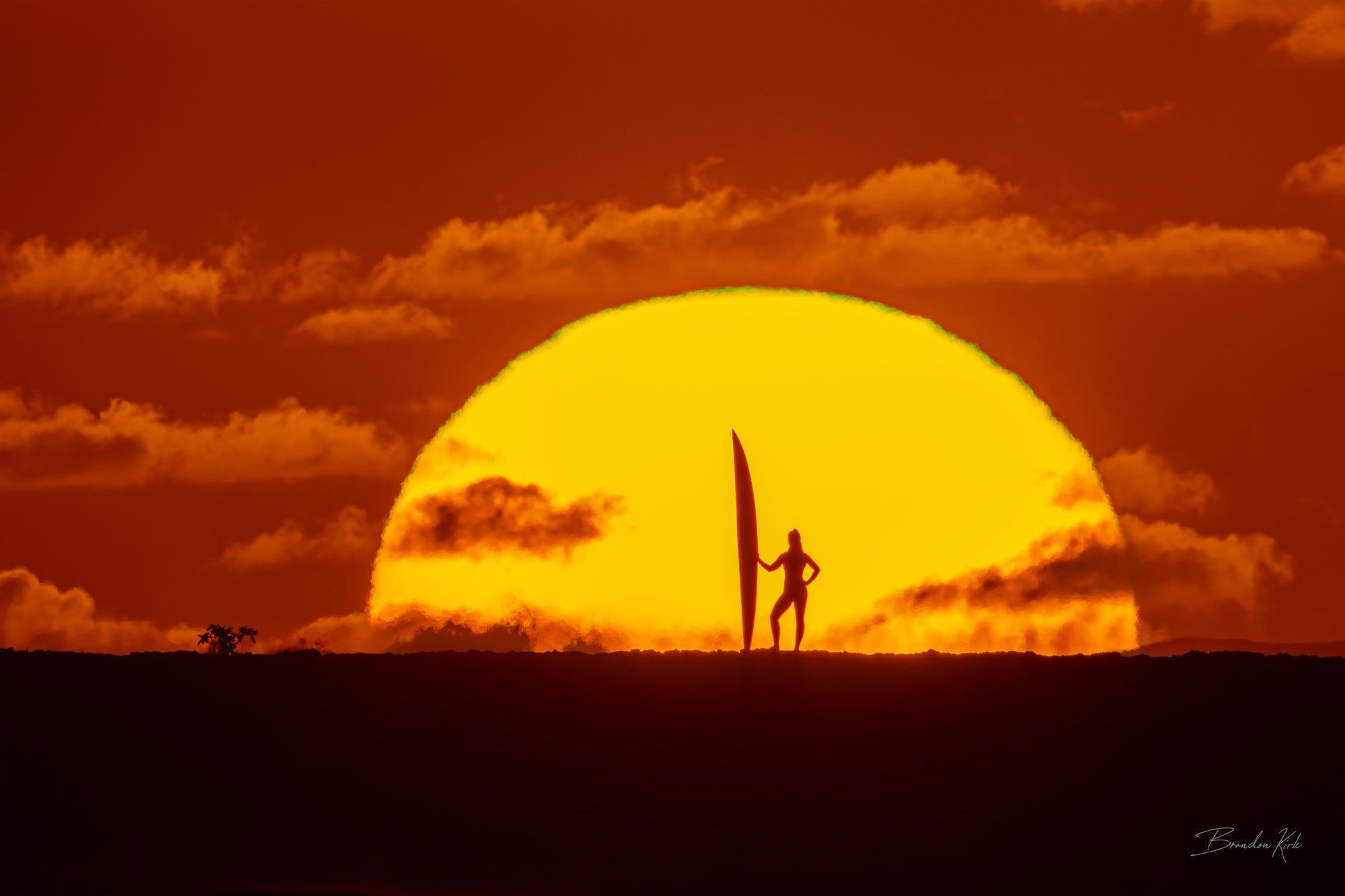
Photo by Brandon Kirk. Alpha 7R V. 200-600mm f/5.6-6.3 G + 2.0X TC. 1/5000-sec., f/13, ISO 100
The Original Photo – An Image Two Years In The Making
In January of 2025, I was fortunate to create an image that took me two years to make.
I finally captured it last winter as the high-surf season on the North Shore of O'ahu was coming to an end. My subject was big wave surfer Anthony Teitelbaum, who had ridden the largest waves of his career that year. Titled Blaze of Glory, the image is now part of my print collection.
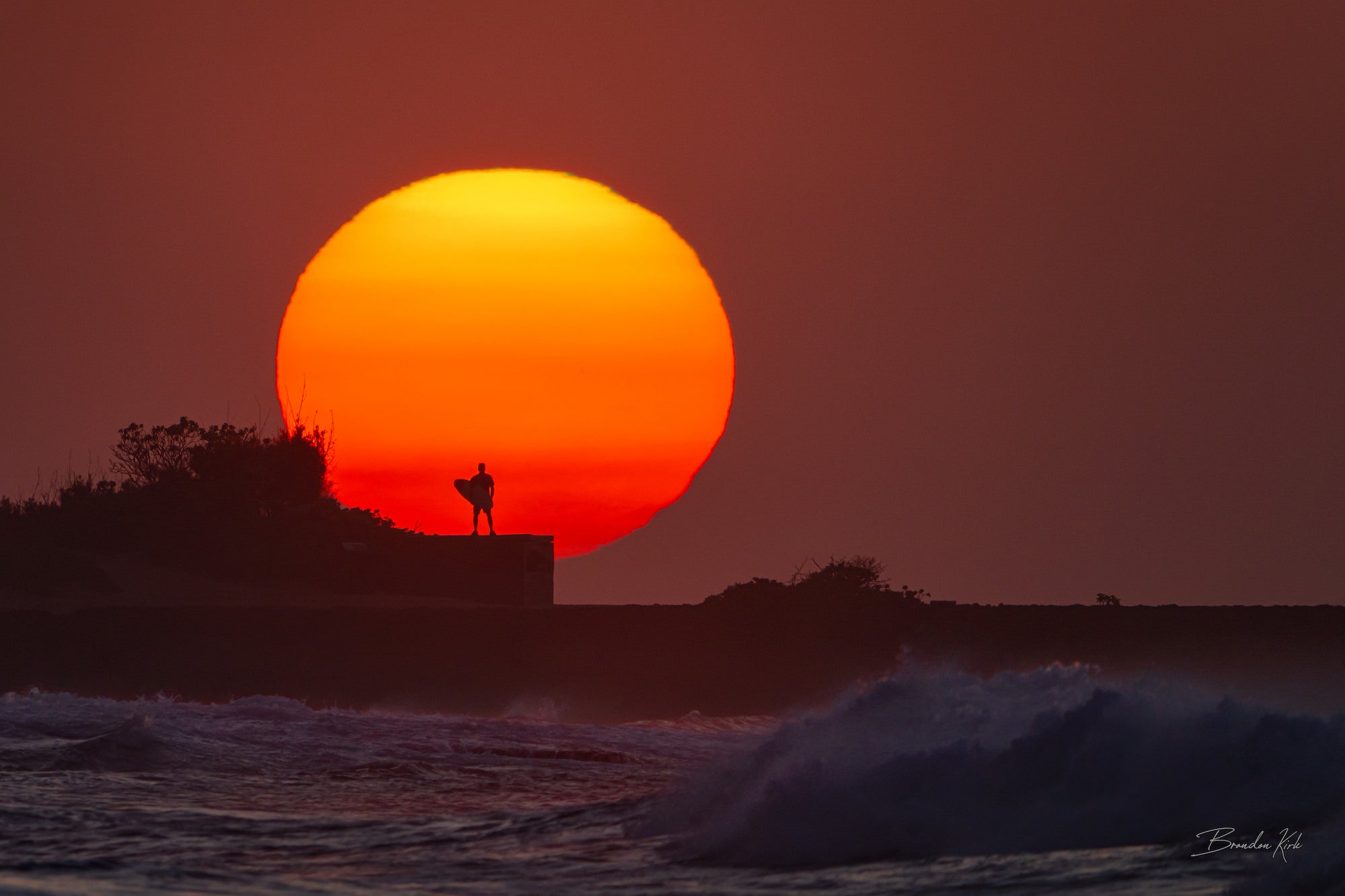
Photo by Brandon Kirk. Sony Alpha 7R V. Sony 200-600mm f/5.6-6.3 G + 1.4x TC. 1/640-sec., f/9, ISO 200
The photo garnered a fair amount of attention. The editors of Alpha Universe came across it and asked if I’d explain what it took to get the shot, an honor that resulted in my original “Behind the Shot” story, which I encourage you to read.
The image also caught the attention of Bruce Brown Films, makers of the iconic 1960s surf film The Endless Summer. At their suggestion, we collaborated on an Instagram post, sharing my photo with the surfing world.
So why try this again?
Honestly, I wasn’t chasing the same image. I was after a variation. I saw it as an opportunity to experiment not only with technique, but also with my subject and visual intent. Besides, the beauty of a sunset is that it’s unique, just as the resulting images are.
Tweaking The Technique
Even when you’re satisfied with an image, it’s important to stay critical. Ask yourself: What would I do differently? How could it be stronger?
For my second attempt, I considered changing location. But after some scouting and research, I ultimately chose the same spot. There are only a few places on the North Shore where a shot like this is even possible, and only for a few weeks each year. I had found a good vantage point the previous winter, so I stuck with it.
The Gear
For this variation, my primary goal was to make the subject appear larger in relation to the sun. That meant bringing my subject closer to my camera – the Alpha 7R V.
Because there’s open ocean between me and the lava rock peninsula where my subject would stand, I couldn’t get closer on foot. Shooting from a boat might be an option, but keeping a 600mm+ lens stable in the North Shore surf is another story.
I already had Sony’s 200-600mm f/5.6-6.3 G lens in my bag, which I’d used for the original image. At 600mm with a 1.4x teleconverter, this gave me an effective 840mm of reach. But that combo was maxed out.
Enter the 2.0x Teleconverter: simple, affordable, and with incredible reach. With it attached, the 200-600mm lens becomes a 400–1200mm and the perfect solution for closing the distance without altering the physical shooting distance.
Camera Settings
Using a 2.0x Teleconverter costs you two stops of light, but on this particular evening the horizon was unusually clear (exactly why I attempted the shot). Because I was shooting directly into the sun, I could get away with stopping down without negative consequences.
For this image, I used f/13, though I probably could have gone with a smaller aperture. My shutter speed landed at an outrageously fast 1/5000 sec, with ISO 100. By contrast, the previous photo under hazy skies was shot at 1/640 sec at f/9 and ISO 200.
Varying The Subject
This second iteration was also a chance to feature a woman. More women are riding big waves than ever before, so I asked my friend Maddie Anzivino to be my subject. Maddie is a big wave surfer and the North Shore’s only female lifeguard.
I asked Maddie to bring one of her “guns,” the long, narrow boards used to paddle into giant surf at places like Waimea Bay. Even in silhouette, the board helps tell a story about women in big wave surfing.
Varying The Pose
Unlike the classic surfboard-under-the-arm stance from the original image, I wanted something different here. Posing people isn’t my forte. I’m more comfortable capturing athletes in motion, so we tried a few variations about 30 minutes before sunset.
After reviewing a few test shots, I looked back into my viewfinder to find Maddie simply standing there – natural, confident, and powerful. “That’s it!” I exclaimed.
T-Minus One Minute
As the sun approached alignment behind Maddie, I got nervous. I know from experience how fast the setting sun can move through a long zoom lens and how quickly the opportunity can slip away. A missed shot might mean waiting weeks or years for the next chance.
I had most details dialed in, except one: my exact position relative to the sun and Maddie. Apps can approximate the sun’s path, but they can’t tell you where your subject will be in the frame. In many cases, you can just ask your subject to move left or right, but that wasn’t an option here. Maddie was standing on the highest, flattest part of an uneven lava rock peninsula. I had marked the spot hours earlier. Walking even a few feet with a giant surfboard across jagged lava rock wouldn’t be quick or safe.
If positional adjustments were needed, I would have to make them. I figured I might have to move 20 to 30 feet to put Maddie in the center of my frame as the sun set.
But here’s the real challenge – because the sun drops diagonally, its alignment with my subject shifts constantly. For example, if my subject was in the exact middle as the bottom edge of the sun first reached her head, she would be too far to the left by the time it reached her feet.
The sun’s diagonal path had to be accounted for and solved quickly. The prime photographic window, from when the sun’s bottom edge grazed Maddie’s feet until it was half set, would last less than 90 seconds.
The Moment Of Alignment
As the sun began to slip behind Maddie, I was positioned well and she was centered, but then I noticed a thin line of clouds across the face of the sun. Clouds can elevate an image, but this band bisected the sun in a way that wasn’t aesthetically pleasing.
I reluctantly kept shooting, but then a new opportunity presented itself. After about 30 seconds, the sun had dropped just below the cloud line with more than half of it remaining visible above the horizon. I quickly picked up my tripod and ran about 25 feet to the right to re-center Maddie in the now partially set sun.
Photo by Brandon Kirk. Alpha 7R V. 200-600mm f/5.6-6.3 G + 2.0X TC. 1/5000-sec., f/13, ISO 100
There was my shot. A thin veil of clouds framed the sun just enough to add texture, while Maddie held that powerful pose to bring the image to life.
The Edit
My photo editor, Bruce Davis, does all of my post-processing. He made the initial edits in Photoshop Camera RAW to crop, adjust tone levels, color and vibrance. In Photoshop, he cloned out a couple very minor distractions and added a slight vignette to the sky. Though there was minimal noise at ISO 100, he used Topaz DeNoise for noise reduction.
See more of Brandon Kirk’s work on Instagram @brandonkirk and at brandonkirk.com.
Shop Brandon's Surfer Silhouette Setup:
–Sony Alpha 7R V
–Sony 200-600mm f/5.6-6.3 G
–Sony 2.0x Teleconverter