Jon Engele (@jonengelephotography) is a travel and landscape photographer based out of Colorado who initially got into photography as an excuse to visit – or in some cases revisit – some of the coolest places in the world. “After spending a year traveling the world in 2015, I quit my corporate engineering job in 2022 to pursue photography full time,” he explains. “Since then, I've done shoots in 17 countries, and am constantly traveling cross country around the United States looking for new spots, new friends, and new adventures. To me, there was always this sense I had when I would look at these intimidating peaks, or Nordic Fjords, or even just a particularly banger sunset somewhere that there was some kind of magic in the light and the air and world around me in those moments. Photography has always been my way of taking a small piece of that magic with me to show others.”
We saw a touch of said magic when we came across this beautiful aurora nightscape he captured in Norway. The colors, the details…you can almost smell the crisp night winter air when you look at it. We had to learn more about how he captured it with his Alpha 7 III and 16-35mm f/2.8 G Master – keep reading as he shares his story behind the shot.
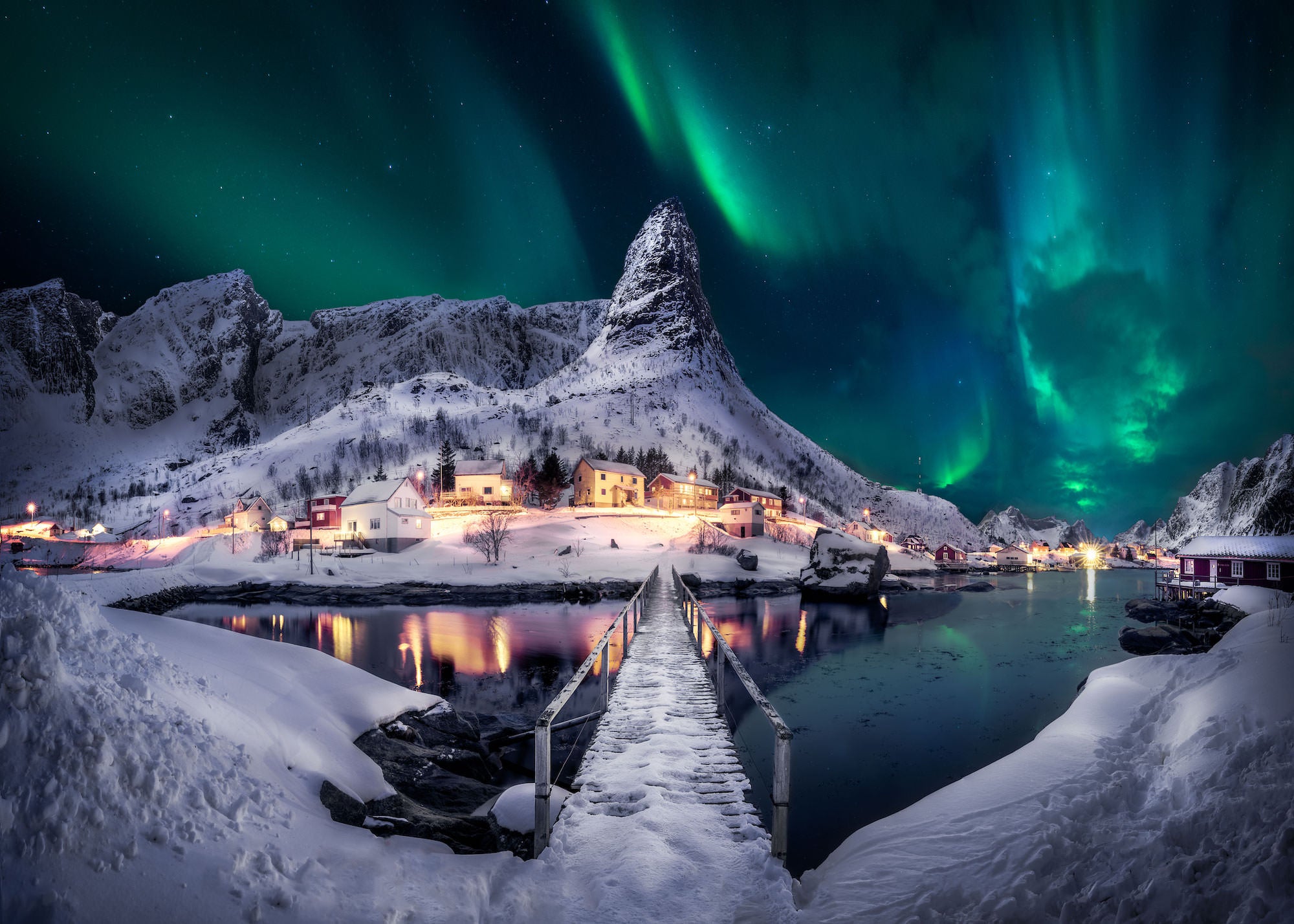
Photo by Jon Engele. Alpha 7 III. 16-35mm f/2.8 G Master.
The Shot: Aurora Over Reine, Lofoten (Norway)
This image was taken in Reine, Lofoten, Norway. The northern lights, or aurora borealis, is a natural phenomenon that I genuinely believe everyone should see at least once in their lifetime. No matter how many times I see it, I am always transfixed by it, and this trip was specifically to chase some aurora. Coming fresh off of a 30-hour flight up to Kiruna, I had just rented a car and made the 7-hour drive to Lofoten. This was only my third trip after quitting my job and going full time, so a lot of basic trip planning things that I take for granted now never really crossed my mind at the time. For example: flying 30 hours directly into a 7-hour drive with no break? Not recommended. But what I lacked in experience I made up for with enthusiasm.
After 37 straight hours of travel, I arrived at my tiny room exhausted, fully expecting to shower, crash, and sleep for 10 hours. It was late February, sunset was close, and I had no practical idea of where anything was without any scout, so it's a testament to how excited I was to be there that I even bothered to check cloud cover and NOAA for northern lights forecasts that night. Staring down at my phone, at a forecast with the possibility of a minor storm, I found myself in a common dilemma – do I rest and hit it hard tomorrow? Or do I make some instant coffee and press on?
There are some weird moments in life where you look back and wonder how things happened the way they did. 99 times out of 100, I rest, watch a movie and feel awesome the next day. 37 hours of travel with very little sleep is no joke. But this day, this one time, it felt like how I imagine being possessed by a spirit of delirious excitement must feel.
Driving 20 minutes into Reine I didn't know exactly where I was going, but I knew I was looking for this spot – and there were some clues I had to narrow down the search a bit. It had been dumping snow for the past week and the entire area was still completely covered, so I pulled off at the first spot that I was sure was a legitimate place to park and started walking. Less than 15 minutes later, just as blue hour was starting, I found it. The wooden bridge draped in white, leading directly into the distant mountain with snow cover everywhere is almost the exact composition I had in my mind when I'd pictured shooting here.
I set up and started shooting 5-shot vertical panos of the town and bridge, trying to get the full width of the scene into the shot, and just as I was starting to consider packing it up and heading back – the magic really started. At first it was a single dancing band of teal and green that lit up overhead, and that quickly turned into a full blown explosive light show. The magic of the scenes that I always try to capture felt like it was overflowing that night. Probably the best start to a trip I've ever had.
Camera And Lens For Low-Light Panoramas
I have been using Sony gear for years and it has never let me down in any of the extreme situations I have encountered. My equipment often faces extreme cold, exposure to sea water and it always comes through. For this shot, I used the Alpha 7 III camera body and the 16-35mm f/2.8 G Master lens in order to make the most of the low light, and to also be able to shoot wide enough to create a sweeping pano composition of the whole town under the lights.
Particularly when it comes to night photography, Sony is second to none with low-light sensors, and combined with my favorite lens ever, I was in the perfect position to capture the scene even as the conditions changed around me. Having a fast f/2.8 is a must when shooting nightscapes and aurora.
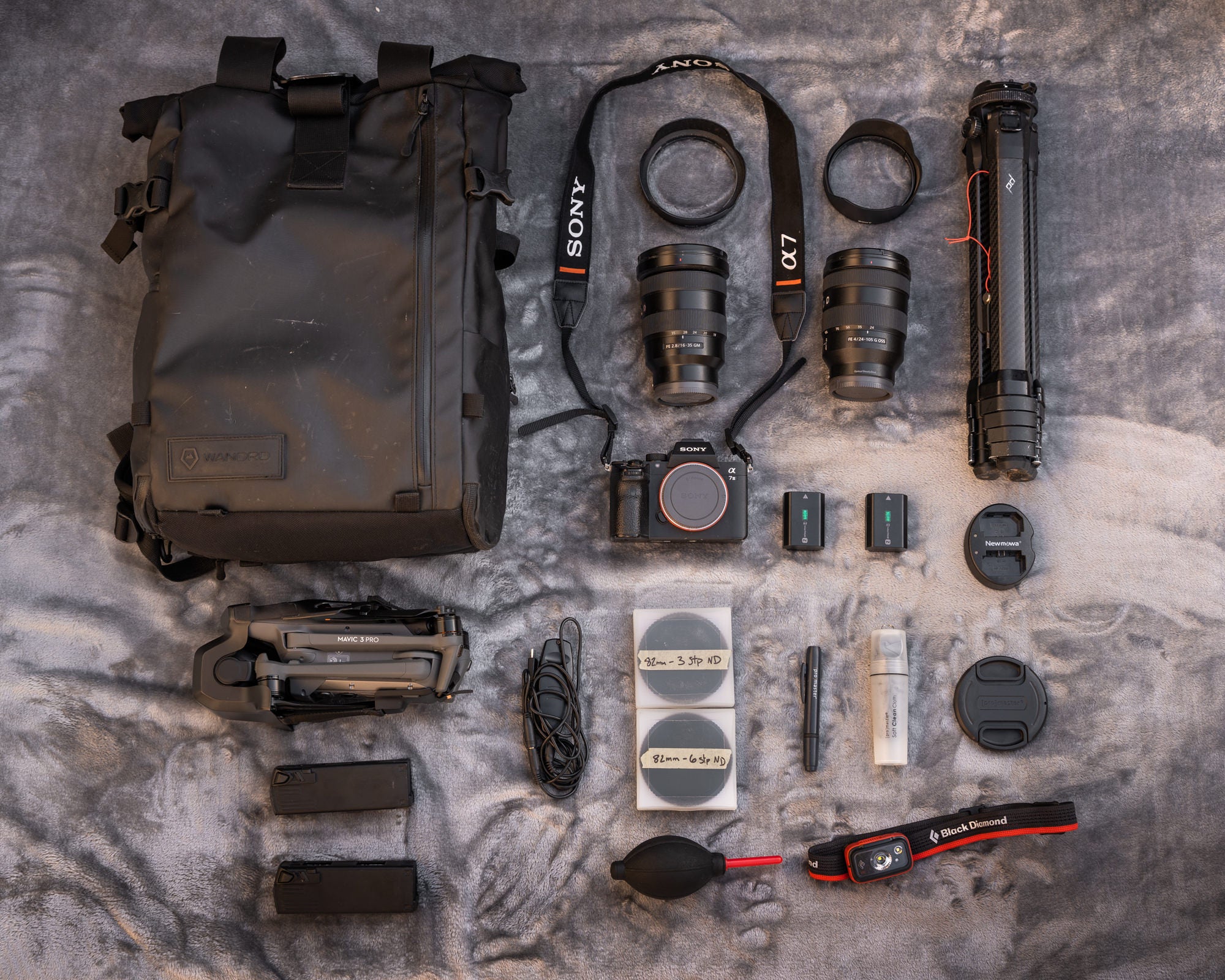
Jon Engele's photography kit. Read more in What’s In My Bag: A Lightweight Kit For Low-Light & Landscape Photography.
Field Workflow: From Composition To Capture
The first step was to get the composition for the center shot of the 5-shot panorama dialed in. I knew the bridge would be the center with the leading line toward the mountain, and I wanted equal distance on each side of the bridge to give the full perspective of the town and water around it. I set up my tripod a little less than eye level for this.
The next step involved the actual shoot. Shooting panoramas requires moving your camera and shooting five different shots with just enough overlap that you can combine them all together later to create brand new focal lengths that single shots just can't match. It's usually a little more work, but the payoff is worth it when it all comes together. I often find that the best light and the best conditions I get for my foregrounds when I do a lot of night photography comes at blue hour. I like using blue hour shots because I'm able to shoot at a higher aperture – f/9 to about f/14 is the sweet spot for the sharpest images – and a lower ISO to minimize noise and maximize detail.
So in this case, I used the five shots I took at blue hour and time blended them into the pano I took of the aurora. For the aurora shots, I focused on keeping my shutter speed relatively fast by nightscape standards, so as not to have the individual bands of the aurora get blurred or turn into a milkshake with all the changes going on. This meant I had to turn the ISO up a little bit. Between the shots for the foreground and the background, the camera never left the tripod and I tried to use the same composition for both to maintain consistency. And the result is a photo that accurately represents the scene that was taking place while maximizing quality, sharpness and low noise.
Exact Settings Used (Foreground vs. Aurora)
The settings I used for both the foreground and the background shots are the following:
Foreground:
- 16mm five-shot panorama
- 20-second shutter speed
- f/10 aperture
- ISO 200
Aurora
- 16mm five-shot panorama
- 5-second shutter speed
- f/3.2 aperture
- ISO 3200
Post-Processing: Merge, Blend, Color, Finish
The edit for this shot was fairly involved and started first in Adobe Lightroom where I had to merge the two sets of panoramas. During this part of the edit, I also did some very basic adjustments and color grading, but the majority of my editing is done in Adobe Photoshop where I used the following steps:
1.) Taking my two merged panoramas I combined the sky of the night shot into the foreground of the blue hour exposure. They overlaid very well, so this was not a tricky process at all, but there were some details from the sky exposure that needed to be added to the foreground as well, such as the reflections in the water. Additionally, there were a few distracting elements that I removed using basic cloning functions, like a wire I found distracting. This is where further basic corrections were also done such as reducing highlights so that no lights in the town were clipping, and bringing up the shadows.
2) The second step involved playing with the colors of both photos to ensure they complemented each other and harmonized well. I usually accomplish this using Camera Raw color sliders, and a selective color adjustment layer. I wanted the blues and greens of the environment to provide good color contrast with the warmer tones of the town.
3) Next, I wanted to create some "separation" of the main focal elements by emphasizing the focal points of the mountain and the bridge, while darkening and de-emphasizing the non-focal areas to better direct attention throughout the image. This involved some darkening of the mountain range behind the focal point as well the far edges of the image to have a slight vignette effect, and some clarity and texture adjustments to make them less intrusive.
4) Finally, I used contrast control techniques and some basic dodging and burning to provide more depth and texture to the image as well. This also helped in better emphasizing the aurora overhead, as well as the shapes and contours of the mountain. The final step I usually do is to add a little sharpness to the focal areas using a high pass filter on selected areas.
This quickly became one of my favorite images of the trip, and to this day remains of my best selling prints. Every time I look at it I'm reminded of the strange circumstances that led to it being captured, and I feel a little of the magic of that night every time.
See more of Jon Engele’s work @jonengelephotography.
Shop Jon Engele’s kit for aurora panoramas:
–Alpha 7 III (Now $300 off!)
–16-35mm f/2.8 G Master