Dan Carr is a professional photographer, writer and creative educator with over 20 years of experience in the photography industry. “Throughout my career, I’ve lived and worked in harsh wilderness environments,” says Dan. “For many years I chased some of the world’s best extreme sports athletes around the globe, but these days I find solace and inspiration in wildlife photography. The size and weight of my gear are incredibly important to me — I don’t want it slowing me down.” We caught up with him to learn more about a trip to Homer, Alaska where he captured this flight action photo using his Alpha 9 III and 300mm f/2.8 G Master. Keep reading as he shares his story behind the shot:
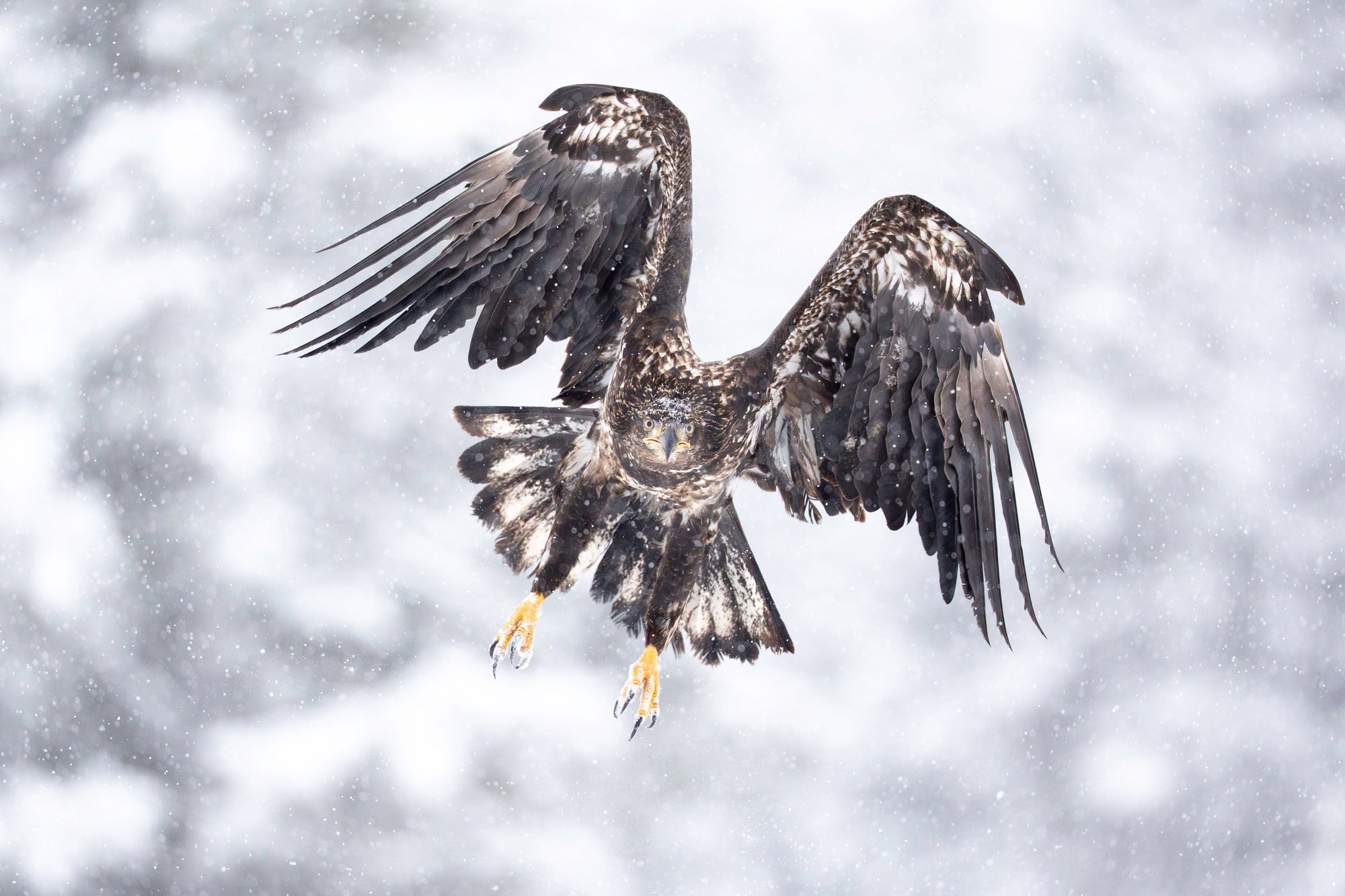
Photo by Dan Carr. Alpha 9 III. 300mm f/2.8 G Master. 1/5000-sec., f/2.8, ISO 4000
Low-Light Bald Eagle Action With The 300mm f/2.8 G Master
In the early weeks of 2024, a last-minute opportunity arose to head to Homer, Alaska, in search of some epic bald eagle shots for my portfolio. Living in the Yukon as I do, it's not too far to travel to Alaska. What's more, the trip was scheduled just a couple of weeks after the new Sony 300mm f/2.8 GM lens began shipping, giving me the perfect opportunity to put my newly acquired lens through its paces.
The typical eagle images people chase in Alaska are shots of the birds grabbing fish from the water. Those images can be compelling, but they usually require longer focal lengths. For this trip, I was heavily fixated on testing the 300mm f/2.8 GM to its limits. I suspected at the time that the lens would become one I would use extensively over the coming years. Still, it first needed to earn my trust, and there's no better way to do that than using it for challenging low-light bird-in-flight photography in the frigid Alaskan wilderness.
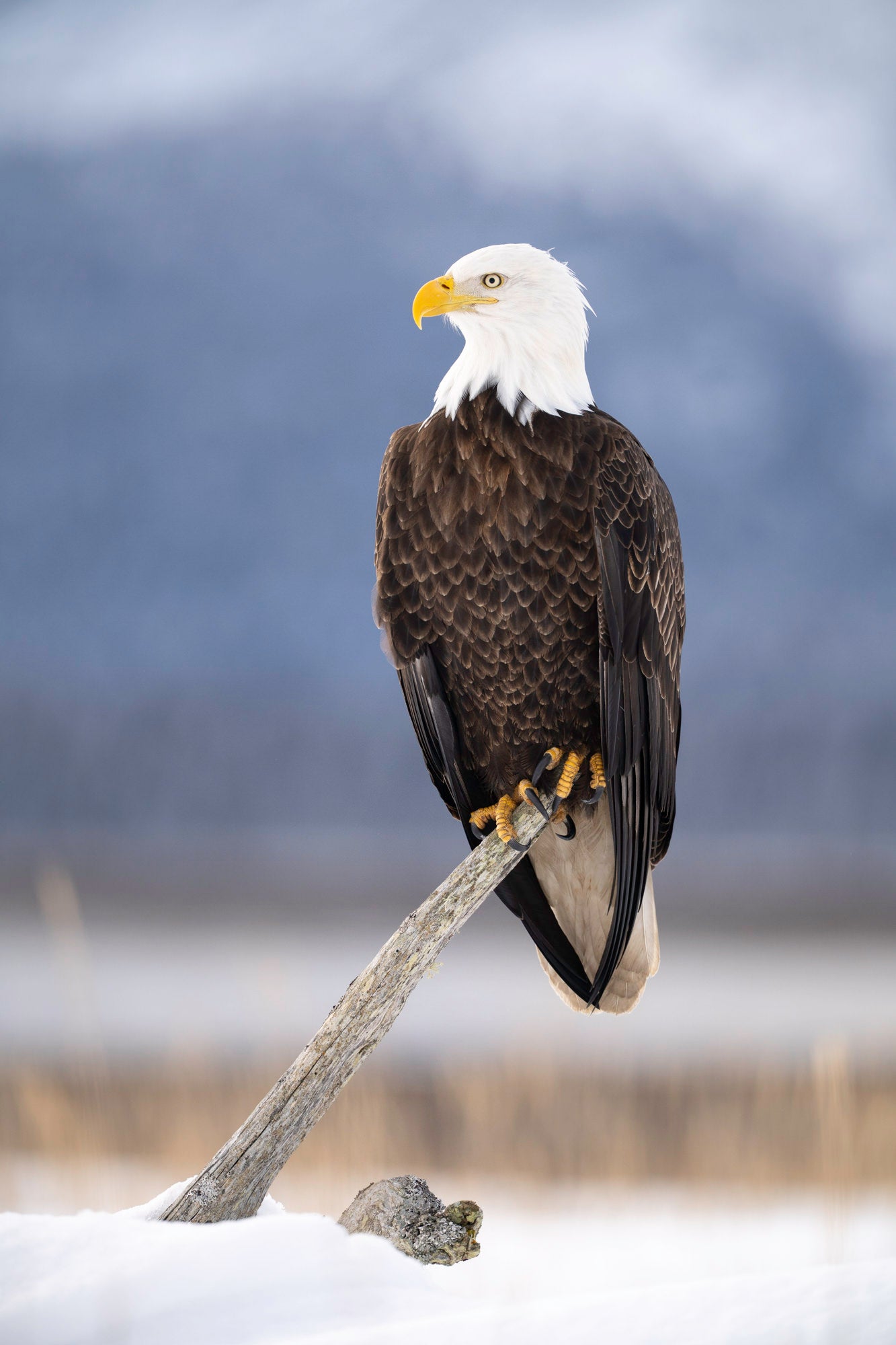
Photo by Dan Carr. Alpha 7R V. 300mm f/2.8 G Master. 1/1000-sec., f/4, ISO 640
Why The 300mm f/2.8 G Master Shines In Low Light
Finding eagles in Homer is generally not a problem, but creating a unique image in a place so often visited by other photographers can be. One morning, our boat landed us on the beach in a full-blown blizzard. The low light and poor visibility disheartened some of our group, but I knew the unfolding scene, though challenging, would likely offer incredible opportunities for flight shots. I also knew that, with the 300mm f/2.8 GM in my hands, I had exactly the right tool for the job: A lens that offered incredible light-gathering from its wide f/2.8 aperture, in an easily hand-holdable package that would allow me to react quickly and stay on target while tracking fast-moving birds in my viewfinder.
Field Technique In A Blizzard
Studying the birds' behavior for a few minutes, I noticed that a few eagles would perch high in the trees on the back side of the beach, before swooping down to the water to grab fish. If I could position myself between one of the perched birds and the ocean, I hoped I might be able to get a head-on shot as it dropped rapidly down from the high perch to reach the water. On a clear day, this shot wouldn't work as well. The dark-feathered eagles would be backed by similarly-toned trees, losing the all-important separation. In a blizzard, though, I could barely see the tree line from my position, creating a beautifully contrasting white and grey background.
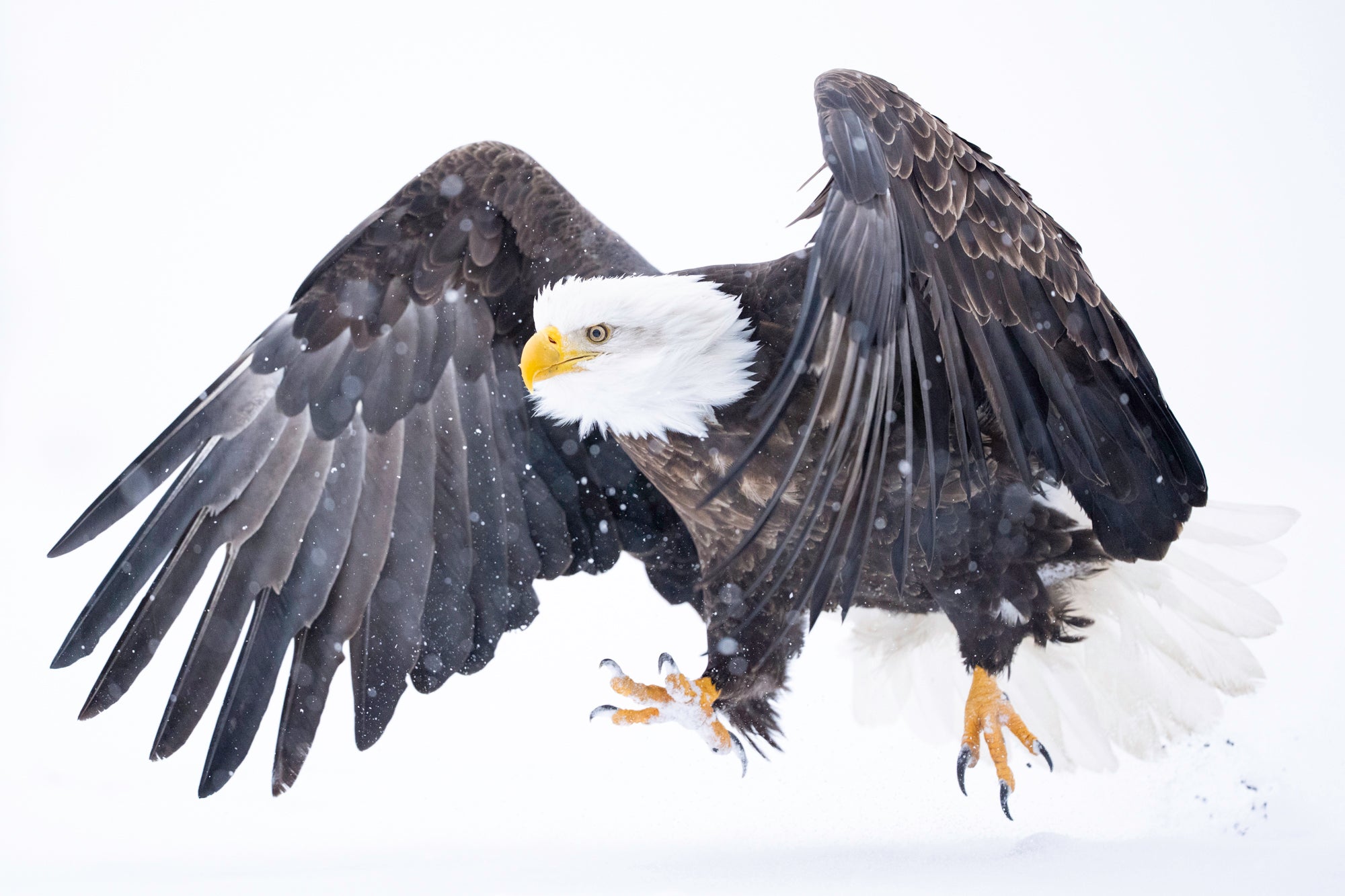
Photo by Dan Carr. Alpha 9 III. 300mm f/2.8 G Master. 1/5000-sec., f/2.8, ISO 4000
Camera Settings For Fast Action
Of course, birds, or any wildlife for that matter, never do things on cue, so getting this shot required a little patience. It also meant picking my position – hand-holding the lens while crouching low on the beach, choosing a perched target, and waiting patiently for them to dive down to the ocean over my head. At the same time, other eagles swooped past me in all directions. It was always tempting to look around to see what was happening elsewhere. However, I'd got this shot in my head, and knew it could be easily missed if I got distracted.
Once my target eagle made the drop from its perch, growing larger and larger in my viewfinder as it shot seemingly straight at me, I deployed my other secret weapon: the 120fps burst rate on the Alpha 9 III. This speed gave me an unprecedented number of options when choosing the best, most dramatic-looking wing position for the final edited image. Typical flight shots look best when the bird's wings are fully extended up or down. In this case, I was thrilled to see the bird tuck its wings and tilt them back to control its fast descent from the perch. The result is a unique shot, with unusual wing positioning that reveals incredible detail, as the eagle seems to look right down the lens.
A 60‑Second Edit In Lightroom Classic
In terms of image editing, my preference is always to do as little as possible. I needed no more than one minute of work in Lightroom Classic. A quick increase in white level and a decrease in black level aligned the contrast with my memory of the moment. A slight increase in vibrancy and saturation was needed to dial in the yellow claws. Then I finished it off with a small amount of noise reduction, and that was it.
Dan made great use of the lightweight Sony 300mm f/2.8 GM lens to capture this shot of a bald eagle in an Alaska blizzard. You can read more of his thoughts on Sony’s best wildlife photography lenses on his blog. Dan also leads wildlife photography tours around the world and writes about the gear he uses for his adventures on his website, Shutter Muse. See more of his work on Instagram @dancarrphoto.
Shop Dan Carr's Bird Photography Setup:
–Alpha 9 III
–300mm f/2.8 G Master