Carlos Molano works in finance in the Chicago area, but loves to get out with his camera in his free time. “I have been a hobbyist photographer since 2018, when I bought my first Alpha camera and G Master lens for a trip to the Galapagos Islands,” he says. “I mostly photograph birds and wildlife, but I also enjoy capturing landscape, cityscape and anything else that catches my eye.” November’s supermoon certainly caught his eye, and he set out to capture its peak illumination over Chicago with a creative twist. Keep reading as he shares the story behind how he captured it with his Alpha 1 II, 300mm f/2.8 G Master and 2x Teleconverter.
A Supermoon Over Chicago
I took the shot from a neighborhood very close to the east of O'Hare Airport in Chicago. I positioned myself in a somewhat open area where I could see the moon rise and also the line of planes on final approach to land at the airport coming from east to west. I was ready with the Alpha 1 II, 300mm f/2.8 G Master and 2x Teleconverter handheld. I did a few practice shots to decide on best settings and adjusted them as the moon gets brighter the higher it rises. This was a very planned shot as explained below.
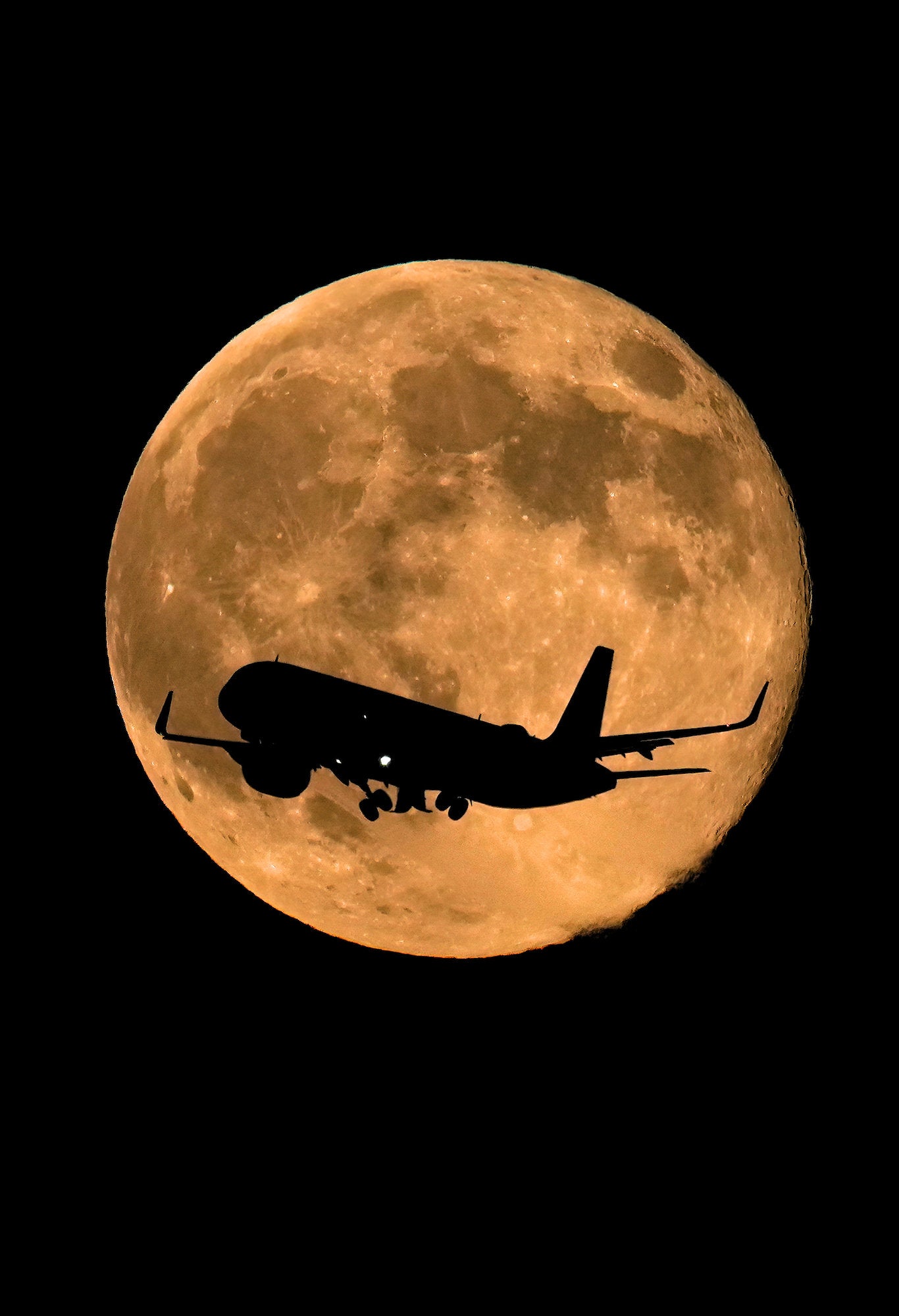
Photo by Carlos Molano. Alpha 1 II. 300mm f/2.8 G Master + 2x TC. 1/2500-sec., f/7.1, ISO 640
Photographing The Moon With A Telephoto & Teleconverter
Early this year I upgraded to an Alpha 1 II and a 300mm f/2.8 G Master lens. I also acquired the 1.4x Teleconverter and 2x Teleconverter. I love this combo because it's very light and allows me to shoot handheld. It's also easy to carry and that gives me flexibility to have the camera with me more often than not. The Alpha 1 II is the absolute best camera for fast-moving action and wildlife photography. For me, quick auto focus, especially with birds in flight, combined with 30FPS guarantees that I will get the shot. The 300mm f/2.8 G Master is my favorite lens now and it's always attached to my camera. The 2.8 allows me to shoot with lower light and the sharpness of the photos is unparallel (I'm a pixel peeper!). Adding the 2x Teleconverter also gives me incredible flexibility because I have three lenses in one. Based on what I'm out to shoot I can easily decide if I want to be a 300mm, 420mm or 600mm. In the case of this photo, I went with 600mm to get the maximum detail of the moon, with no loss of quality on the capture.
Settings For Photographing A Supermoon
I shot this photo at 600mm, and the settings were at 1/2500-sec., f/7.1 and ISO 640 handheld in full manual. I shot about 50 photos as the plane entered, passed in front of the moon and exited on the other side. I shot at 20FPS. I shot JPG, no RAW. I needed 1/2500-sec and 20FPS to make sure I got at least one photo with the plane inside the moon, not touching its circumference. I would say that the plane was at about 500 feet in the air and five miles from the runway give or take.
For background, I live close to the O'Hare airport in Chicago and a few years ago I noticed that on certain full moon days, the path of the rising moon intersected with the path of the planes landing at the airport if positioned in the right spot. Being that the landing path of the planes is always the same once they are over the city, I figured that if I put myself in the right spot within the area, I can potentially capture the moment when the plane passes right in front of the moon. There is a plane landing on the path to that runway about every 2-3 minutes at busy times.
Photography: A Process Of Trial & Error
This was a very planned shot and not something random that I just happened to catch. To capture the photo, based on prior experience (trial and error) I positioned myself in an area near the airport where I could keep an eye on the trajectory of the full moon and the planes landing into the airport. I got there about 30 minutes early based on when I estimated both objects would intersect in the sky. From then on, I just had to wait as the moon rises on a diagonal path towards the sky because at some point, there is a chance that one of the planes that is landing intersects the path of the moon and passes right in front of it.
However, based on past experience there is no guarantee that I will always get a shot because there has to be a plane coming in at the same time that the moon rises at the spot of intersection. If airplane traffic slows down and no planes come in, the moon will continue to rise and I will miss the chance for that night. Also, for me there is only one night a month where I can do this from my location and many factors have to come together. I need a clear night, a full moon, plane traffic landing from east to west (this is not always the case) on a specific runway, constant traffic for a chance that one of the planes crosses the moon at the right time and me not busy with other commitments!
A Simple Edit
Edit is pretty simple. I shot JPG and got about 50 frames. Out of those 50 there were two where the plane was just in the middle of the moon. I picked one and used Paint.net (free software) to adjust white balance, brightness, tone, contrast and saturation. I cropped the photo and then using Topaz, I added a very light touch of sharpness to some of the craters on the moon.
See more of Carlos Molano’s work on Instagram @carlitos_birds.
Get the latest in technology, add the Alpha 1 II to your kit.
Get the lightest large aperture lens in its class, purchase the 300mm f/2.8 G Master.