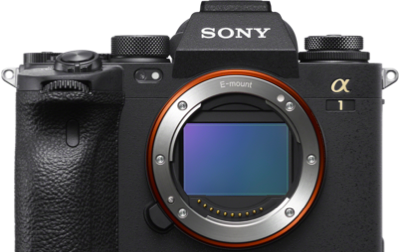
Connor Snelgrove (@connorjsnelgrove) is an aspiring landscape photographer with a true love for astrophotography. "I am based out of Cochrane, Alberta and I enjoy experimenting in various fields of photography but I always find myself drawn to the mountains and beautiful scenery of the Banff National Park." We came across this absolute scroll-stopper on Instagram of an image he captured of an aurora in Banff with his Alpha 7 IV (Buy Now) and 20mm f/1.8 G (Buy Now). Keep reading as he shares his story behind the shot in his own words, including his settings, composition choices and editing steps.
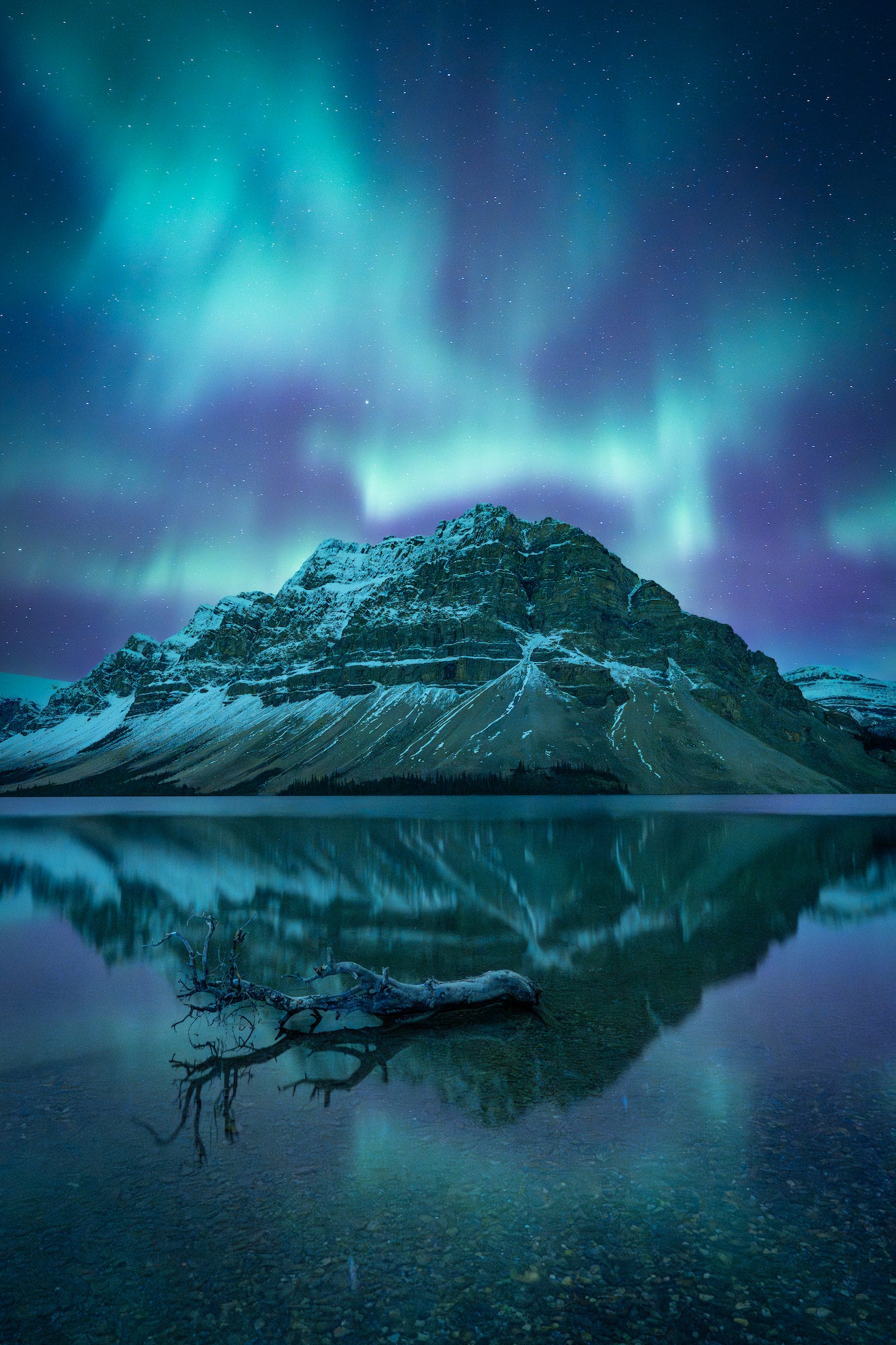
Photo by Connor Snelgrove. Alpha 7 IV. 20mm f/1.8 G. 20-sec., f/6.3, ISO 2000
Tracking A Banff Aurora
This took place during the massive aurora storm on October 10, 2024. I had been tracking some of the data a few days before and was hopeful that I would be back from work in time to catch the storm. That evening, my son and I decided to drive out into Banff National Park toward Peyto Lake and Bow Lake in hopes of catching a shot of the aurora over each lake.
Catching the aurora over Peyto Lake had been on my list of bucket shots for quite some time and I couldn’t believe that I might finally get the opportunity. I captured some images at Peyto lake and then decided to move on to Bow Lake before making the journey back home. As we stood on the shore of Bow Lake, I took note of a piece of driftwood that was lodged in the lake bed but mostly visible above the water and it immediately drew my eye.
Gear & Settings For Astrophotography
To capture the shot, I utilized my Alpha 7 IV and the 20mm f/1.8 G lens that evening. I love shooting most of my astrophotography at a relatively wide angle and I find the form factor of the 20mm to be quite nice. The low-light performance of the Alpha 7 IV combined with the 20mm f/1.8 G makes for some fantastic imagery.
I had my camera locked off on my tripod along the shore line and played around with a few angles before settling on the driftwood resting in the lower left of the frame with the mountain in the background. I was shooting at a slightly longer exposure of 20 seconds, f/6.3, and an ISO of 2000. The result truly blew me away as the aurora danced over the north of Crowfoot Mountain and the reflections were so vivid in the lake. We took a little more time to enjoy the show from the water’s edge before making the drive back home. It was one of those nights that I don’t think I will ever forget.
Post-Processing Steps
The next day I was extremely eager to review my images and see if anything turned out how I remembered. This image stood out as one of my favorites from the night. For the edit, I started by bringing up the exposure and shadows from the lake area to draw some more attention to the drift wood and reflections on the lake. Then I brightened up the sky and shifted the color temperature to the slightly cooler side as I prefer the look of the cooler tones in my astro images. I used some noise reduction to clean the image up a little bit and bumped up the clarity over the whole image. Lastly, I bumped up the highlights of the sky to give the aurora a little more pop. It definitely turned into one of my favorite images from the whole year.
See more of Connor Snelgrove's work on Instagram @connorjsnelgrove and at connorsnelgrove.myportfolio.com.
For true-to-life resolution and remarkable AI-powered autofocus, purchase the Alpha 7 IV.
For a compact and high-resolution wide-angle prime, purchase the 20mm f/1.8 G.