India-based Neeraj Kaku is a wildlife photographer and founder of Wildscappe Expeditions. “For me, wildlife photography has always been more than documenting animals. It is about storytelling, behavior and emotion in the wild,” he explains. “Over the years, I have spent extensive time in India’s forests photographing tigers, leopards, birds and other wildlife species, but what excites me the most are unpredictable behavioral moments. Those are the moments that truly showcase the raw intensity and authenticity of nature.”
From the gear – the Sony Alpha 9 III paired with the Sony 400mm f/2.8 G Master – to the settings, to the edit, keep reading as Neeraj shares his story behind the shot in his own words below.
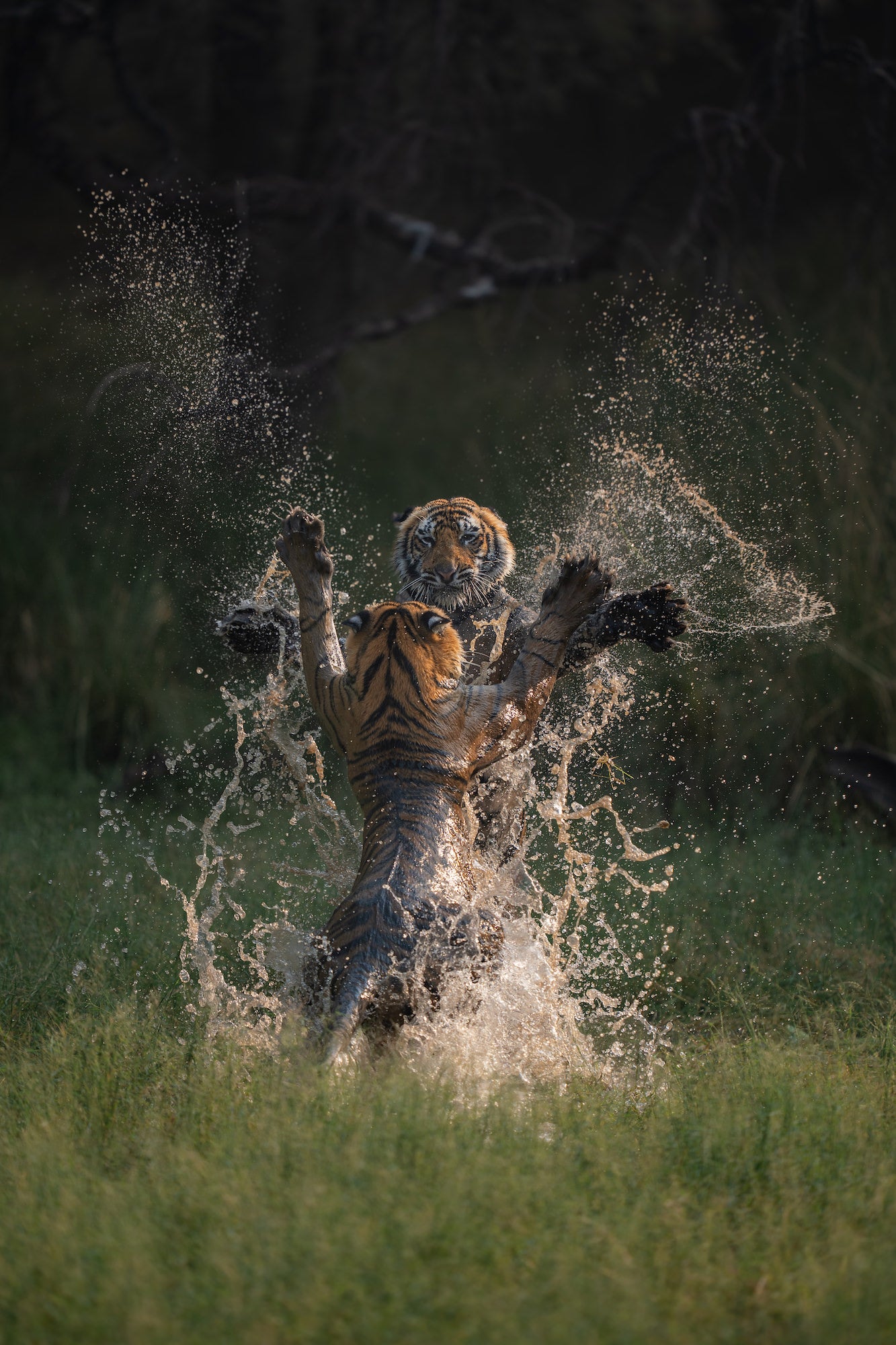
Photo by Neeraj Kaku. Alpha 9 III. 400mm f/2.8 G Master. 1/1000-sec. f/2.8, ISO 160
A Paradise For Wildlife Photographers
Ranthambore National Park has always been one of my favorite places to photograph because every drive there carries a sense of unpredictability. The dramatic terrain, hunting palaces, dry forests, and dominant tiger personalities often create opportunities for extraordinary encounters. It has always felt like a paradise for wildlife photographers, but this particular safari in October turned into one of the most memorable experiences of my journey behind the lens.
The focus of our trip was Riddhi’s cubs – the spirited young tigers of the famous tigress Riddhi, herself a descendant of the legendary Machli. Over the course of the trip, we had already spent meaningful time photographing the family. During our fifth safari, we had successfully sighted the cubs in Zone 2, while our fourth safari gave us an opportunity to photograph Riddhi in Zone 3. By the time we headed out for our sixth and final safari, uncertainty surrounded our chances of another sighting, especially since Riddhi had been moving between Zones 2, 3, and 4. That morning, we entered Zone 3 with cautious optimism, completely unaware of the extraordinary sequence of events that was about to unfold.
Our first stop was near Chota Chatri, close to the border of Zones 2 and 3, where we hoped the cubs might reappear after their sighting the previous evening. Suddenly, to our amazement, Riddhi herself emerged and walked calmly right beside our jeep after completing what appeared to be a territory-marking round across the forest.
While the sighting itself was incredible, we quietly worried that she might continue deeper into Zone 3 without the cubs, reducing our chances of another family interaction. We decided to remain patient, scanning the landscape carefully through binoculars for any movement near the tree line.
A few tense minutes later, we spotted movement.
To our absolute delight, all four tigers began making their way from Zone 2 toward Zone 3. Anticipating where they might emerge, we quickly repositioned ourselves toward a better vantage point. Within moments, an unforgettable scene unfolded in front of us – Riddhi and her cubs gracefully stepping out from the dhonk forest and moving toward the lake before finally entering the Rajbaug area.
What happened next was pure magic.
As Riddhi observed calmly nearby, her two male cubs began engaging in energetic mock fights inside the waterbody. The interaction was playful yet powerful – an important part of their development and learning process before adulthood. Water splashed in every direction as the brothers lunged, wrestled, and challenged each other with youthful intensity.
It was one of those rare wildlife moments where behavior, environment, light, and emotion aligned perfectly. Watching the cubs play freely under their mother’s watchful presence offered a glimpse into the softer and more intimate side of tiger behavior that very few people get to witness in the wild.
That single sequence became one of the most exhilarating photographic moments I have ever experienced.
A Camera & Lens Combination For Fast-Paced For Wildlife Action
This image was captured using the Sony Alpha 9 III paired with the Sony 400mm f/2.8 G Master lens – a combination that proved exceptional for fast-paced wildlife action.
The Alpha 9 III’s speed and autofocus performance were critical in this situation because the cubs were moving unpredictably and the interaction inside the water lasted only a matter of seconds at a time. The camera’s ability to track fast-moving subjects with precision allowed me to stay locked onto the cubs even during rapid splashes and sudden directional changes.
The 400mm f/2.8 G Master gave me the perfect balance of reach, subject isolation, and sharpness. It allowed me to frame tightly while maintaining enough space around the subjects to capture the splashing water and environmental atmosphere of Rajbaug.
The lens also performed beautifully in separating the cubs from the background, helping draw attention directly to the expressions, movement, and interaction between the two brothers.
Dialing In Your Camera’s Settings For Wildlife Photography
Capturing this image required constant anticipation because the behavior unfolded incredibly fast inside the waterbody. The two sub-adult male cubs were continuously lunging, splashing, and mock-fighting, which meant every second created a completely new frame.
I shot handheld directly from the safari vehicle to maintain flexibility and react quickly to the constantly changing interaction. Since the cubs were moving unpredictably in shallow water, I relied heavily on the Alpha 9 III’s autofocus tracking and high-speed burst capabilities to maintain focus throughout the sequence.
Camera Settings:
• Focal Length: 400mm
• Aperture: f/2.8
• Shutter Speed: 1/1000-sec.
• ISO 160
• Exposure Mode: Aperture Priority
• Metering: Pattern Metering
• Autofocus: Continuous AF Tracking
• Drive Mode: Continuous High+
I intentionally kept the lens wide open at f/2.8 to isolate the cubs from the background while also allowing enough light for a fast shutter speed. The 1/1000-sec. shutter speed helped freeze the splashing water and preserve sharp details in the expressions and movement of the cubs.
The most challenging part was timing. The interaction lasted only moments at a time, and the composition changed instantly with every splash and movement. I kept following their body language, waiting for the perfect frame where both cubs aligned naturally while the water exploded around them.
What makes this image special to me is that it captures a softer and more playful side of tiger behavior, two young brothers learning, bonding, and preparing for adulthood under the watchful gaze of their mother, Riddhi.
How He Edits Wildlife Photography
My post-processing workflow for wildlife photography is always centered around maintaining authenticity while enhancing the emotion and atmosphere of the moment. I prefer subtle adjustments that help the viewer experience the scene as I witnessed it in the field rather than heavily altering reality.
For this image, I used Adobe Lightroom Classic for the primary adjustments and Adobe Photoshop for minor refinements. The first step was carefully balancing the exposure and recovering detail in the highlights created by the reflective water surface. Since the scene involved fast-moving splashes and bright reflections, maintaining texture in the water while preserving detail in the cubs’ fur was especially important.
I then worked on enhancing the natural contrast and clarity to bring out the energy of the interaction. Selective texture adjustments helped emphasize the frozen water droplets and fur detail without making the image feel over-processed.
Color grading was intentionally kept natural and true to Ranthambore’s environment. I slightly enhanced the warm earthy tones of the forest and water to retain the mood and atmosphere of the early morning safari while ensuring the tigers remained the clear focal point of the frame.
One of the most important parts of the edit was directing attention toward the expressions and interaction between the cubs. I applied subtle selective sharpening around the eyes, faces, and splashing water to strengthen the sense of action and connection within the image.
Finally, I made very minimal cleanup adjustments to maintain the authenticity of the scene. For me, wildlife photography is about documenting genuine moments in nature, so I always try to preserve the integrity of what actually unfolded in front of the camera.
What I love most about this frame is that it captures a rarely seen softer side of tiger behavior – playful, energetic, and full of character – while still carrying the raw beauty and unpredictability of the wild.
See more of Neeraj Kaku's work on Instagram @neerajkakuphotography.
Want to learn more about wildlife photography?
Click here to take our free Wildlife Photography 101 course on Alpha Camera Academy.