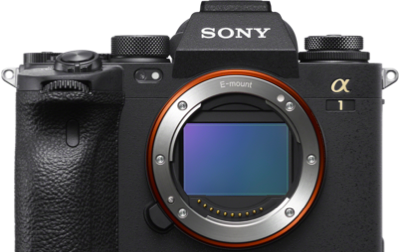
Timo Oksanen (@timoksanen) is a Finnish landscape photographer and videographer specializing in night photography. His hobby frequently takes him above the Arctic Circle, where long nights and minimal light pollution create the perfect conditions for capturing the wonders of the northern night sky. We came across this image he captured with a stellar combination – the Alpha 7R V and 24-70mm f/2.8 G Master II – and had to learn more. Keep reading for his story behind this image, featuring both the northern lights and a comet in the night sky.
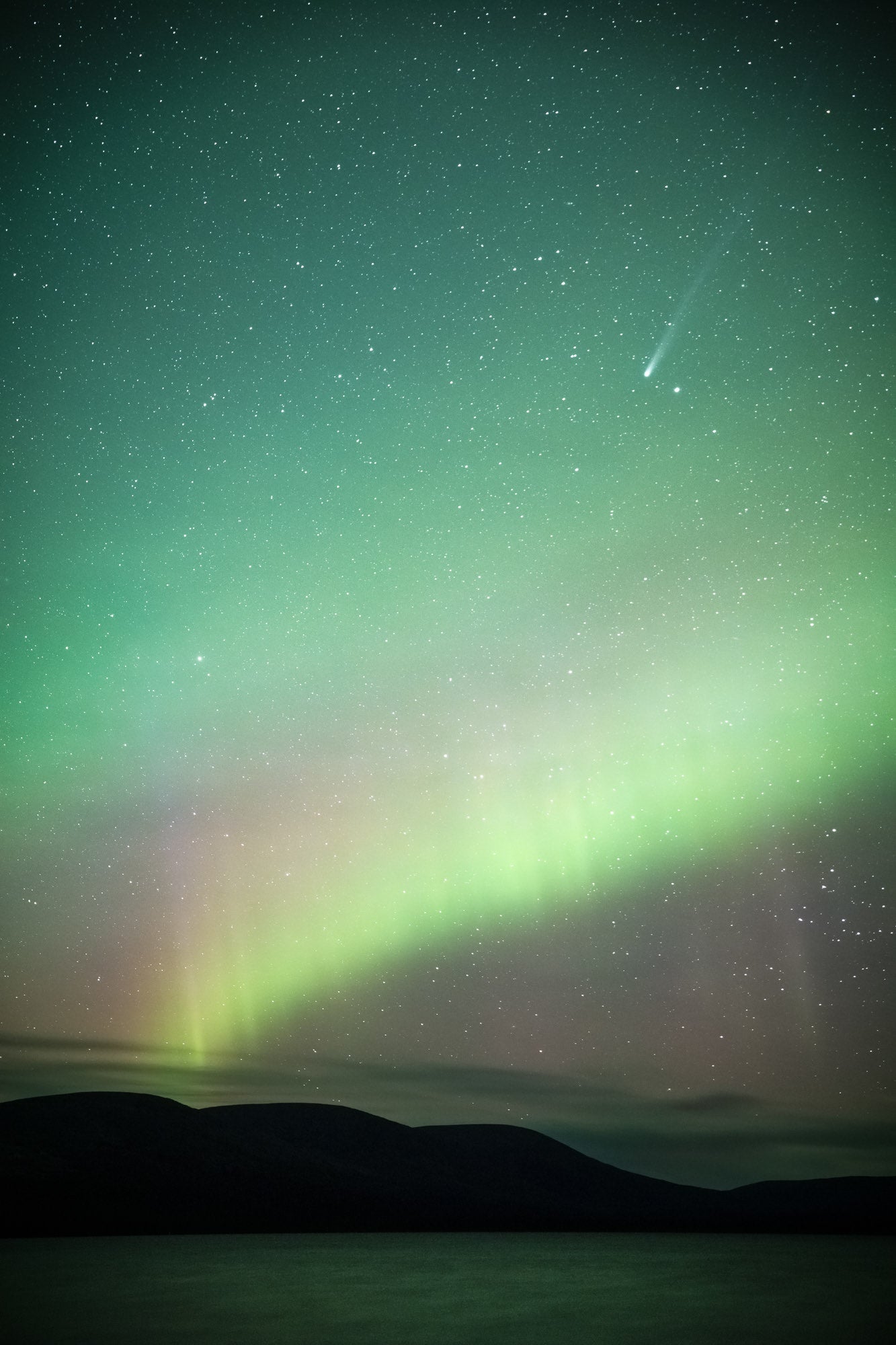
Photo by Timo Oksanen. Alpha 7R V. 24-70mm f/2.8 G Master II.
The Scene: One More Night Under Arctic Skies
In October 2025, I spent a full week in Northern Norway chasing auroras. On our drive back home to Southern Finland, we decided to stop for one night in Finnish Lapland. With the forecast promising clear skies, there was no way we were going to let that opportunity pass.
There was another reason to head out as well: Comet C/2025 A6 (Lemmon) was predicted to be visible that night. Combining the northern lights with a passing comet is never guaranteed, but the possibility alone was enough to justify the extra effort.
We headed to Lake Pallasjärvi in Kittilä, an area known for its exceptionally dark skies and complete absence of light pollution. The temperature hovered close to zero, but strong winds sweeping across the open lake made it feel much colder. I quickly realised I should have dressed even warmer. Fortunately, working between three Sony Alpha cameras – the Alpha 7R V, Alpha 7 IV and Alpha 7S III – kept me moving constantly while capturing both timelapses and real-time video.
Early Calm: Photographing The Comet
Early in the evening, auroral activity remained relatively calm. That quiet phase was the perfect window to focus on the comet. To the naked eye, Lemmon appeared as little more than a faint dot – barely brighter than the surrounding stars – so using a wide-angle lens alone wouldn’t do it justice.
To make the comet clearly visible and retain enough detail for post-processing, I needed more reach and resolution.
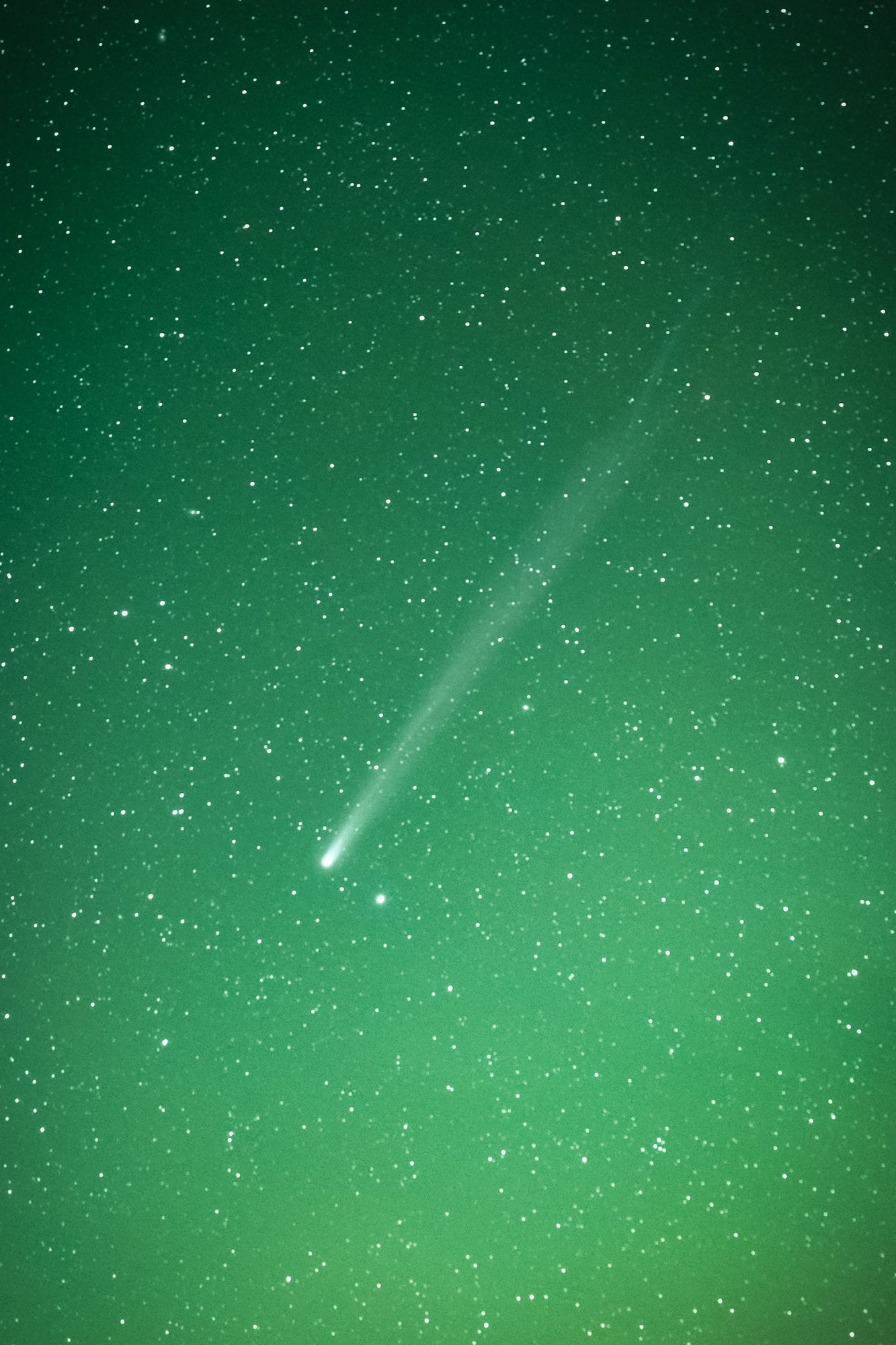
Photo by Timo Oksanen. Alpha 7R V. 24-70mm f/2.8 G Master II.
The Gear: Balancing Resolution, Stability and Wind
For this shot, I paired the 24-70mm f/2.8 G Master II with the Alpha 7R V. The camera’s high resolution allowed me to crop confidently while still retaining fine detail in both the comet and the surrounding stars.
Because I often work with multiple cameras simultaneously, lightweight support is essential. I use carbon fiber tripods from 3 Legged Thing, which offer an ideal balance between portability and stability. For this particular setup, the 3 Legged Thing Winston 2.0 with the AirHed Pro kept the camera well balanced, even in the strong winds blowing across the lake.
The Shot: Precision, Stacking and Star Sharpness
To extract as much detail from the comet as possible, I planned to stack multiple exposures in post-processing. I set the camera to interval shooting mode and started with the lens fully zoomed in to 70mm, capturing a tight composition of the comet that could later be cropped for maximum detail – an approach made possible by the Alpha 7R V’s generous pixel count.
After completing that sequence, I zoomed out to 61mm to include more of the environment, framing the comet above the silhouette of Pallas fell on the horizon and anchoring the scene in the surrounding Lapland landscape.
At these focal lengths, shutter speed becomes critical. To keep stars sharp and perfectly round, I limited exposure times to 4 seconds and 3.2 seconds. Knowing that stacking would significantly reduce noise, I wasn’t afraid to push the sensitivity to ISO 12,800.
Once the stills were secured, I zoomed back out and captured a longer interval sequence for a timelapse, showing auroras slowly moving around the comet – something that still images alone can’t fully convey.
Watch the timelapse here:
The Edit: Preserving Detail Without Losing Atmosphere
My editing process starts with careful fine-tuning in Adobe Lightroom, after which I export TIFF files for stacking in Starry Landscape Stacker. This software excels at aligning stars while preserving landscape detail.
Final refinements happen in Photoshop, where I blend a single frame of the aurora on top of the stacked image. When you stack too many aurora frames, their motion turns into a smooth green glow – as the combined exposure time from 31 frames exceeds two minutes. By masking in one carefully chosen frame, I can restore the true shape and structure of the northern lights.
The latest Denoise function in Lightroom plays a key role here, ensuring that these blended aurora elements match the noise characteristics of the stacked image and feel completely natural.
See more of Timo Oksanen’s work on Instagram @timoksanen.
Shop Timo’s setup:
–Alpha 7R V
–24-70mm f/2.8 G Master II