Wildlife photographer Holly Kirkland took to the skies above Lake Natron in a doors-off helicopter to photograph an otherworldly scene shaped by recent rainfall, shifting sediment and light. In this Behind The Shot, she explains how she used the Alpha 1 II and 70-200mm f/2.8 G Master II lens to frame a small group of Lesser Flamingos within the lake’s sweeping, abstract patterns – revealing both the visual drama and ecological story beneath the surface. Read more about her Alpha Female+ grant-winning image below.
I’m Holly Kirkland, and I’m a wildlife photographer from the U.S. At the heart of my photography is a genuine reverence for the natural world, especially for the individual animals I have the opportunity to photograph. I’m fascinated by their intelligence, behavior, relationships, and all the decisions they make as they go about their lives. The more time I spend with these little (or big!) wild souls, the more I realize how much there is to learn about their world, and how much of it we have yet to fully understand.
Gear Used:
–Alpha 1 II (now $200 off!)
–70-200mm f/2.8 G Master II (now $100 off!)
A Reverence For The Natural World
With every frame, I hope to tell a little of their stories and share some of what makes their lives and ecosystems so remarkable. I’m just as captivated by the artistry of nature itself—the light, the patterns, the textures, and the ways all of these elements combine in a scene. I love finding creative ways to bring those two interests together, making photographs that are visually compelling but also say something meaningful about the animals and the places they inhabit. Much of my recent work has taken me to Kenya, where there’s always something new to discover, whether it’s an unexpected moment of animal behavior or an entirely different way of seeing a landscape.
A New Perspective From Above
In Kenya, I’ve fallen in love with photographing from a helicopter. I feel endlessly inspired by the entirely different perspective it offers of the natural world. From above, the landscape reveals itself in layers of beauty—patterns, textures, and relationships that are impossible to see or appreciate from the ground. Familiar environments become almost abstract, and I find it incredibly exciting to explore these visual qualities photographically.
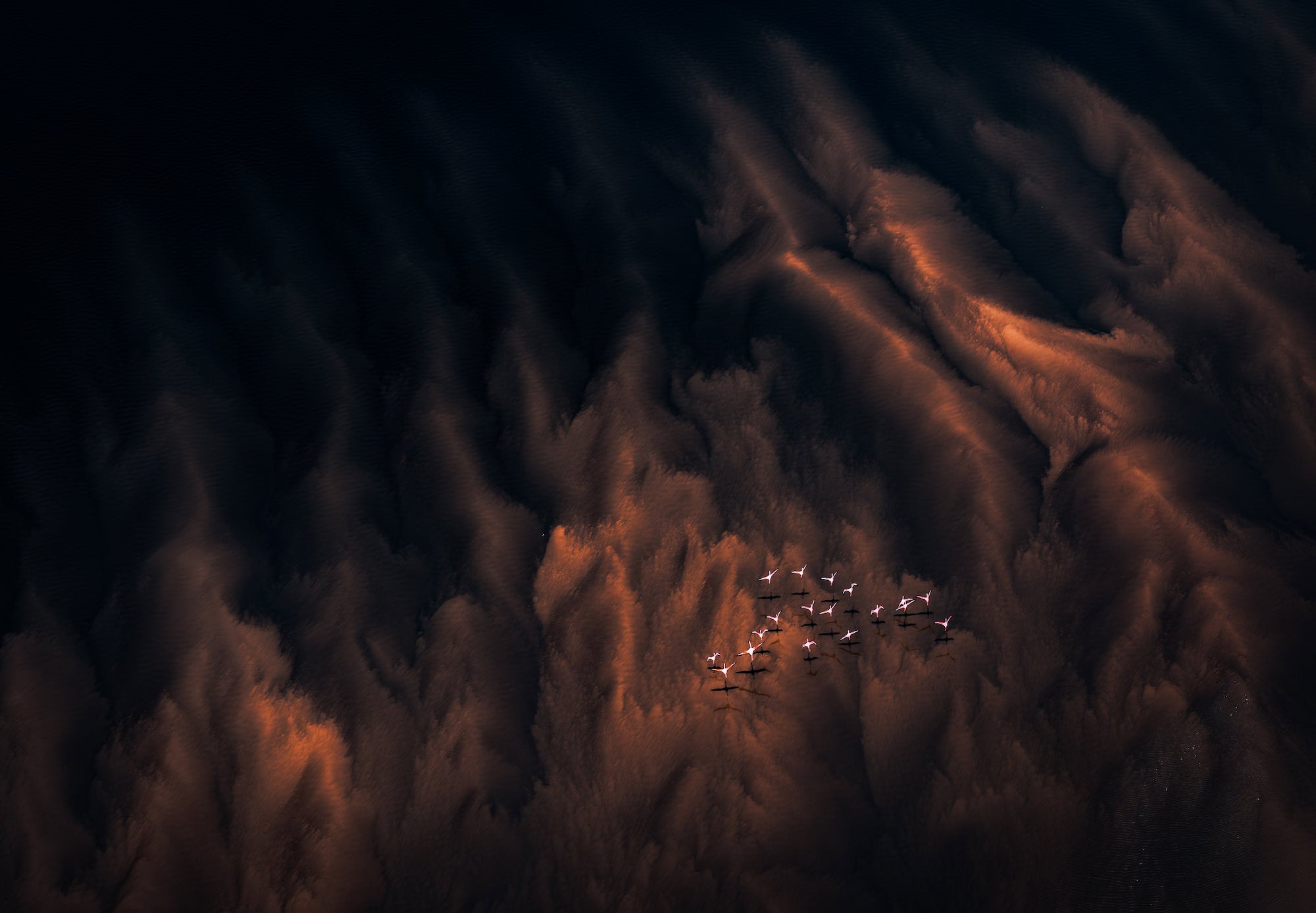
Photo by Holly Kirkland. Alpha 1 II. 70-200mm f/2.8 G Master II. 1/2500-sec., f/2.8, ISO 80
Lake Natron’s Specialized Ecosystem
I captured “What Lies Beneath” while flying with a doors-off helicopter over Lake Natron, near the Kenya–Tanzania border in the Great Rift Valley in March 2026. We had approached the area from the Kenyan side, exploring the extraordinary landscapes surrounding Lakes Magadi and Natron. Both are highly saline, alkaline lakes that support very specialized ecosystems. Although their caustic waters are inhospitable to many animals, they provide a critical habitat for Lesser Flamingos, which feed on the microorganisms that thrive in these conditions. Lake Natron is also one of the most significant breeding sites for Lesser Flamingos in East Africa.
When Rainfall Revealed The Pattern
In the week leading up to our flight, the region had experienced unusually heavy rainfall. The movement and redistribution of sediment had produced extraordinary swirling patterns beneath the surface of the lake. From the helicopter, I found these formations mesmerizing – like Mother Nature dreamed up something I could have never imagined myself. The interaction between water, sediment and light created an almost painterly landscape, with sweeping gestures and intricate textures extending into the darker reaches of the lake.
Composing The Flamingos Within The Landscape
It was those patterns that initially caught my attention. As we flew over them, I noticed a small group of flamingos moving across the scene in sustained flight, and suddenly the composition came together. I positioned the birds near the intersection of the lower and right thirds of the frame, leaving an expansive area of negative space in the direction of their flight.
It took a lot of conscious restraint not to zoom in on the flamingos – they’re such strikingly beautiful birds – but I knew that zooming closer would sacrifice the larger story. Keeping the birds small within the frame allowed me to preserve the scale and complexity of the landscape, and to emphasize their relationship with the environment rather than isolating them from it. The flamingos provide a delicate point of reference within an otherwise abstract landscape, but the sediment formations remain the dominant visual element. To me, the birds are almost a punctuation mark within a much larger story.
Protecting Highlights & Shaping The Light
One of the most important technical considerations for this frame was exposure. Lesser Flamingos can vary greatly in their coloration depending on their diet and age. These particular birds appeared almost white from our vantage point, apart from the more saturated pink visible beneath their wings. With direct sunlight illuminating their plumage, I needed to protect those delicate highlights to preserve the subtle pink coloration and feather detail. As a result of exposing for such brightly illuminated birds, I allowed the rest of the frame to fall more into darkness.
This exposure decision created a particularly dramatic interplay of light and shadow, emphasizing the sediment’s sweeping forms while allowing the birds to stand out against the darker portions of the lake. The gradual falloff of light toward the deeper areas added a sense of depth and mystery that I believe became essential to the final composition.
Settings For A Fast-Moving Aerial Scene
Aerial wildlife photography is also a constant exercise in anticipating and managing movement. The helicopter is moving relative to the light source, the birds are following their own unpredictable flight paths, and the landscape below – the background – is constantly changing. It can feel as though the entire world is moving around you, and it forces me to be very intentional about my settings. I chose a shutter speed of 1/2500-sec. to render the flamingos sharply despite the combined motion of the aircraft and the birds. Working at f/2.8 allowed me to maintain that fast shutter speed at ISO 80, while the 70–200mm lens gave me the speed and flexibility to refine the composition slightly as the scene unfolded. I had also used a circular polarizing filter in the field to help manage reflections from the water’s surface.
Alpha 1 II + 70-200mm f/2.8 G Master OSS II
I photographed the image using my Alpha 1 II and 70-200mm f/2.8 G Master II lens, shot at 129mm. The Alpha 1 II’s speed was particularly valuable in this situation and gave me confidence in a situation where the relationship between the birds, the light, and the landscape was changing from moment to moment. I often shoot at higher continuous frame rates in these fast-paced, dynamic situations. There was very little time to react, and being able to capture the composition precisely as I saw it was critical. I was excited about this shot the moment I pressed the shutter.
A Restrained Post-Processing Approach
When I got home and downloaded the files, I wanted to make sure I preserved the scene the way I saw it, while emphasizing the qualities that made it so special. My post-processing approach was intentionally restrained. I always begin with a standard base edit I apply for consistency. Photographing through a substantial amount of atmosphere from a helicopter can introduce haze that reduces clarity and separation between elements. I used a modest amount of Dehaze in Adobe Lightroom Classic to restore some of that definition and refined the contrast using the tone curve. Flying in a helicopter makes it very difficult to keep the camera truly level, so I straightened and cropped a bit until the composition felt balanced.
Beyond that, I made local adjustments to guide the viewer’s eye through the sediment patterns with subtle luminance masks, along with a slight vignette using a radial gradient to reinforce the natural falloff of light toward the edges. I also did a final pass to denoise and appropriately sharpen for screen output. No elements were added to or removed from the scene; my goal in processing was not to reinvent the landscape, but to preserve and clarify the visual qualities that made it so remarkable in the first place.
The Story Beneath The Surface
What’s most meaningful to me about “What Lies Beneath” is that it operates on two levels. At first glance, it is an abstract composition of light, movement, and form. But look a little closer, and it becomes a story about an ecosystem in constant flux. The sediment patterns reveal the influence of recent rainfall, while the flamingos remind us that these seemingly otherworldly environments are also living habitats, shaped by the relationships between water, geology, climate, and wildlife.
What continues to surprise me about aerial photography is how dramatically a change in perspective can change our understanding of a place. “What Lies Beneath” is a reminder that even the most abstract beauty in nature has an ecological story behind it, often far more complex and fascinating than we might first perceive.
See more of Holly Kirkland’s work on Instagram @wildlife.and.wanderlust.photo.
Click here to join the Alpha Female+ Facebook group, where you can enter our weekly micro-grant content for your chance to win $500.