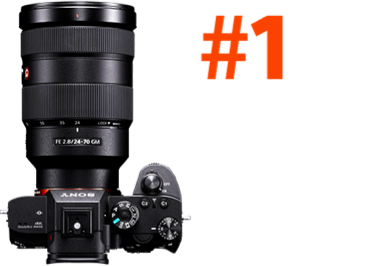
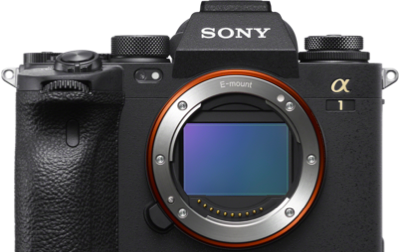
When Kyle Terada crouched down at the end zone pylon at Levi's Stadium on November 9, 2025, he wasn't sure the shot would even work. The TV videographer in front of him kept inching closer. Photographers flanked him on both sides. He had nowhere to go – all he could do was hold his position, keep the Sony Alpha 1 and Sony 50-150mm f/2 G Master steady at grass level, and wait.
What he captured was George Kittle, airborne and fully extended, reaching for the pylon to complete a 13-yard touchdown reception against the Los Angeles Rams. The image – body outstretched, face visible, every limb in the frame – would go on to beat nearly 1,300 entries and win the Pro Football Hall of Fame's 58th annual photo contest: the Dave Boss Award of Excellence, the most prestigious photography honor in professional football.
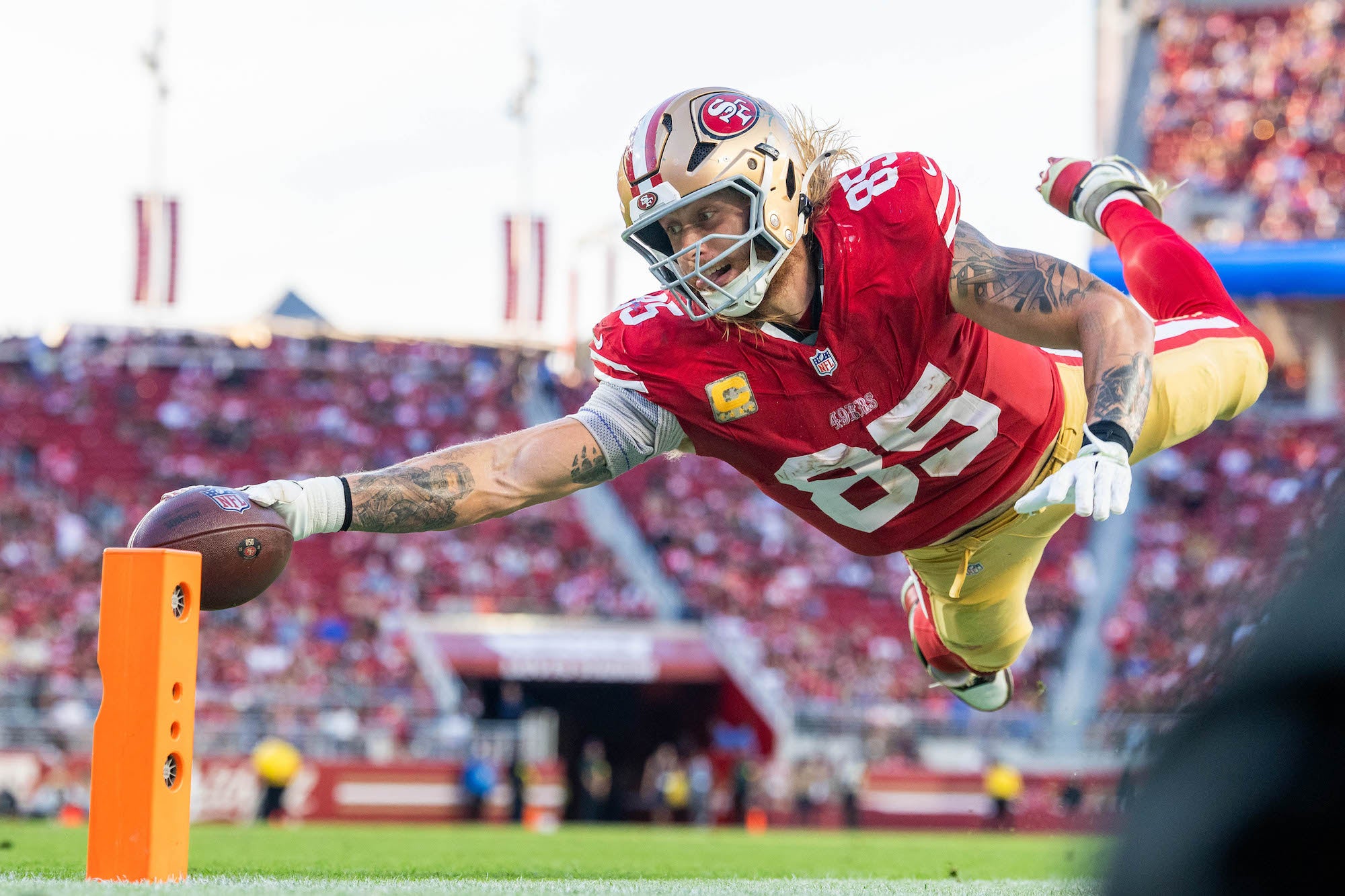
Photo by Kyle Terada. Alpha 1. 50-150mm f/2 G Master.
"I was submitting the photo – I knew it was a great image because you could see the face, you could see the arms stretched out, the body stretched out, and you could see all the limbs," Terada recalls. "It just kind of reaches out at you."
16 Years On The Sideline
Terada has been with Imagn Images – formerly US Press Wire, then USA Today Sports Images – for about 16 years, based in San Francisco covering primarily the 49ers, alongside Golden State Warriors and Sacramento Kings games. He's also a regular at marquee events across the country. More recently, he's transitioned into an assignment editor role, overseeing photographer deployments across F1, IndyCar, and other motorsports events – though when it comes to the biggest moments, he still picks up a camera himself.
It was during those years on NFL sidelines that Terada developed the low-angle approach that would eventually produce his award-winning shot. "I've been trying to go for this low angle for the longest time, ever since the Sony cameras came out," he says. "I'm trying to do something different – and it finally paid off."
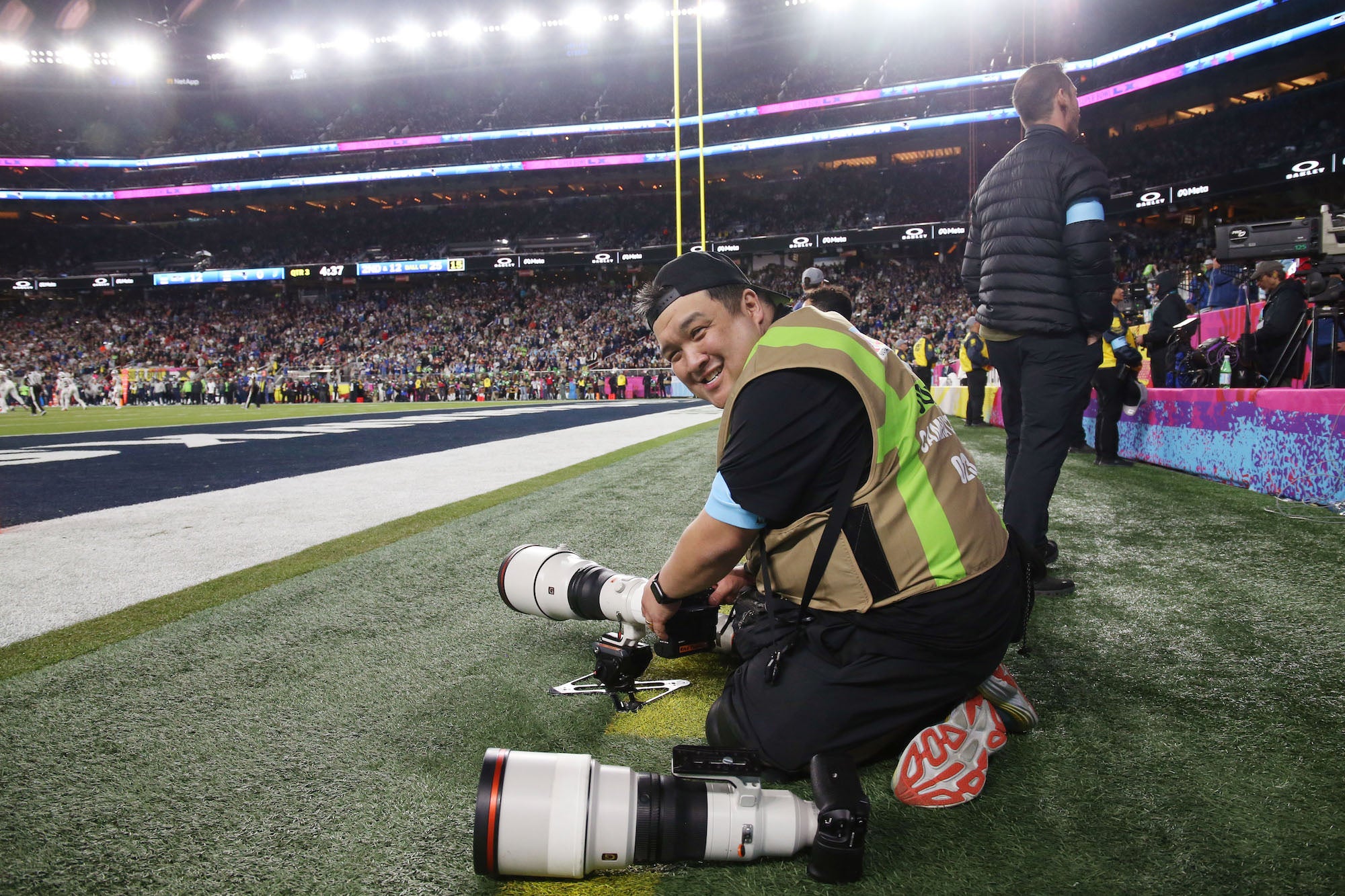
Imagn Images photographer Kyle Terada
The Technique: Camera At Grass Level, Eyes On The Tilt Screen
The setup looks unconventional from the outside. For his longer glass – the 400mm f/2.8 G Master or 600mm f/4 G Master – Terada mounts the camera on a video tripod head with a camera plate, lens collar resting on the ground, the whole rig sitting roughly five inches off the turf. He rotates left and right from that fixed position, tracking the action. For his mid-range work, like the 50-150mm f/2 G Master he used to capture Kittle's TD, the camera stays just as low, shifted side to side by hand.
Throughout the entire game he shoots with the tilt screen flipped up.
"The tilt screen allows me to shoot from a different angle, from down below and up, and it gives the athlete more of an athletic feel to the image," he explains. "It pops out at you."
In his own words: "Sony Alpha has many wonderful features including the AF performance, Focus Area Color, sunny weather screen brightness, and tilt screen, that allow me to photograph the entire football game from a grass-level point-of-view with minimal risk of missing the shot. This has stepped up my game to produce award-winning images by helping photograph an angle that showcases the athleticism of the subject."
The Shot: Navigating The End Zone
On that November afternoon, Terada was positioned between the two pylons at the end zone – his preferred spot when coverage allows. The challenge with the end zone, he explains, is that NFL Films and TV videographers have designated front-row access, leaving photographers like Terada to work around them in the second row.
"It depends on where they're positioned – and then we can maneuver around them trying to find the angle," he says. "I try to be as close to the front of the end zone as possible."
As the down sequence progressed, the videographer in front of him crept closer and closer. Terada was hemmed in, photographers on both sides. He held his ground, kept the Alpha 1 pointed at the end zone, and fired.
"I was nervous looking at the photos afterwards because I didn't know if the videographer was in the way for the entire sequence," he says. When the image came up clean – one errant knee aside – the relief was immediate.
Why Sony Alpha
For a game that unfolds at full speed with no room for hesitation, Terada keeps it simple: he points, and the camera delivers.
"I really do enjoy using the Alpha 1 and Alpha 1 II, which I use for my long glass," he says. "I feel like I can rely on these cameras because the autofocus is so great at following the action. I just have to point and shoot."
That reliability becomes especially critical when you're shooting blind from five inches off the ground, reading the play through a tilted LCD rather than a viewfinder. The Alpha 1's real-time tracking, combined with the bright, readable tilt screen even under California sun, means Terada can focus on positioning and anticipation rather than fighting his gear.
What The Award Means
For a photographer who has spent nearly two decades building a body of work at the highest level of American sports, the Dave Boss Award landed as something of a validation – not just of this image, but of a long-term commitment to pushing his craft.
"It's a wonderful surprise," Terada says. "I've been trying to go for this low angle for the longest time. And it finally paid off."
Terada's winning image will be displayed on a video kiosk at the Pro Football Hall of Fame in Canton and printed and mounted for permanent display inside the museum. He'll be on hand for the 2026 Awards of Excellence program on June 24–25 to accept the honor in person.
Not bad for a shot he wasn't sure would even clear the frame.
Congratulations to Kyle Terada on the award! See more of his work on Instagram @teradaphoto.
Learn more about Imagn Images in Imagn Images: Inside The Nation's Largest Sports Image Wire Service.