Sydney Smolla is a conservation photographer based in the southwest corner of Colorado, near New Mexico, Arizona and Utah.
“I have lived in the Southwest for the past five years, and I fell in love with documenting landscapes and stories of the area,” she says. “The topic I have always been drawn to is water. I love to explore water systems, policy, history and the connection between water, humans and wildlife, whether here in the Southwest or while traveling.”
We caught up with Smolla to learn more about a conservation project she helped document using her Sony Alpha 7R IV and Alpha 7 IV cameras. Keep reading as she shares her first-hand account.
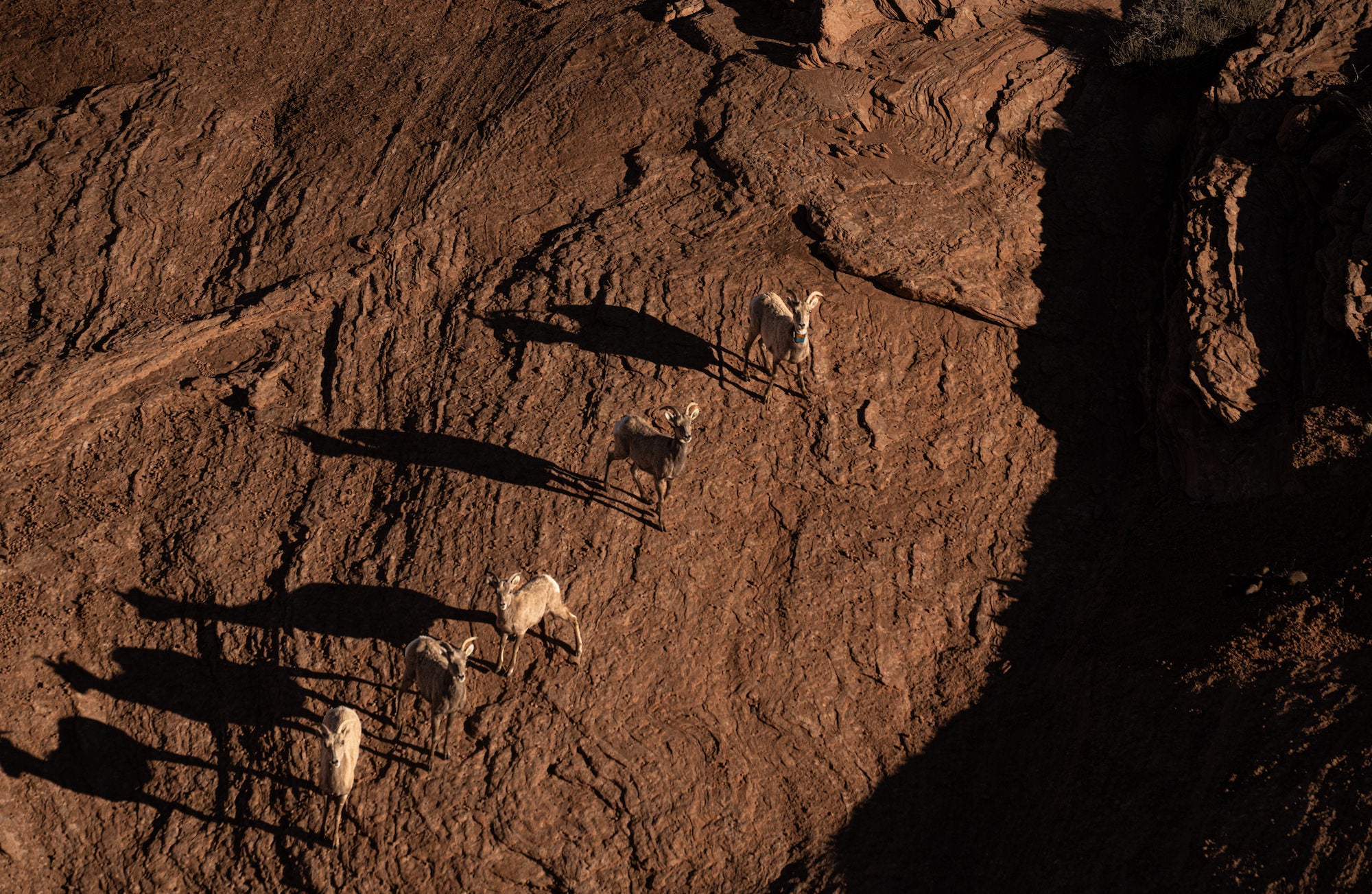
"During the Navajo Nation Department of Fish and Wildlife (NNDFW) helicopter bighorn sheep survey, this herd of bighorn sheep stand still on the valley floor in the Lake Powell region." Photo by Sydney Smolla. Alpha 7R IV. 1/4000-sec., f/5.6, ISO 1250
Documenting The Navajo Bighorn Sheep Population Survey
I recently photographed and filmed the Navajo Bighorn Sheep Population Survey for the Navajo Nation Department of Fish and Wildlife (NNDFW). We were in a helicopter for about six to seven hours each day for three days, flying over desert bighorn sheep range. We started on the Navajo Nation side of Lake Powell for two days, and on the third day, we flew the San Juan River just outside of Bluff, Utah.
Helicopter population surveys are an opportunity for wildlife biologists to count and classify bighorn sheep groups and assess environmental conditions such as forage and livestock overgrazing.
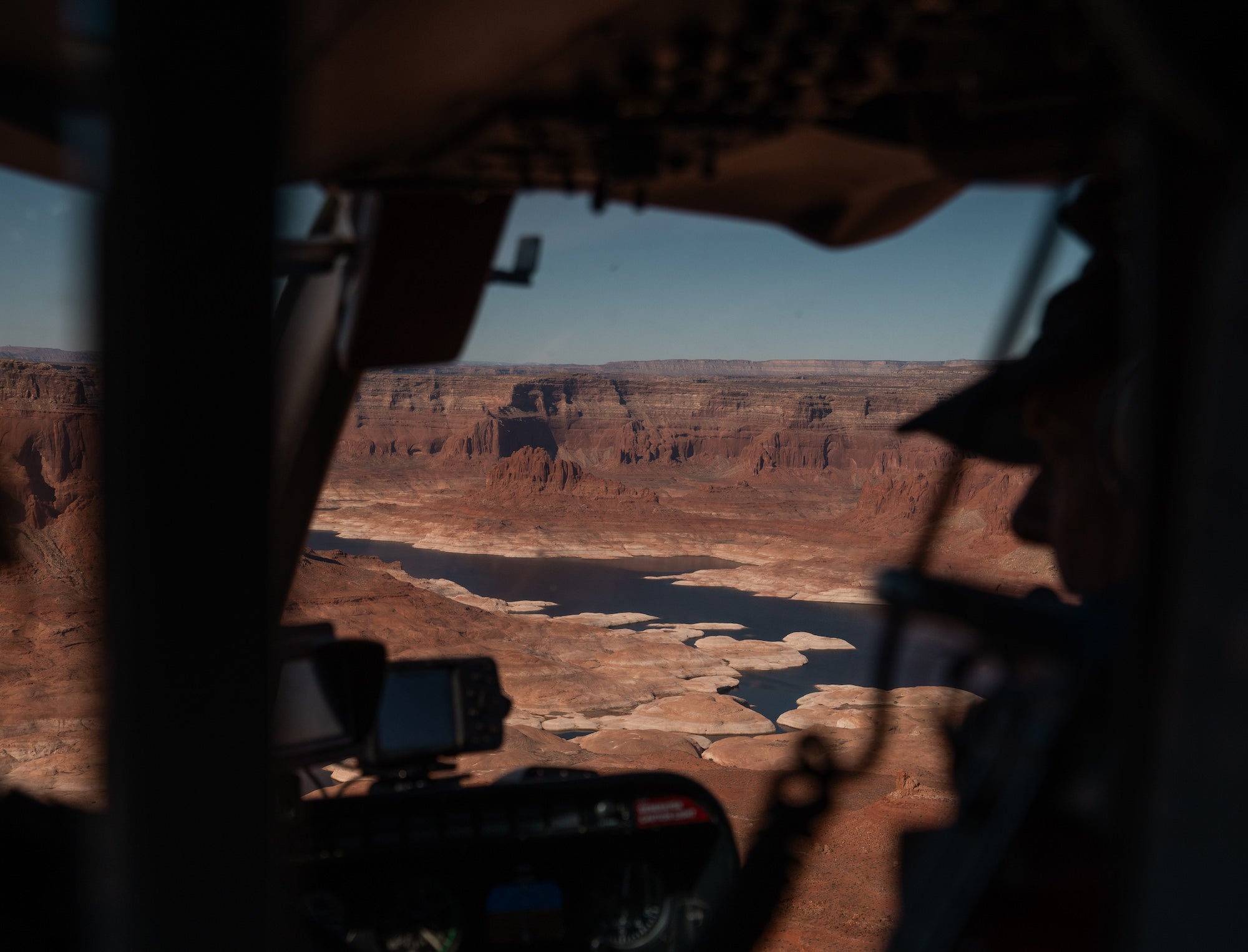
"This view of lake Powell from the helicopter is taken while contouring the canyon walls in search of bighorn sheep for the population survey." Photo by Sydney Smolla. Alpha 7R IV. 1/5000-sec., f/5.6, ISO 640
Bighorn sheep herds across the western United States, Canada and Mexico have been battling a disease called Mycoplasma ovipneumoniae (M. ovi). This disease, also referred to as pneumonia, can be fatal and puts especially young lambs at risk. It is passed on to bighorn sheep from livestock, most commonly domestic sheep. Due to severe and extended drought in the region, the bighorn sheep are forced to use the same watering holes as livestock.
The population survey was organized by Jessica Fort, wildlife biologist with NNDFW. This was the first time the department was able to professionally document the survey with video and high-resolution photographs.
During the survey, the pilot contoured the canyons, starting from the top or bottom of the canyon walls and working his way up or down while searching for bighorn groups. The first day, we saw roughly 100 bighorn sheep; the second, we saw about 30; and on the third day along the San Juan River, we saw only one or two.
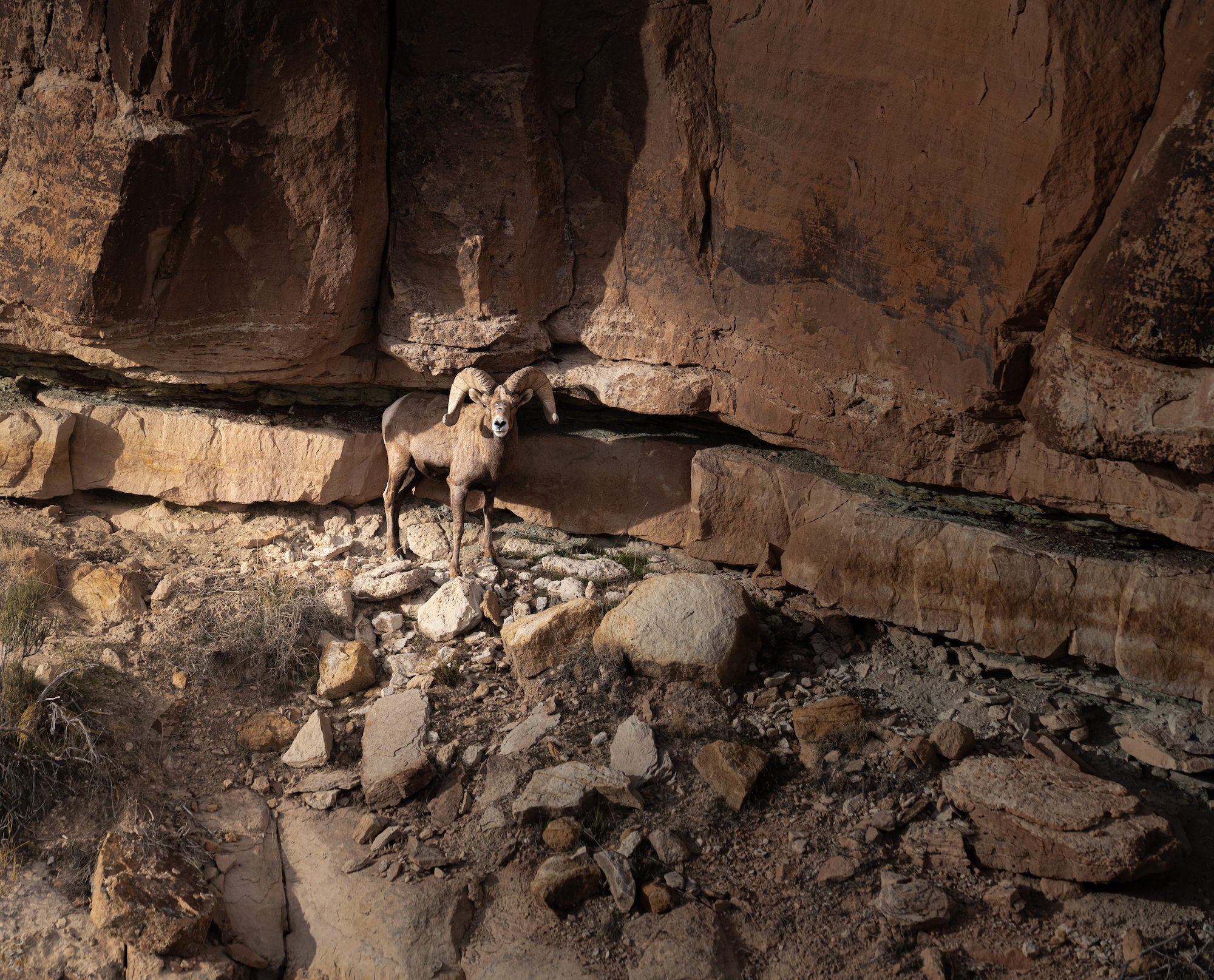
"As the helicopter contours the canyons, starting up at the top and working down, or vise versa, the bighorn sheep can be found at any point along the canyon walls or on the valley floor. The photos used from these population surveys help the wildlife biologists classify the sex and age of individual sheep. This ram was fairly high up on the canyon walls." Photo by Sydney Smolla. Alpha 7 IV. 1/2000-sec., f/2.8, ISO 640
High-Resolution Images Support Wildlife Research
Because the photographs are high-resolution, they help wildlife biologists classify the sex and age of individual sheep after the survey is completed and verify that the counts were correct. Once a bighorn sheep or herd is spotted, the helicopter circles back while the biologists count. It is my job to capture the images of the herds.
Before going up in the helicopter, I asked what the preference was when sheep were spotted: Did we want video or photographs? We decided photos would be more important to capture. When we were up in the air and I saw bighorn sheep, I made sure to prioritize the photographs first. Then, I would quickly switch to video.
The short film and photography created for NNDFW help show the work they are doing and support efforts to bring funding back into their conservation programs.
Photographing From The Helicopter
One of my favorite things about photographing and filming in the back of a helicopter for this type of work is that it forces me to be creative within really strict bounds. It takes all of my skills and forces me to rely on them quickly, with little room for error.
One of the most surprising things I learned while photographing from a helicopter is how important it is to be in sync with the pilot – communicating what I need beforehand, having a shot list in mind, while also being prepared for any surprises. One of the most important skills to have when shooting from a helicopter is being able to communicate what image I want to capture, where I need to be, and how to capture it quickly.
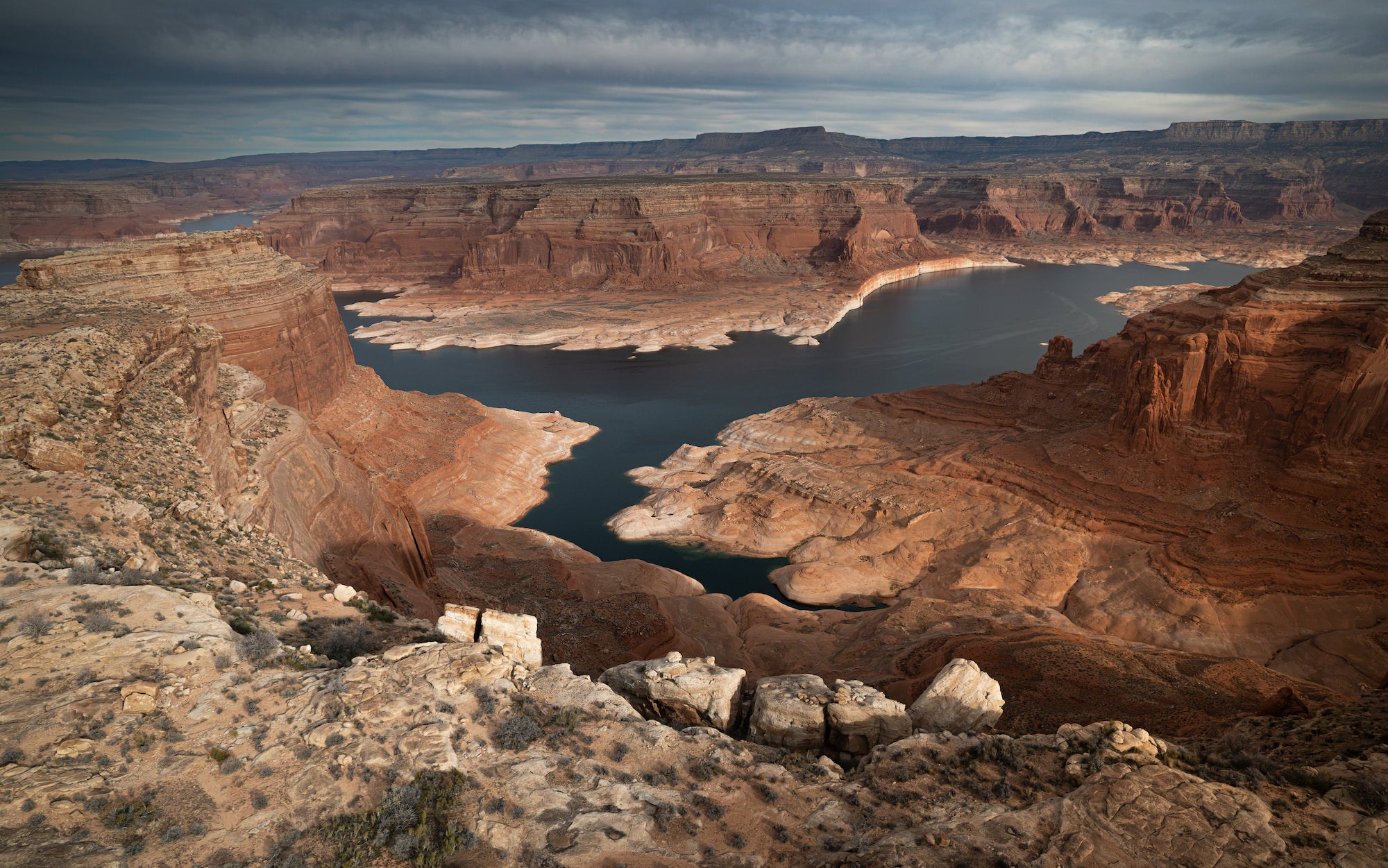
"This angle shows the complex landscapes we were flying through. This is atop a canyon overlooking a valley leading into Lake Powell." Photo by Sydney Smolla. Alpha 7 IV. 16-35mm f/2.8 G Master. 1/4000-sec., f/2.8, ISO 1250
I asked our pilot, John, what one of the most challenging maneuvers is when flying a helicopter, and he said, “Hovering.” What I found was that hovering is the easiest way to capture an image, but the most difficult maneuver. Being able to keep my shutter speed and ISO high, and capture the image fast while we were moving, was what I always tried to rely on.
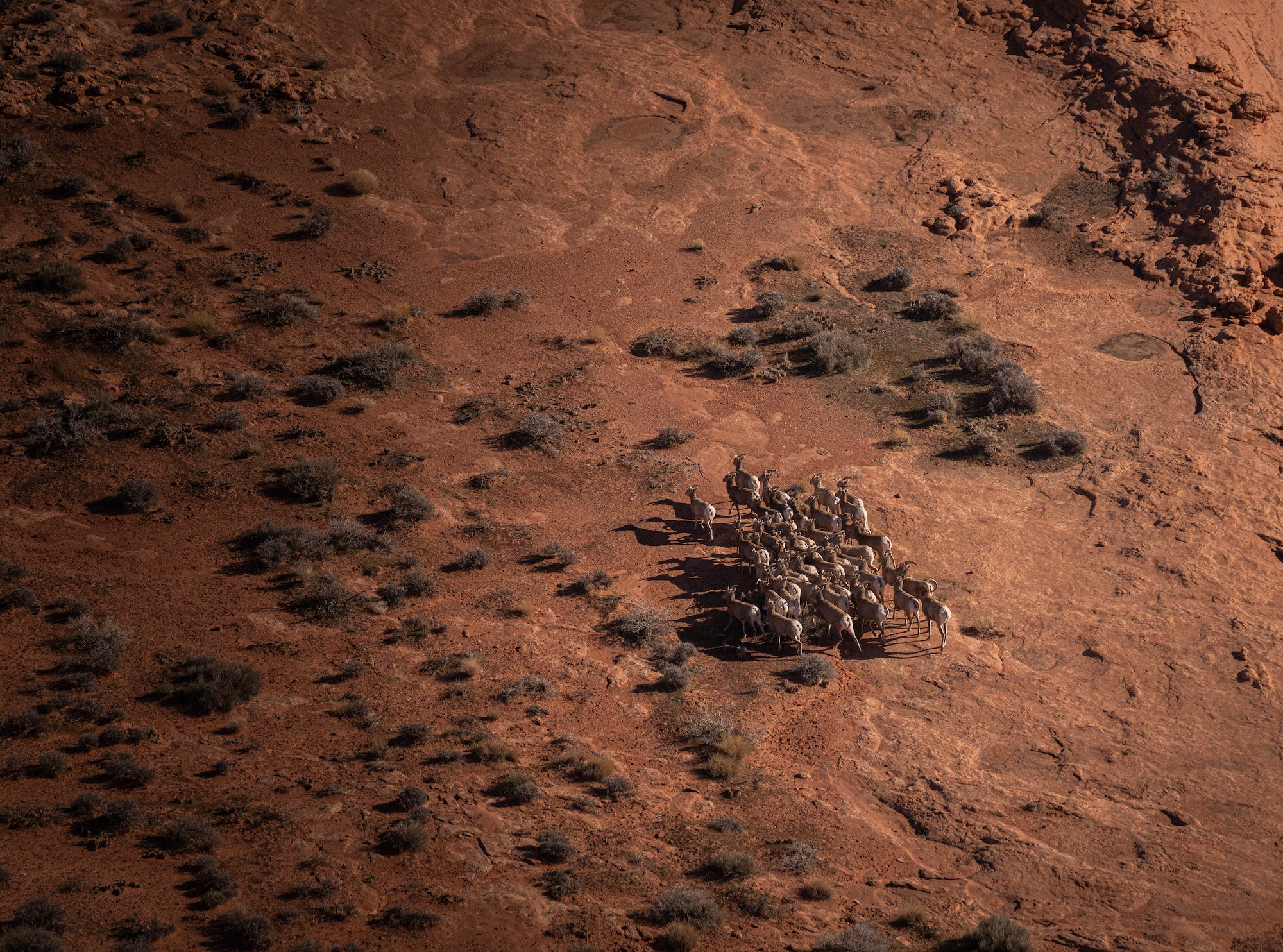
"During the helicopter surveys, it takes great attention to detail to spot the bighorn sheep. During this time of day, the shadows from the canyon walls on the valley floor are longer. This herd was one of the largest ones documented during this survey." Photo by Sydney Smolla. Alpha 7R IV. 1/8000-sec., f/5, ISO 640
When I was capturing video, John was really good at seeing the shot I wanted and would move the helicopter in the way I needed to get a good shot, and occasionally turn back around so I could capture it.
One of the challenges of photographing the bighorn sheep is that we were contouring canyons for about six to seven hours each day. The sheep are great at not sticking out. Often, when they were spotted, we had only a few seconds to make a video or picture.
Another challenge of photographing in canyons during a six- to seven-hour period is that the light shifts significantly. There were harsh shadows. Fortunately, I love working in complex light situations, and this made it fun for me when making a composition.
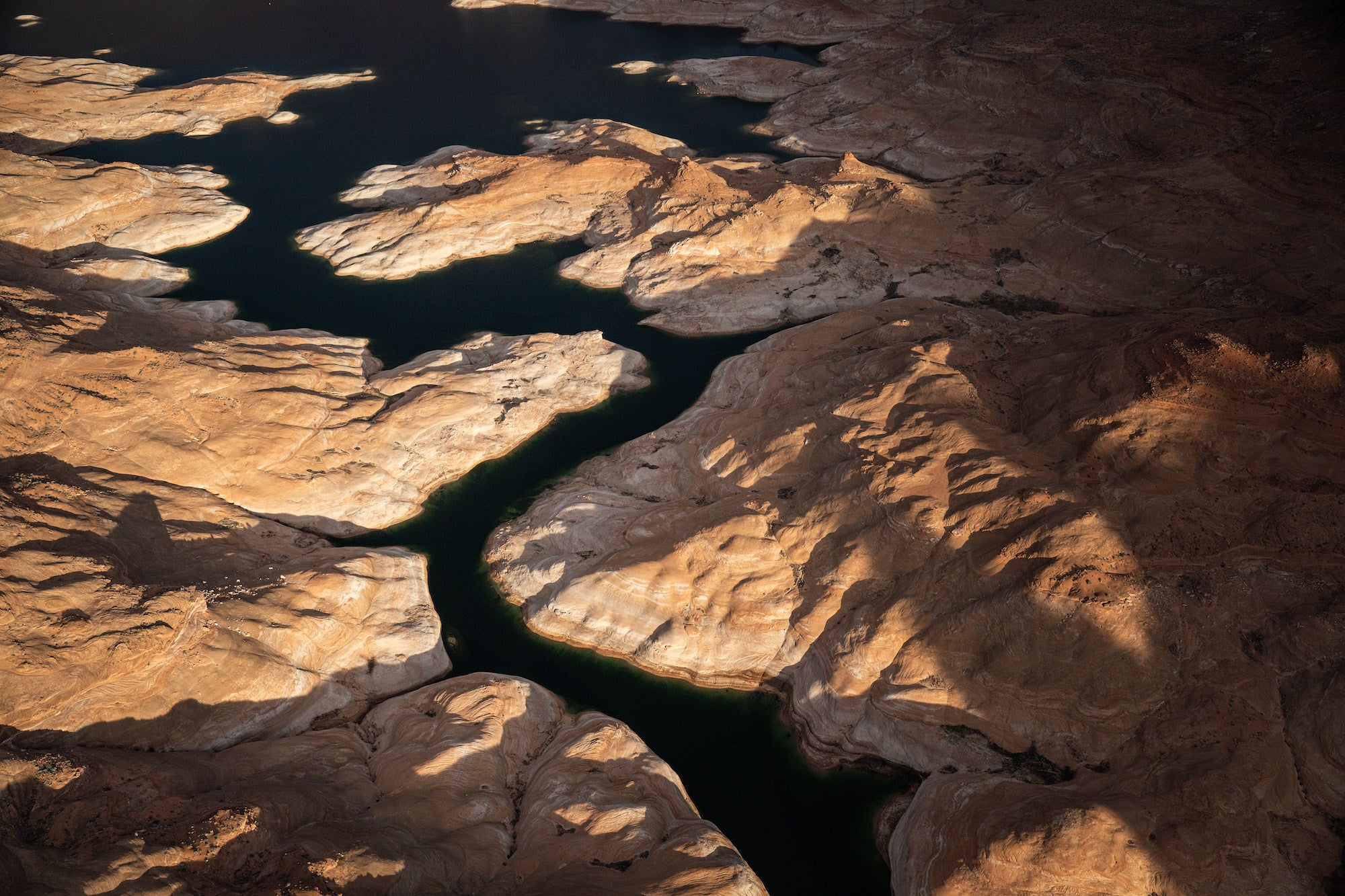
"This angle shows the complex landscapes we were flying through. This is atop a canyon overlooking a valley leading into Lake Powell." Photo by Sydney Smolla. Alpha 7 IV. 16-35mm f/2.8 G Master. 1/4000-sec., f/2.8, ISO 1250
How The Gear Made It Possible
I used two cameras: the Sony Alpha 7R IV for photos, and the Sony Alpha 7 IV paired with the 16-35mm f/2.8 G Master for hybrid shooting. While up in the helicopter, I knew I wanted to capture photos, audio and create a short film.
I am a one-woman creative team, so having three days in a helicopter – with six to seven hours each day – gave me plenty of time to get enough images and video, but I had to be strategic.
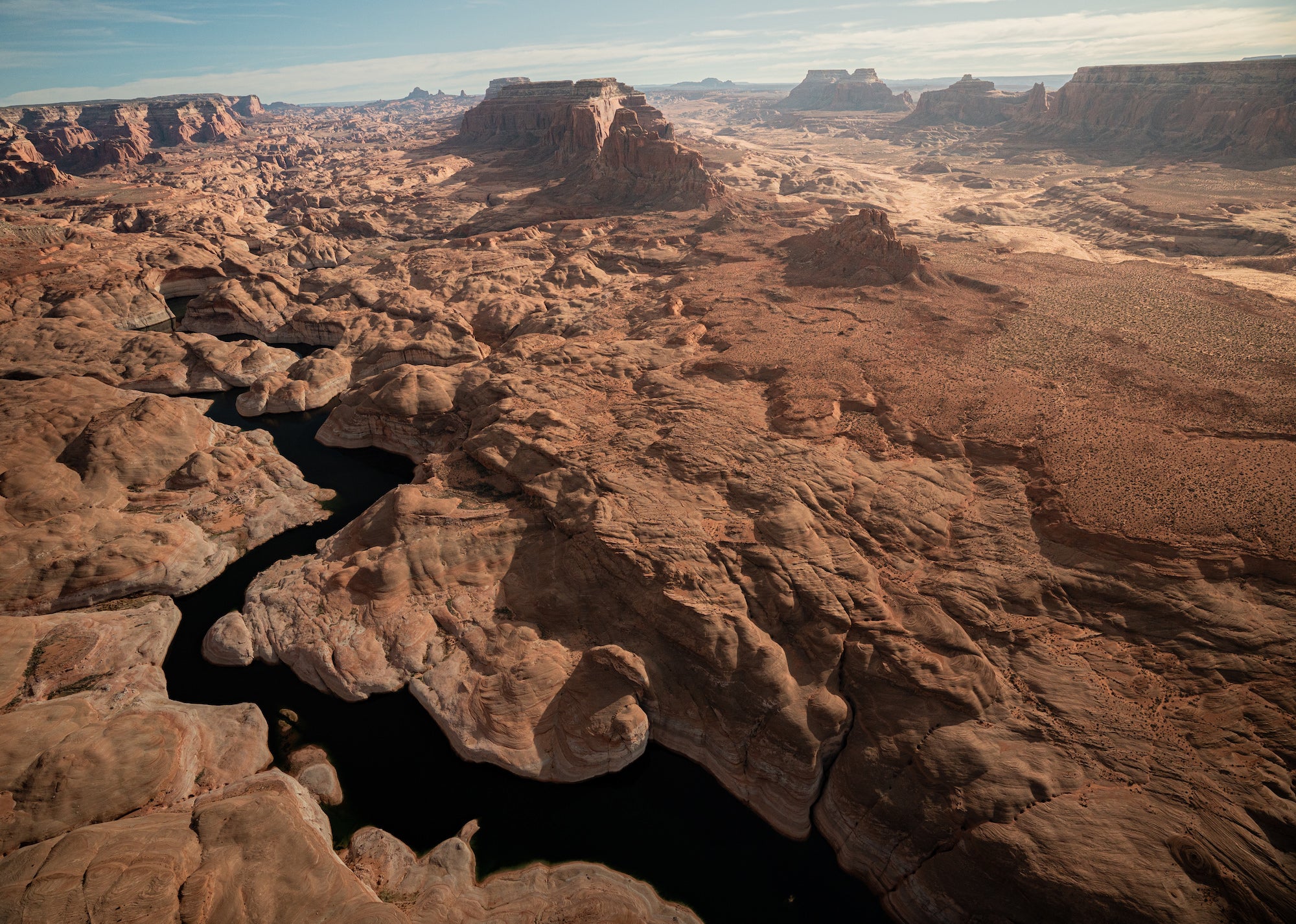
This view from the helicopter was taken with the Sony Alpha 7 IV and Sony 16-35mm f/2.8 GM. This lens is great for capturing wide angle establishing shots. I used this camera body and lens combo as I was switching back and fourth between video and photos during the entire survey." Photo by Sydney Smolla. Alpha 7 IV. 16-35mm f/2.8 G Master. 1/3200-sec., f/4.5, ISO 400
There were only four seats on the helicopter, including the pilot, two biologists and me. I was in the back seat, capturing through a small sliding window. It was January in the desert, so it was fairly cold; therefore, we kept the doors on.
One of the most important things I have found when doing fieldwork is having a streamlined system. I don’t like bringing heavy bags with me, and I prefer not to have to switch lenses constantly. Minimizing things that could fall or move around in the helicopter is the goal. These Sony mirrorless cameras are lightweight and dependable, and help me maintain that streamlined system.
Why I Chose The Sony Alpha 7R IV
I chose the Sony Alpha 7R IV as my photo camera because of its capability to capture detailed shots with 61 megapixels. Since this camera had my longer zoom lens, I was able to crop in more and gather detailed shots of the bighorn sheep.
This was helpful for the biologists who reviewed the images, so they could spend more time classifying the herds later with detailed, high-quality images rather than trying to do it from a moving helicopter far away.
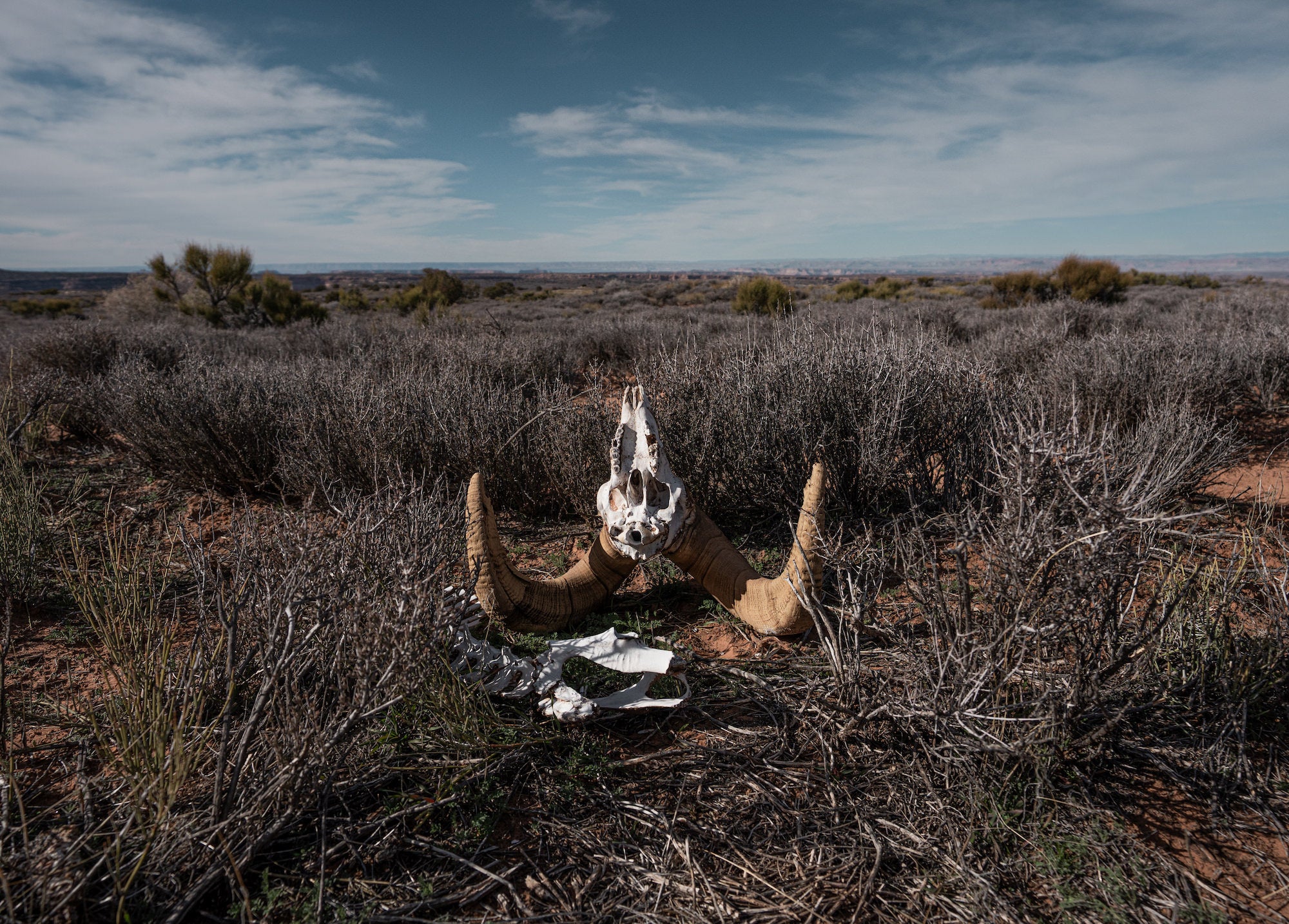
"When capturing images from a helicopter, it can be overwhelming how much beauty is around you, so to narrow it down, I always look for areas where light, shadow and abstract textures are all at play. This documentation not only showcases the beauty but also can be used to show the water levels as comparison for future years." Photo by Sydney Smolla. Alpha 7R IV. 1/2000-sec., f/5.6, ISO 640
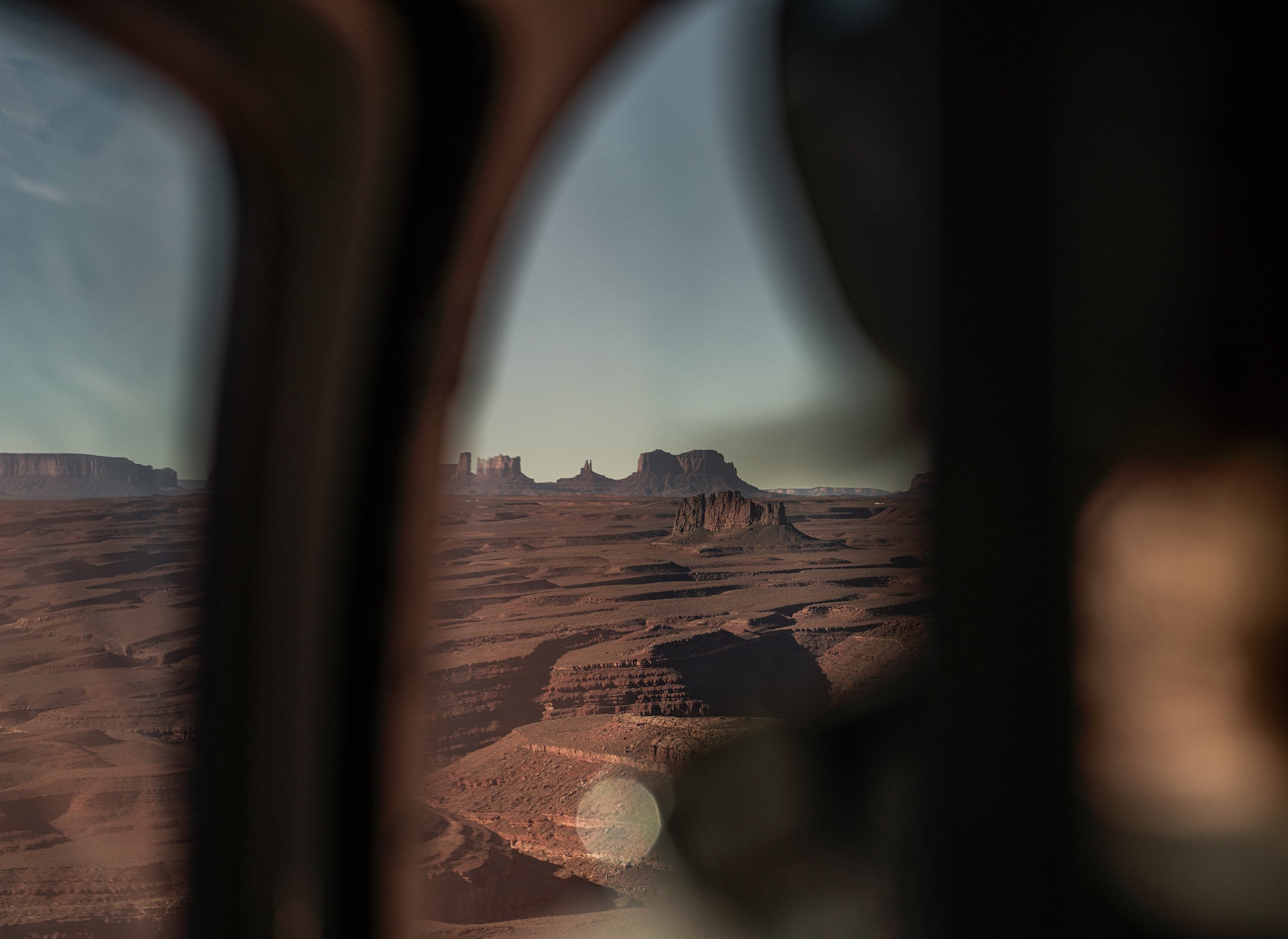
"This view from the helicopter is taken above the canyons surounding the San Juan river in search of bighorn sheep for the population survey." Photo by Sydney Smolla. Alpha 7R IV. 1/640-sec., f/5.6, ISO 125
Why I Chose The Sony Alpha 7 IV
I chose the Sony Alpha 7 IV as my hybrid camera. It creates incredible video, but also delivers excellent-quality photographs. When shooting both images and video in a helicopter for a client, it is important to have all settings set beforehand. I used the user settings on the Sony Alpha 7 IV so I could quickly switch from video to photo settings in a split second.
This is how I was able to film a short film and capture incredible images at the same time. I also love the screen on the back of the Alpha 7 IV. Because I was shooting from multiple angles out of a small sliding window, the screen moved out and gave me enough options to capture scenes from different perspectives without having to look through the viewfinder.
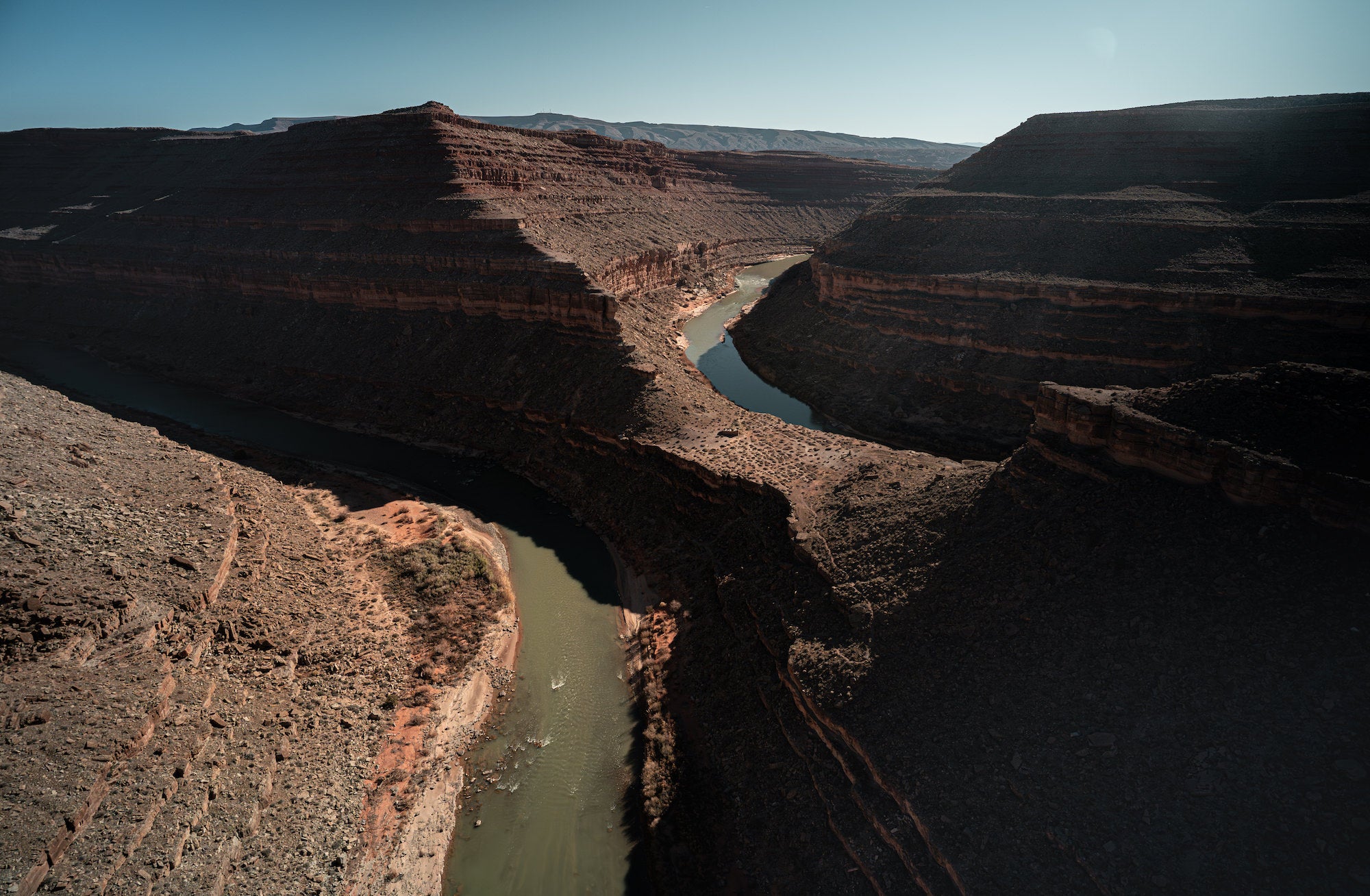
"This portion of the population survey was over the San Juan River, just outside of Bluff, Utah. This population of bighorn sheep is much smaller than the herds at Lake Powell. Because of this we only saw about one or two on this portion of the river. We flew over this "saddle" like shape in the canyons where the river curved around and we saw this archeological site right in the center. During the survey we also saw eagles and some fox." Photo by Sydney Smolla. Alpha 7 IV. 16-35mm f/2.8 G Master. 1/2000-sec., f/2.8, ISO 1250
I chose the 16-35mm lens because I knew from previous helicopter work that, even though I would be high up, I still wanted to capture the grand landscapes. Flying through a canyon, we were fairly close to the canyon walls, and having wide-angle capability was vital to capturing the scale of the landscapes we were in.
Wide angles are great for establishing shots, so having this lens on the camera that allowed me to do both video and photography was my biggest priority. It let me capture supporting images and video both in the helicopter and out of it.
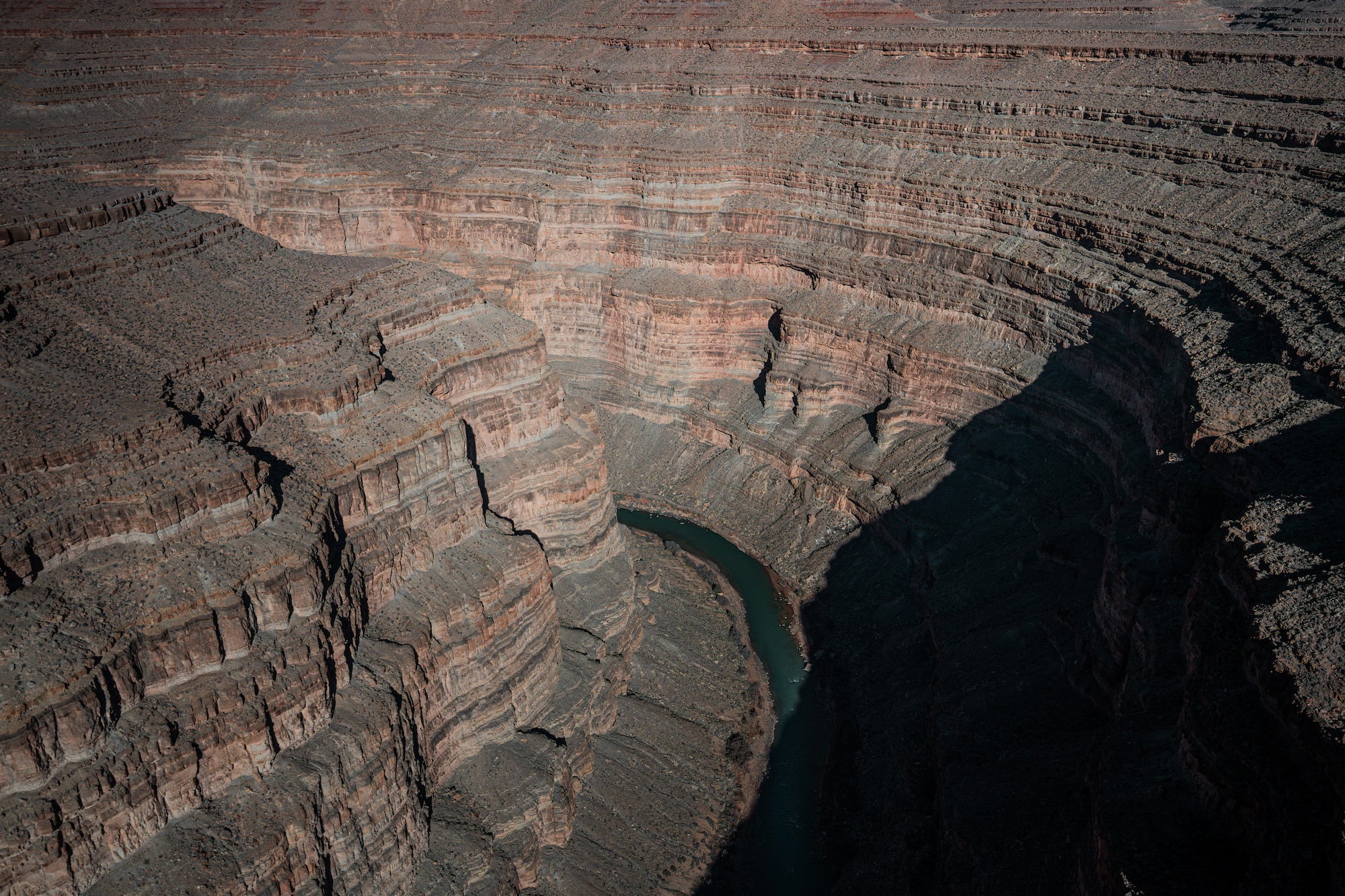
"The textures of the San Juan River with the sand below caught my eye. The shadows of these deep canyons were harsh so one curve around the canyon, and the river may be covered in shadows. I took every opportunity to capture the water levels and how the light interacted with those textures." Photo by Sydney Smolla. Alpha 7 IV. 16-35mm f/2.8 G Master. 1/500-sec., f/4.5, ISO 500
Final Thoughts
Conservation photography and filmmaking are not only important tools for education, outreach and storytelling, but they can also play a vital role in data collection for wildlife research projects.
It is so special to accompany biologists and learn more about the natural world. It gives you the opportunity to focus on different details than you would notice without a biologist near you. When flying over Navajo Nation, there are archaeological sites, rare plant species and extremely unique scenery that would be hard to reach on foot.
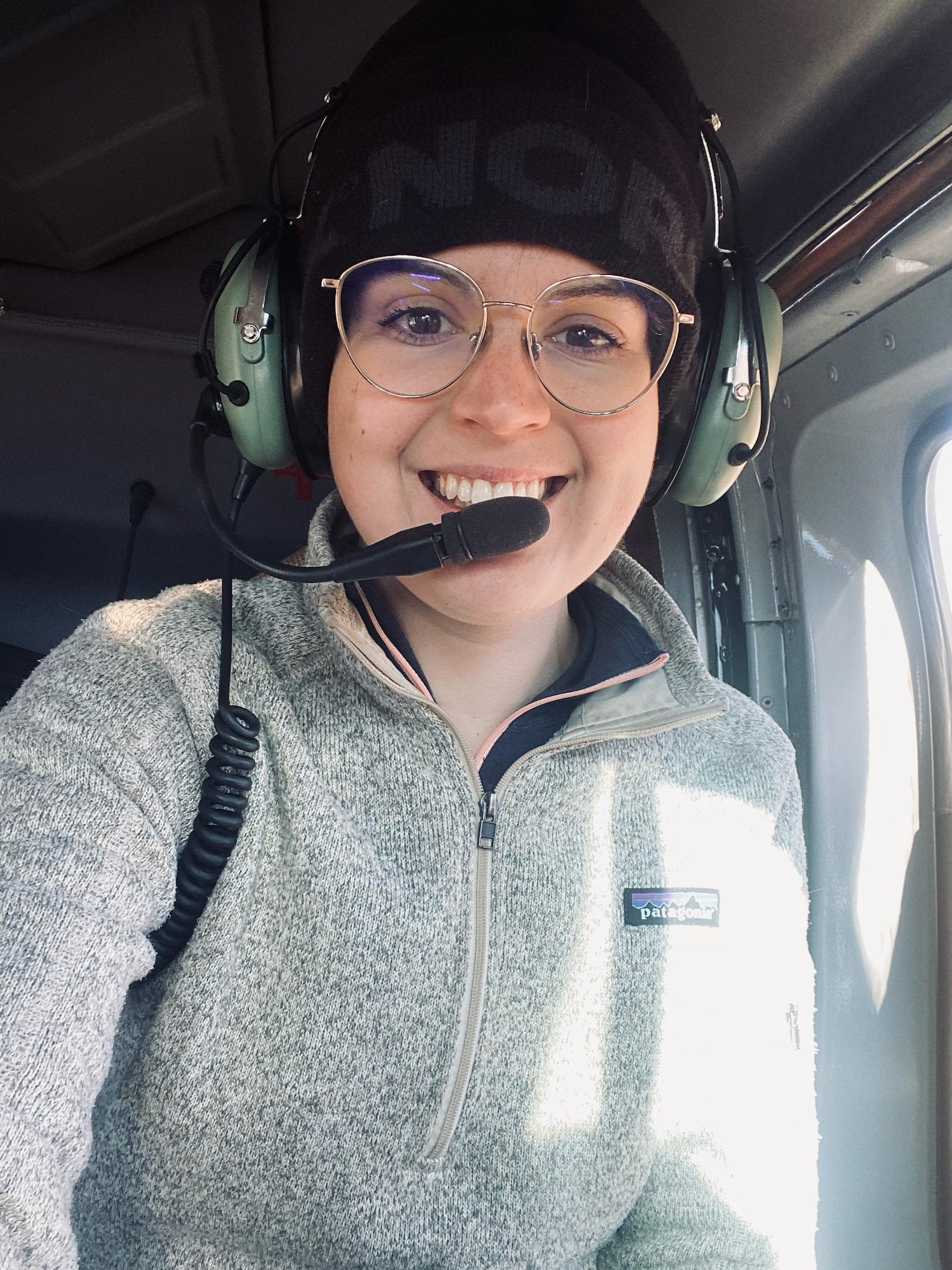
Conservation photographer & filmmaker Sydney Smolla
Having real-time photographs and timestamps of what environments look like over time is extremely valuable data for future research and documentation. Local conservation photography is especially important right now in the Southwest, as water, public lands and ancestral lands are being threatened by policy changes and climate change.
I believe conservation photography is an incredible tool to get curious about things we don’t completely understand, help protect the things we care about, and encourage photographers to use the images they capture as a way to advocate for those things – starting in their own backyards. Sony cameras help me do just that.
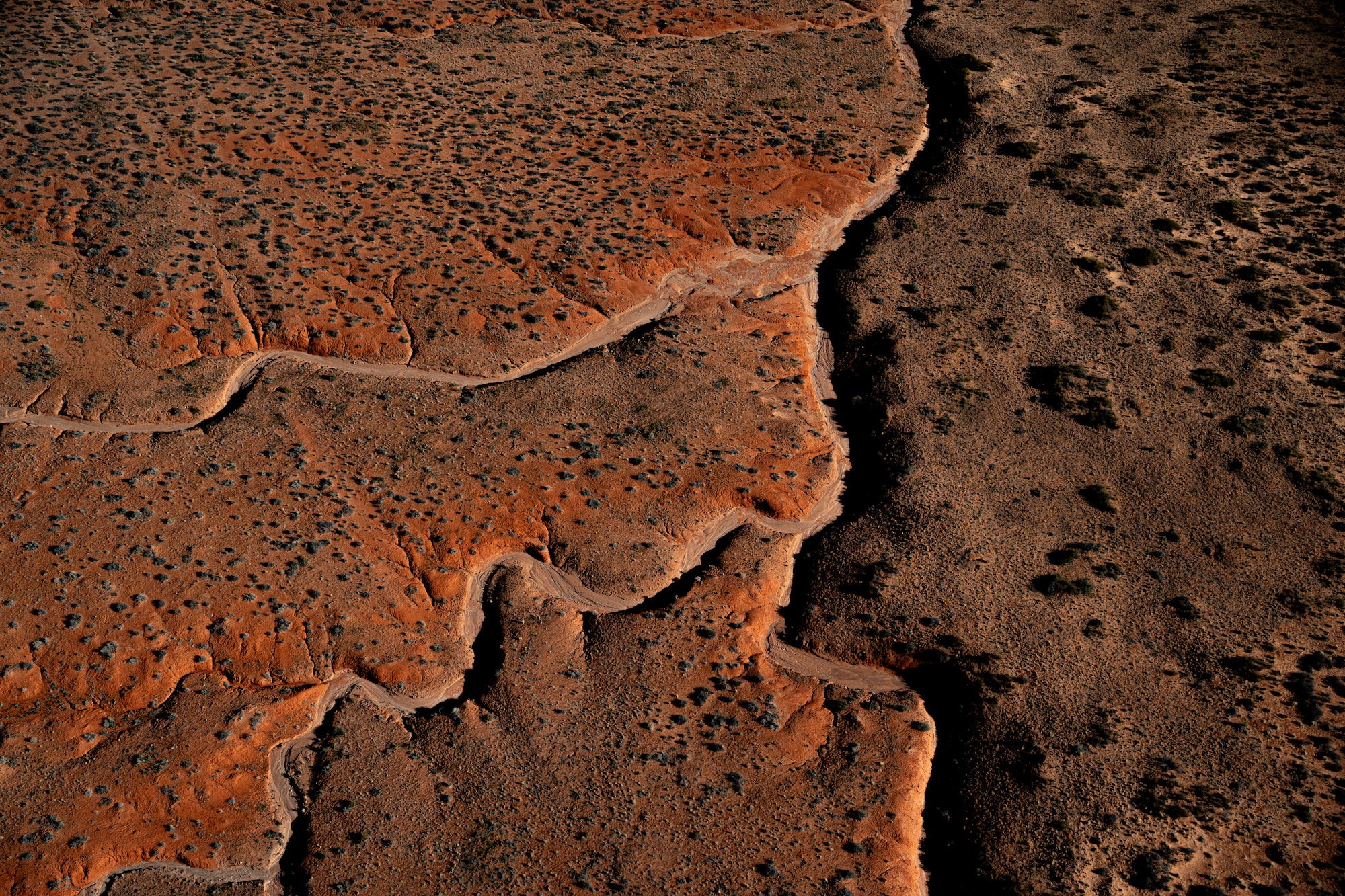
" I love to capture these abstract view points of where water has shaped the landscape into the shap of a vein. It connects the bigger picture that these desert landscapes are actually full of life and are full of deep cultural history and need to be cared for and protected." Photo by Sydney Smolla. Alpha 7 IV. 1/3200-sec., f/4, ISO 500
Explore more of Sydney’s Smolla’s work on Instagram @sydneysmolla_art and at www.sydneysmolla.art.