When photographer Brandon Kirk spotted a surfer disappearing into a barreling wave, he saw something more than a great moment of surf action. Sunlight filtering through the curling wave created a soft, almost surreal light on the surfer’s face. Using the Alpha 7R VI and 600mm f/4 G Master lens, Brandon was able to freeze the fleeting moment in remarkable detail. Go Behind the Shot to learn how he found the light and captured the image.
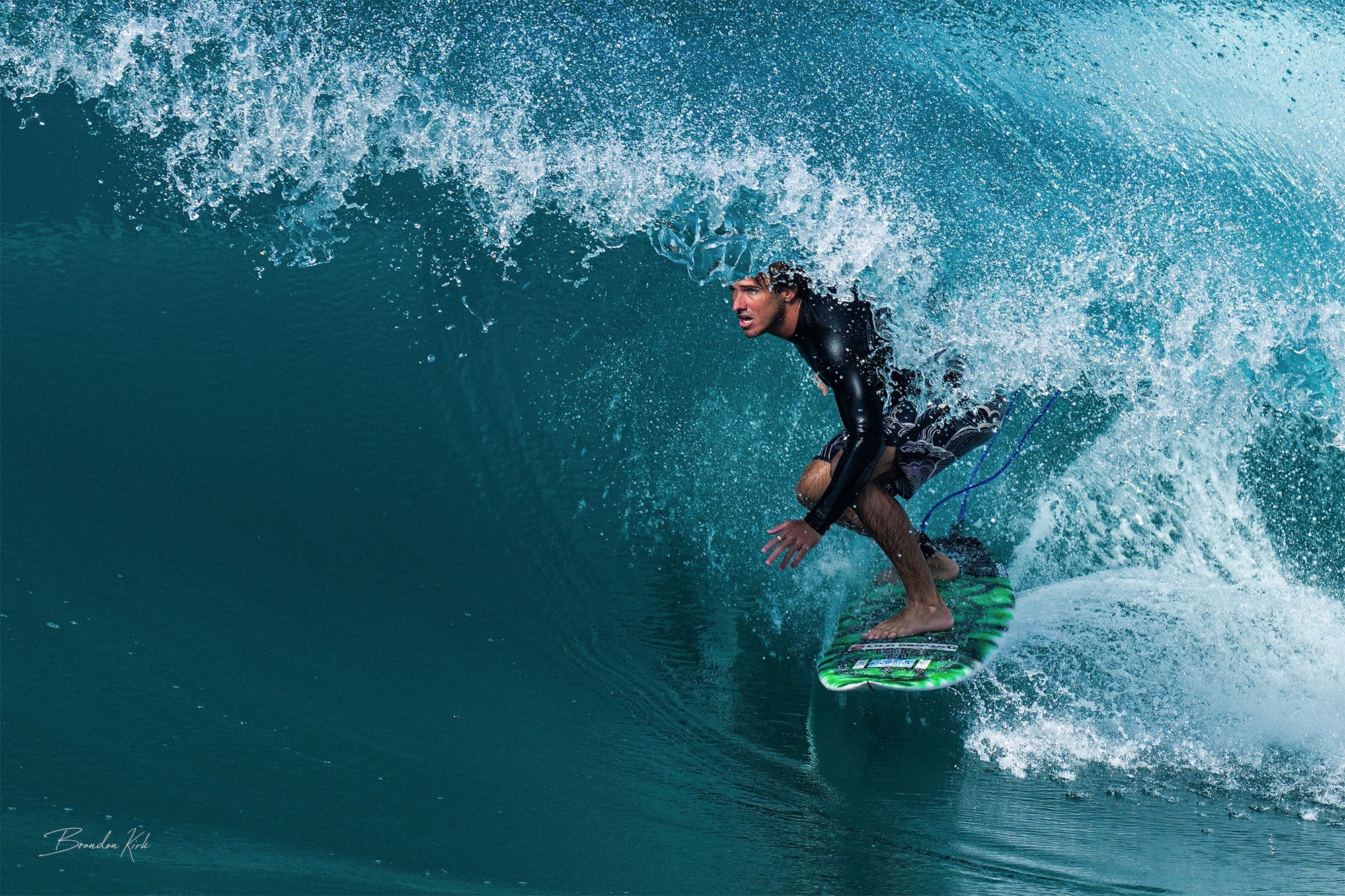
Surfer Josh Burke. Photo by Brandon Kirk. Alpha 7R VI. 600mm f/4 G Master. 1/2500-sec., f/4, ISO 100
During the week of July 27, Southern California saw some of the best summer surf in years. Hurricane Genevieve was the primary reason, strengthening into a Category 5 hurricane with sustained winds of 160 mph and generating swells that brought high surf to Southern California.
For four straight days, I chased the best waves I could find. Newport Beach was one of the standout spots, even attracting big-wave surfers from Hawaii.
But my favorite image from those four days didn’t come from the biggest wave I photographed.
It came from the best light.
The Scene
Whenever I’m on the beach photographing surf, I look for fleeting moments of action that make a compelling photograph. As with any sport, you have to anticipate these moments because they often last only a few seconds – or even fractions of a second.
For most of my surf photography, I shoot early in the morning or late in the day when the light is limited. To make things even more challenging, the coastlines of Southern California are frequently shrouded in low clouds and fog, particularly in early and mid-summer.
The early morning of Friday, July 31, in Newport Beach was no different. Low clouds hugged the coastline but were beginning to burn off, giving me several small windows of beautifully diffused light throughout the morning.
My Gear
Since I first began shooting professionally, I’ve chosen Sony’s R-series cameras for their high resolution and reasonably fast shooting speeds. The Alpha 7R V had been my workhorse for the last several years.
The high resolution is a necessity for capturing beach landscapes for my large-format print collection, but I also need a fast frames-per-second rate to capture moving surfers and breaking waves.
On this morning, I was particularly excited because I was shooting with my new Sony Alpha 7R VI. It was only my third outing with the camera.
The Alpha 7R VI was an attractive upgrade for me not only for the increased resolution—66.8 megapixels – but particularly for its ability to shoot 30 frames per second.
And if that wasn’t reason enough to be stoked, I had also recently acquired Sony’s 600mm f/4 G Master lens. I had some prior experience with this lens, having rented it a few years ago during my first winter on the North Shore of Oʻahu. Though it took a bit of time to get used to having a fixed focal length rather than a zoom lens, the image quality was incredible.
But with a price tag that rivals some used cars, it was a hard purchase to justify early in my surf photography career. As a result, my go-to lens when shooting surf from the beach was Sony’s 200-600mm f/5.6-6.3 G. I’ve had great results from this lens and still believe it is the best “bang for your buck” lens on the market for the type of shooting I do.
But the 600mm f/4 G Master has one undeniable advantage: that f/4 aperture.
Camera Settings
I didn’t fully appreciate just how much a faster-aperture lens could benefit my surf photography until that morning.
When I’m shooting action, I almost always want my lens wide open. A wide aperture has two benefits. The resulting shallow depth of field helps isolate my subject from the background, while the additional light allows me to use a faster shutter speed.
With a long lens, I always consider camera shake. The traditional rule of thumb is to use a shutter speed at least as fast as the reciprocal of the focal length. For example, at 600mm, that means 1/600-sec. or faster, primarily to minimize the effects of camera movement. For relatively static subjects, this has worked pretty well.
For action surf photography, however, I consider 1/1000-sec. my minimum. Particularly with a 600mm lens, I try to shoot at 1/1250-sec. or faster to give me a better chance of freezing my moving subject.
A blurry surfer is a total deal killer.
Light permitting, I much prefer to shoot at 1/1600-sec. and faster because something very interesting starts to happen with breaking waves. The water becomes almost ice-like, with individual droplets and textures frozen in midair.
The faster the shutter speed, the more dramatic that effect becomes.
Of course, when light is limited – as it often is in the early morning or under clouds – you have to make a tradeoff. You either accept a slower shutter speed, raise your ISO, or sometimes both.
I know photographers who don’t hesitate to push their ISO well above 1000. But I’m not one of them.
Because I may capture an image for my collection that I’ll want to print 40x60 inches and sometimes even larger, I’m very reluctant to push my ISO. I don’t want to see noise in my large-format prints, and I don’t want to sacrifice detail in the noise-reduction process.
As a result, I generally try to stay between ISO 100 and 200. If I have to, I’ll go to 320. I think I have only one image in my print collection above ISO 400.
The cleaner the starting image, the better the final result.
For this image, even under the still-diffused morning light, I was able to shoot at an incredibly fast 1/2500-sec., f/4 at ISO 100.
How I Got the Shot
Because of the direction of the sun and the waves, this image was much more difficult to capture than it might appear.
The morning sun was in the southeast, so I initially positioned myself to shoot toward the northwest with the sun directly behind me – the ideal position for colorful surf photography. But the hurricane-generated waves approached the beach at an angle, causing the waves to break diagonally along the coastline from south to north.
I could get beautiful morning light on the breaking waves, but the surfers riding them were traveling away from me, so I could only photograph their backs.
I repositioned myself so I could photograph surfers coming toward me and capture their faces. But from this angle I was looking almost directly into the sun, producing heavily backlit images. Not the look I was after considering how beautiful the morning light was.
So I moved back to my original position and waited.
As I watched a large set approach the beach to the north, the first wave looked a little different from the others. It appeared that it was going to break toward me rather than away from me, as almost all of the other waves had done that morning.
Luckily, one surfer saw this too and immediately started paddling for the wave.
I locked on to him as he paddled, saying, “Go, go, go!”
This wave was the needle in the haystack that morning.
The surfer paddled hard and dropped into the wave, heading directly toward me and almost straight into the morning light.
I immediately knew I had an opportunity. I held the shutter down as a curtain of water began to drop over him as he raced across the face of the wave.
And then something magical happened with the light.
As the top of the wave pitched over him, the sunlight pierced through it. The wave acted like a giant diffuser, illuminating his face almost like a perfectly placed softbox.
A split second later, he disappeared inside the barrel.
I saw it all through my viewfinder, thanks to the Alpha 7R VI's blackout-free shooting, but it happened so fast that I wasn’t certain I had captured the exact right moment. After the wave passed, I quickly played back the images and found the perfect frame.
I was shooting at 1/2500-sec., f/4 and ISO 100 with the Alpha 7R VI and 600mm f/4 G Master, allowing me to freeze both the surfer and the intricate details of the breaking wave.
Why the 600mm f/4 G Master and Alpha 7R VI Mattered
The advantage of an f/4 aperture isn’t merely the shallow depth of field it provides, which is tremendously helpful for isolating your subject. It’s also what that abundance of light allows you to do – specifically, increase shutter speed and lower ISO.
To put my settings into perspective, my 200-600mm has a maximum aperture of f/6.3 at 600mm. Compared with f/4, that’s about 1⅓ stops less light. In other words, the f/6.3 aperture lets in only about 40% as much light as f/4.
With my 200–600mm at 600mm, f/6.3 and ISO 100, the fastest I could have shot would have been around 1/1000-sec. under the same conditions. That’s probably fast enough to get a sharp surfer, but with no margin for error. I also would have lost some of that frozen-in-time quality that I love to see in the breaking wave.
With the 600mm f/4, I can have my cake and eat it too: super-fast shutter speed + very low ISO = maximum image quality.
The other major advantage came from the Alpha 7R VI’s speed. In electronic shutter mode, it’s capable of up to 30 frames per second. That’s a whopping three times as fast as my Alpha 7R V.
That’s a massive difference when photographing action sports. So much happens in a single second.
A surfer disappearing into a barrel is a perfect example. The difference between a frame where the surfer is perfectly positioned inside the wave and one where he has disappeared behind the curtain of water can be a fraction of a second.
Shooting at 30 fps gave me a much higher probability of capturing exactly the right moment.
The higher-resolution sensor is another advantage for my work, particularly because I often make very tight crops of distant surfers, as I did with this image, without losing significant detail.
Surfer Josh Burke. Photo by Brandon Kirk. Alpha 7R VI. 600mm f/4 G Master. 1/2500-sec., f/4, ISO 100
The Unexpected
You can spend hours watching waves, trying to anticipate where and how a wave will break, which direction the surfer will travel, where the sun will be and how the light will look.
But every wave is unique, so there’s often an element of surprise. You don’t know exactly what the wave is going to look like or what the surfer might do until it’s happening.
Being ready to capture something unexpected is exciting and challenging, and it’s what I love about surf photography.
For me, that’s what made this image special. It wasn’t the biggest wave of the day, and it wasn’t necessarily the most dramatic action.
It was the magical light.
The Edit
My photo editor, Bruce Davis, does all of my post-processing. He made the initial edits in Photoshop Camera RAW to rotate, crop, adjust tone levels, color and vibrance. In Photoshop, he added a slight boost in contrast and sharpness. Though there was nearly no noise, he used Topaz DeNoise for slight noise reduction.
See more of Brandon Kirk’s work on Instagram @brandonkirk and at brandonkirk.com.
Shop Brandon's Surf-Action Setup:
–Sony Alpha 7R VI
–Sony 600mm f/4 G Master