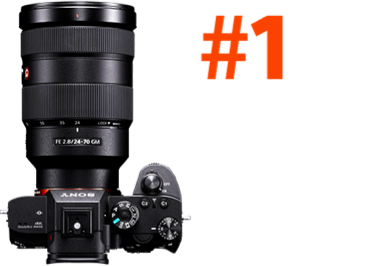
The moon's been getting a lot of attention lately, as the world has watched the Artemis II crew and their exciting lunar mission before they return to Earth tomorrow. It's certainly a worthy subject and photographers have long been turning their lenses to the moon – part muse, part technical proving ground. While he didn't leave the planet for this adventure, earlier this year photographer and filmmaker Chris Olivas went on a pursuit to capture a rare lunar eclipse over Sedona’s Cathedral Rock. In this behind-the-scenes story, Chris explains how he was able to balance motion, light and distance as the full moon shifted to deep red.
Chris's Lunar Eclipse Kit:
–Alpha 7S III
–200-600mm f/5.6-6.3 G
–70-200mm f/2.8 G Master II
–24-70mm f/2.8 G Master II
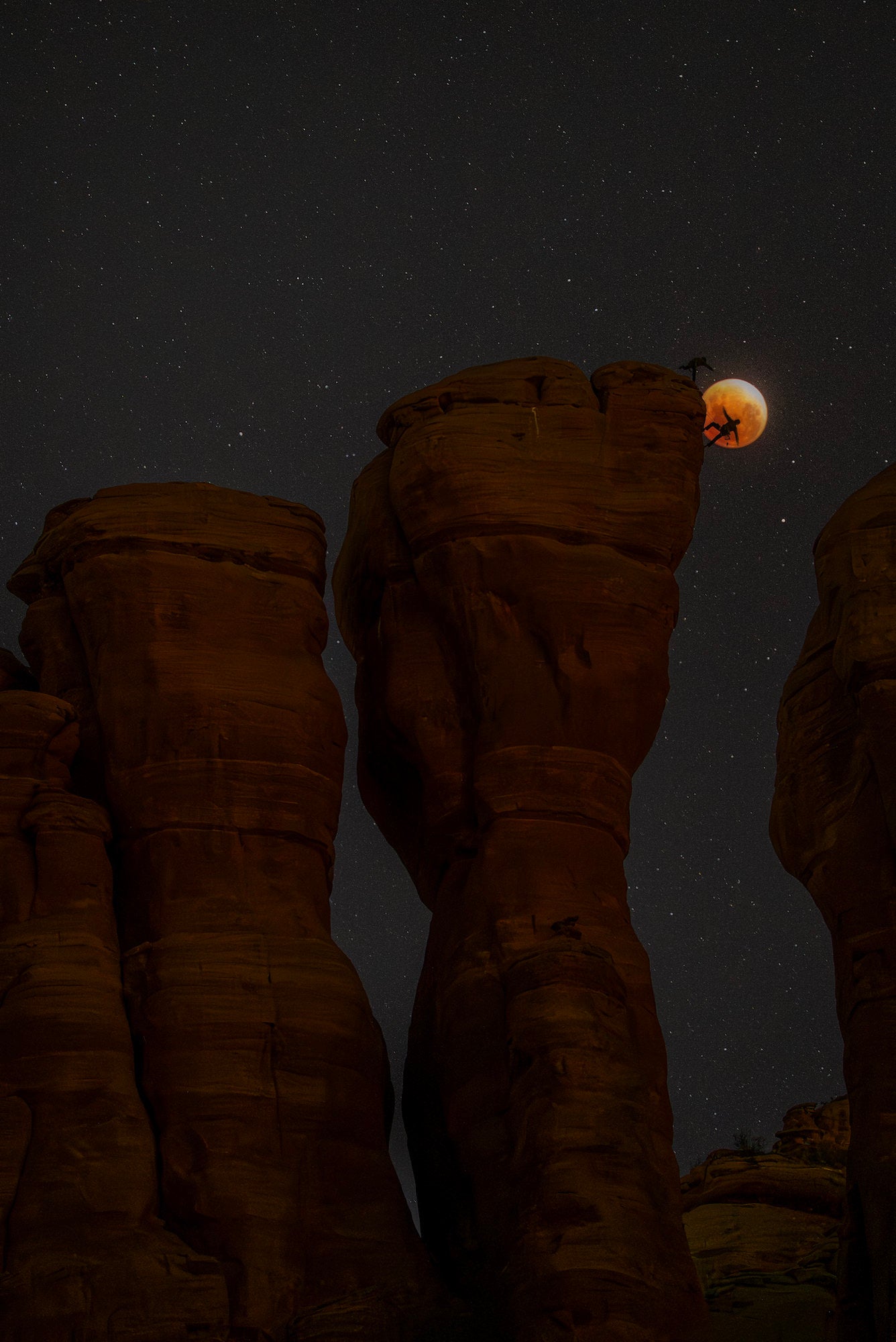
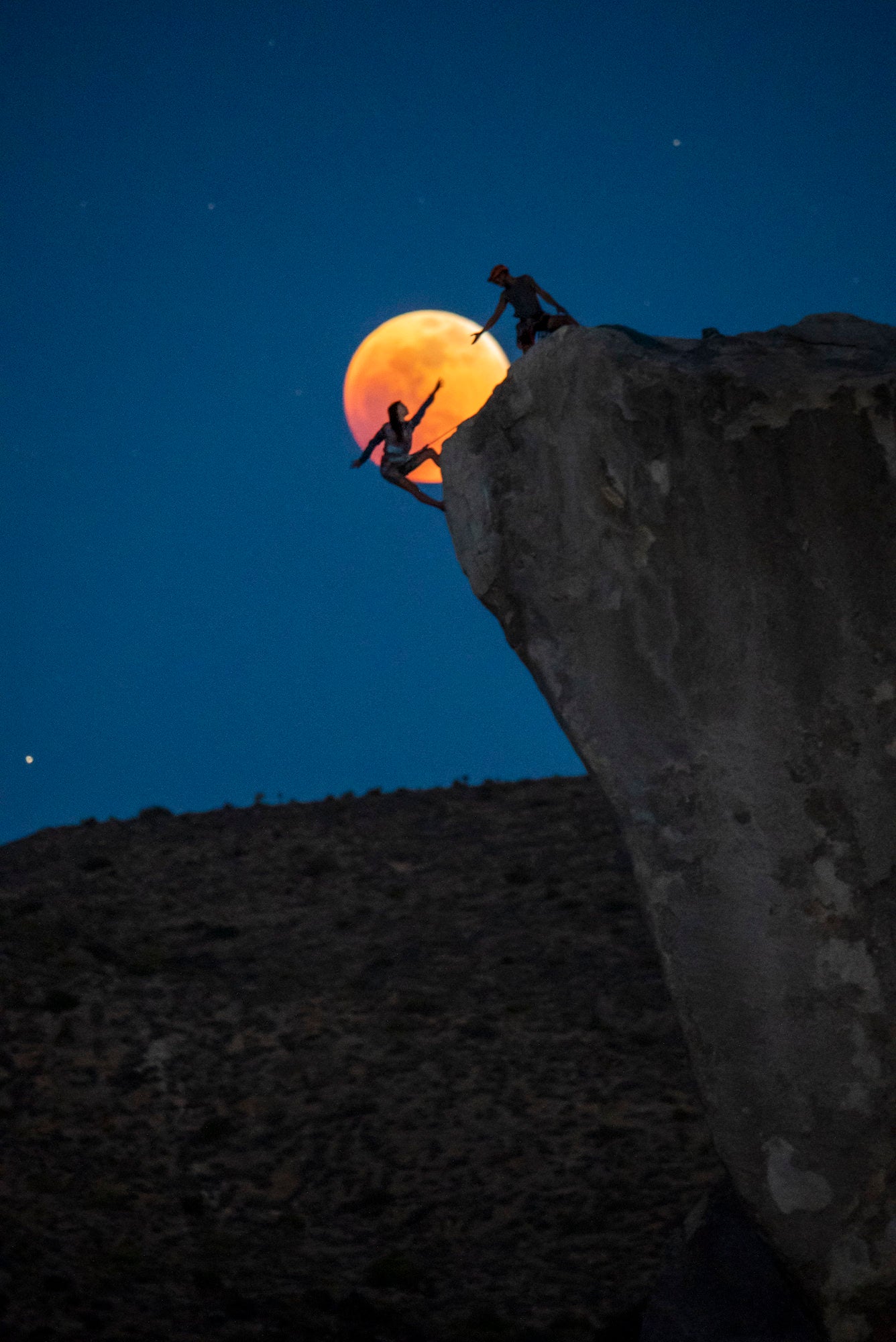
Climbers Jakob Tyler Chew and Chris Ruel at Mace Tower. Photo by Chris Olivas. Alpha 7S III. 200-600mm f/5.6-6.3 G.
The Night The Sky Turned Red
It doesn’t happen often – just enough to keep you chasing the next one. The planning, the research, the obsession over every detail. This is eclipse hunting. This is cosmic climbing. I’m Chris Olivas, and this is the story behind capturing a blood moon over Sedona’s Cathedral Rock.
On March 3, 2026, the night sky transformed from full moon brightness into a deep, eerie red glow. Set against Sedona’s iconic red rock sandstone towers, it was the perfect stage for something ambitious. Alongside climbers and creative partners Jacob Tyler Chew and Chris Ruel, we set out to capture a precise alignment: climbers silhouetted against the blood moon from Mace Tower. Everything came together – but only after intense planning, multiple setbacks, and a relentless push to adapt in the field.
Fundamentals: Speed, Light & Motion
Photographing the full moon presents a unique balance of light, motion, and positioning. The moon moves roughly 15 degrees per hour, which means at long focal lengths, you need a fast shutter speed – typically around 1/100-sec. or faster – to keep it sharp. But faster shutter speeds reduce available light, making it harder to properly expose your foreground subject.
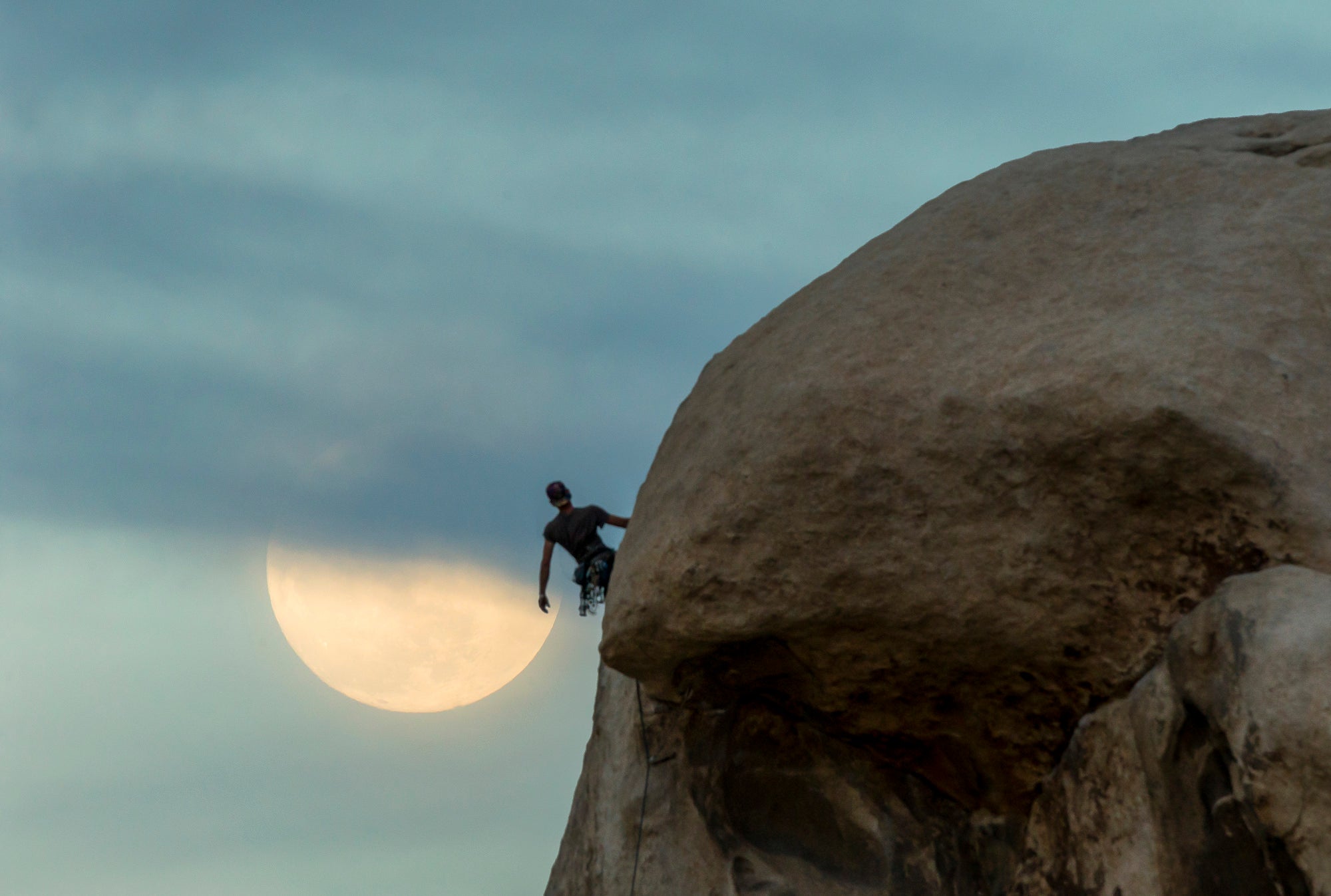
Climber Jakob Tyler Chew at Intersection Rock, 2018. Photo by Chris Olivas. Alpha 7S III. 200-600mm f/5.6-6.3 G.
During a lunar eclipse, the challenge intensifies. As the moon enters totality, its brightness drops dramatically – from a magnitude of about -12.7 to roughly 1.15 – transforming it from a bright light source into something much more subtle. That shift opens creative possibilities, but demands fast, light-sensitive gear. I like to use my Sony Alpha 7S III for this setup. It is very versatile for night photography. It has extra large megapixels for capturing many photons in a low light setting. It also has a very large ISO range of 80-102,400, ensuring a high signal to noise ratio. The battle astrophotographers are always engaged in.
Climbers Esther Marino and Chris Ruel at Headstone Rock, 2022 . Photo by Chris Olivas. Alpha 7S III. 200-600mm f/5.6-6.3 G.
Glass Matters: Choosing The Right Focal Length
Full moon photography also requires selecting the right lens focal length for your desired image. I like to use my 200-600mm f/5.6-6.3 G super telephoto. The super telephoto allows me to get a really tight image of the moon with it’s incredible steady shot features. It allows for really filling the frame and highlighting the moon’s massive beauty.. This super telephoto focal length produces another challenge, alignment. We have to have enough distance from the subject to use a telephoto that also aligns with the position of the moon. Too close to the subject and they overshadow the size of the moon, too far and the alignment doesn’t match up. The moon also spends very little of its path in the sky low enough to include a human sized subject. It needs to be anywhere from 5-25 degrees above the horizon to align with anything terrestrial(unless we're at the base of a steep cliff or skyscraper).
Exposure Window: Planning For Movement & Totality
With the rate that the moon is moving in the sky there is a short time window we need to plan for on top of the time the moon will be fully eclipsed and under the Earth’s umbra. Fortunately, lunar eclipses tend to happen over a long period of time, sometimes lasting an hour. However, while being eclipsed, the moon's brightness reduces from a magnitude of -12.7 to 1.15. I like to use my 70-200mm f/2.8 G Master II telephoto. This telephoto is very fast and tack sharp with its constant 2.8 aperture, perfect for night photography. This means we can still get the moon when it’s in the blood moon stage.
For this eclipse, the optimal alignment occurred between 4:05 and 5:03 a.m., with the moon moving from roughly 251° to 261° WSW. We needed a tall formation with a clean northern face and enough distance – at least 500 feet – to safely shoot at a steep upward angle.
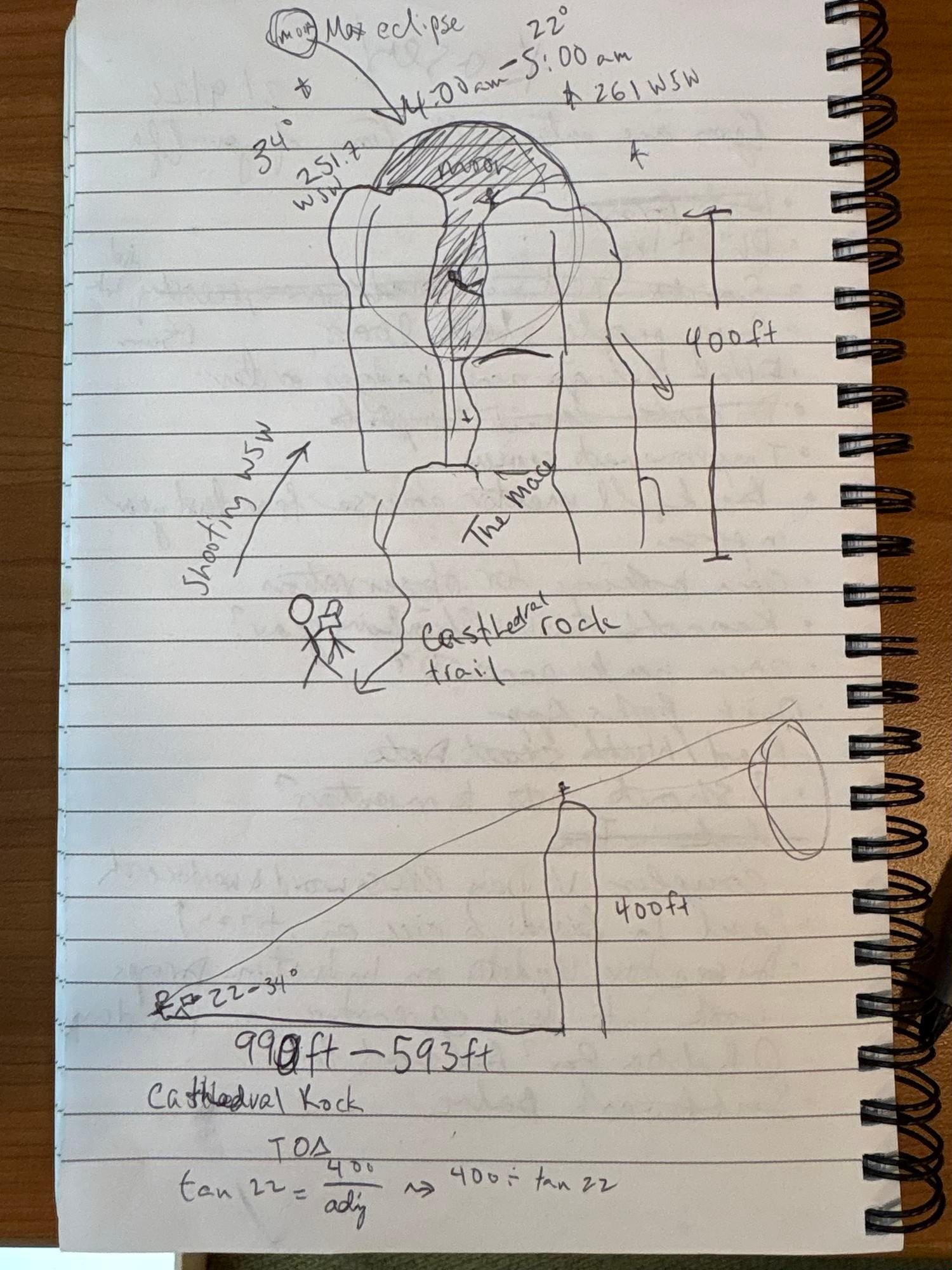
Chris' plan to capture the eclipse
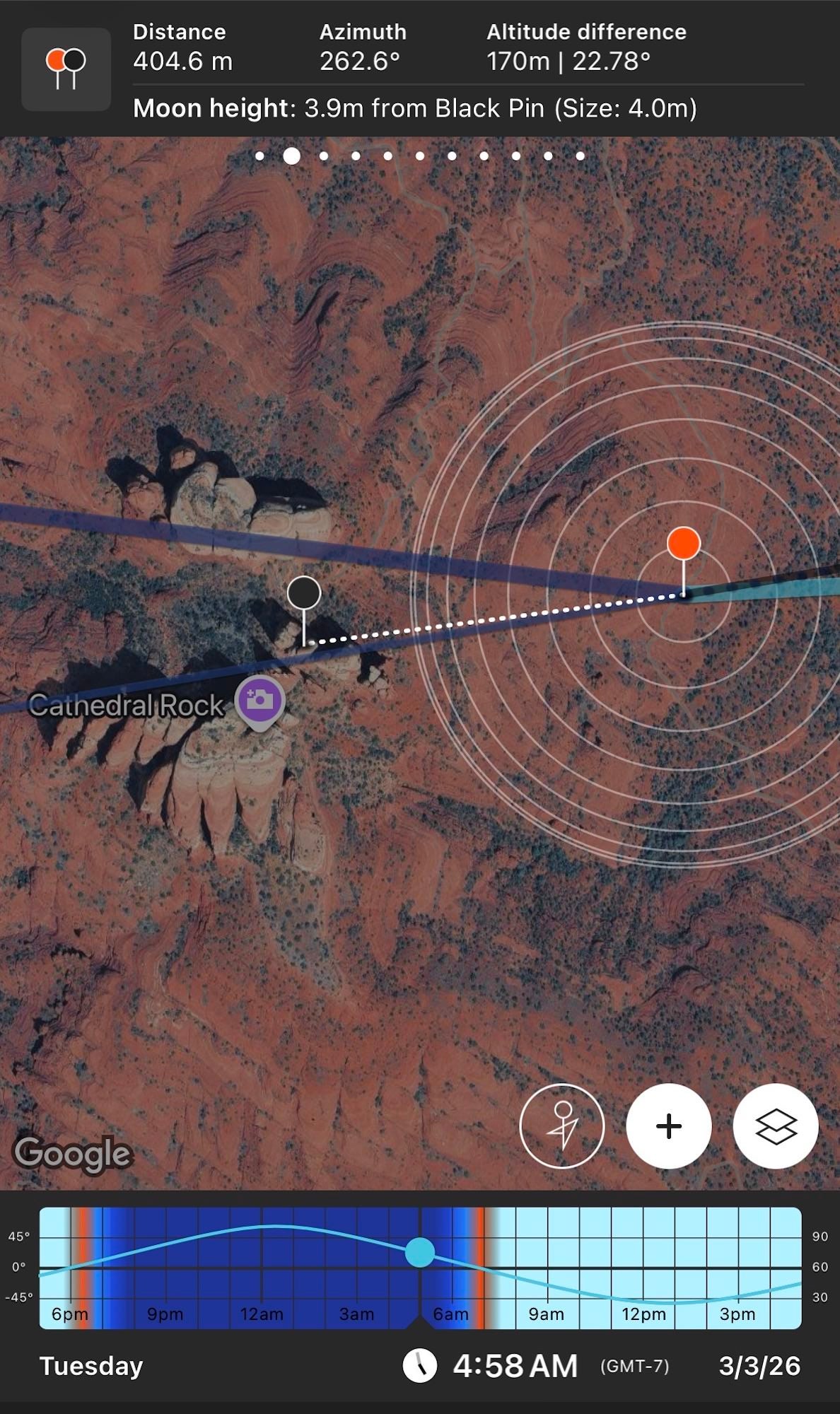
Jakob suggested Mace Tower, a classic sandstone climb within Cathedral Rock. It checked every box: height, orientation, and visual impact. Using the PhotoPills app, I mapped the alignment – and it looked perfect.
Scouting Day: When Plans Meet Reality
But planning tools can only take you so far.
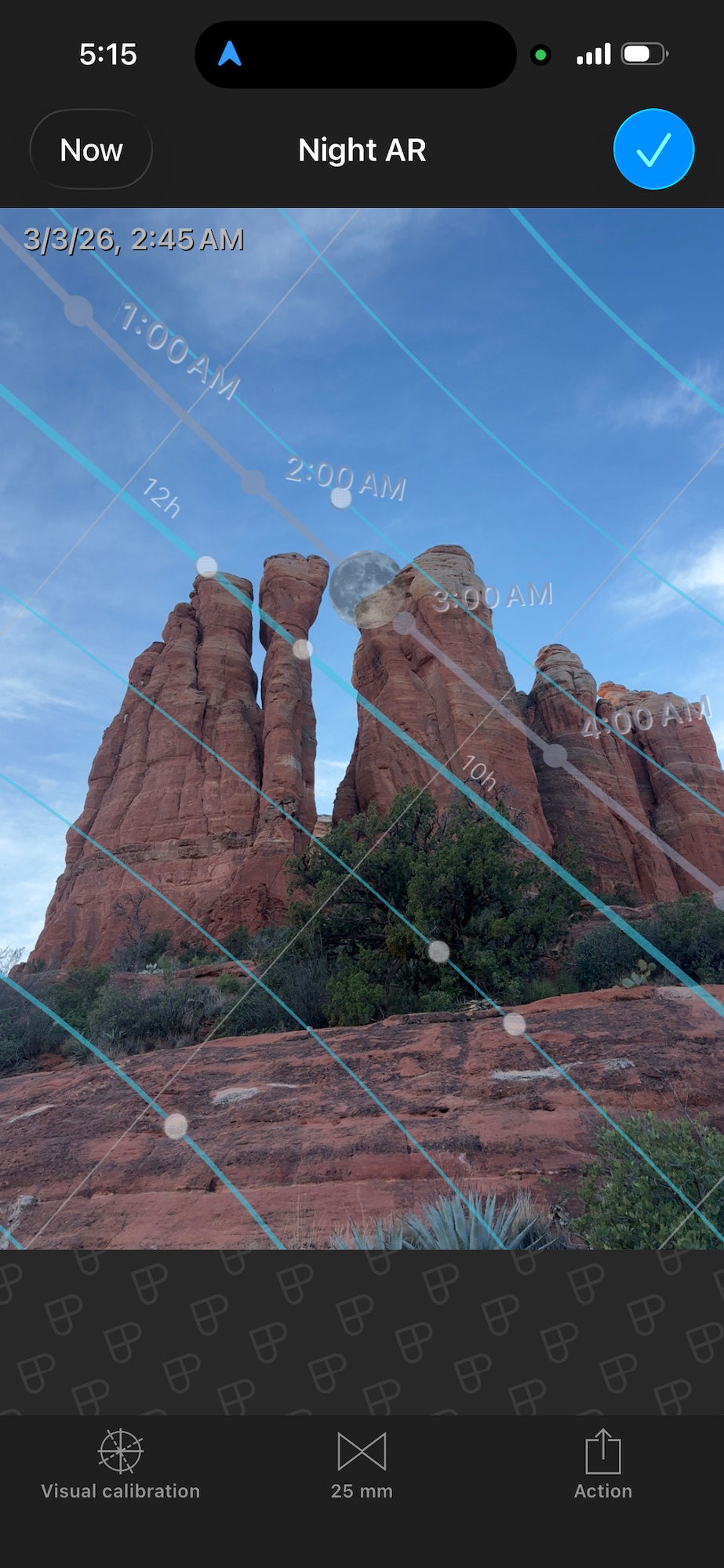
Chris and I arrived a day early to scout the location in person. From a distance, Cathedral Rock is breathtaking – a massive monument towering over the Red Rocks State Park. A quick scramble to the base of the Mace tower we were pleased to see the alignment looked great!
Night Check: The First Big Setback
Encouraged, we returned later that night under a near-full moon to confirm alignment. That’s when things fell apart. The moon was off by about 10 degrees. Nearby rock formations blocked the clean silhouette we needed. Every adjustment either broke the composition or put us in unsafe terrain.
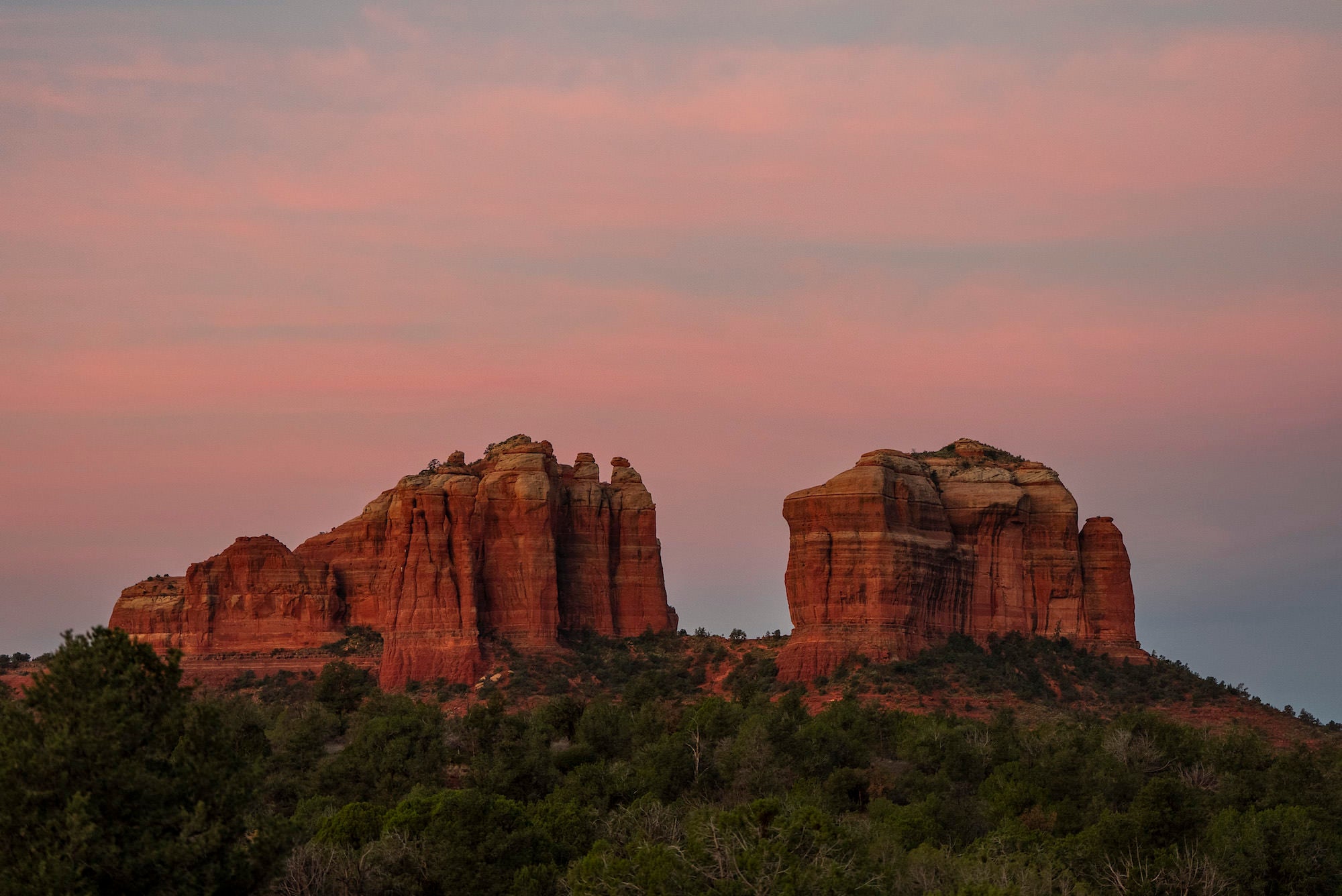
Cathedral Rock - Sedona, Arizona. Photo by Chris Olivas. Alpha 7S III. 200-600mm f/5.6-6.3 G.
We scrambled. We ran to alternate vantage points – down trails, into creek beds, across different angles – but each one introduced new problems: obstructed views, misaligned towers, or poor perspective. By the end of the night, we were out of options.
We stepped back, regrouped, and decided to explore new locations the next day. The next day, we scouted a new area near the Chapel of the Holy Cross. On paper, it looked promising – but once again, reality complicated things.
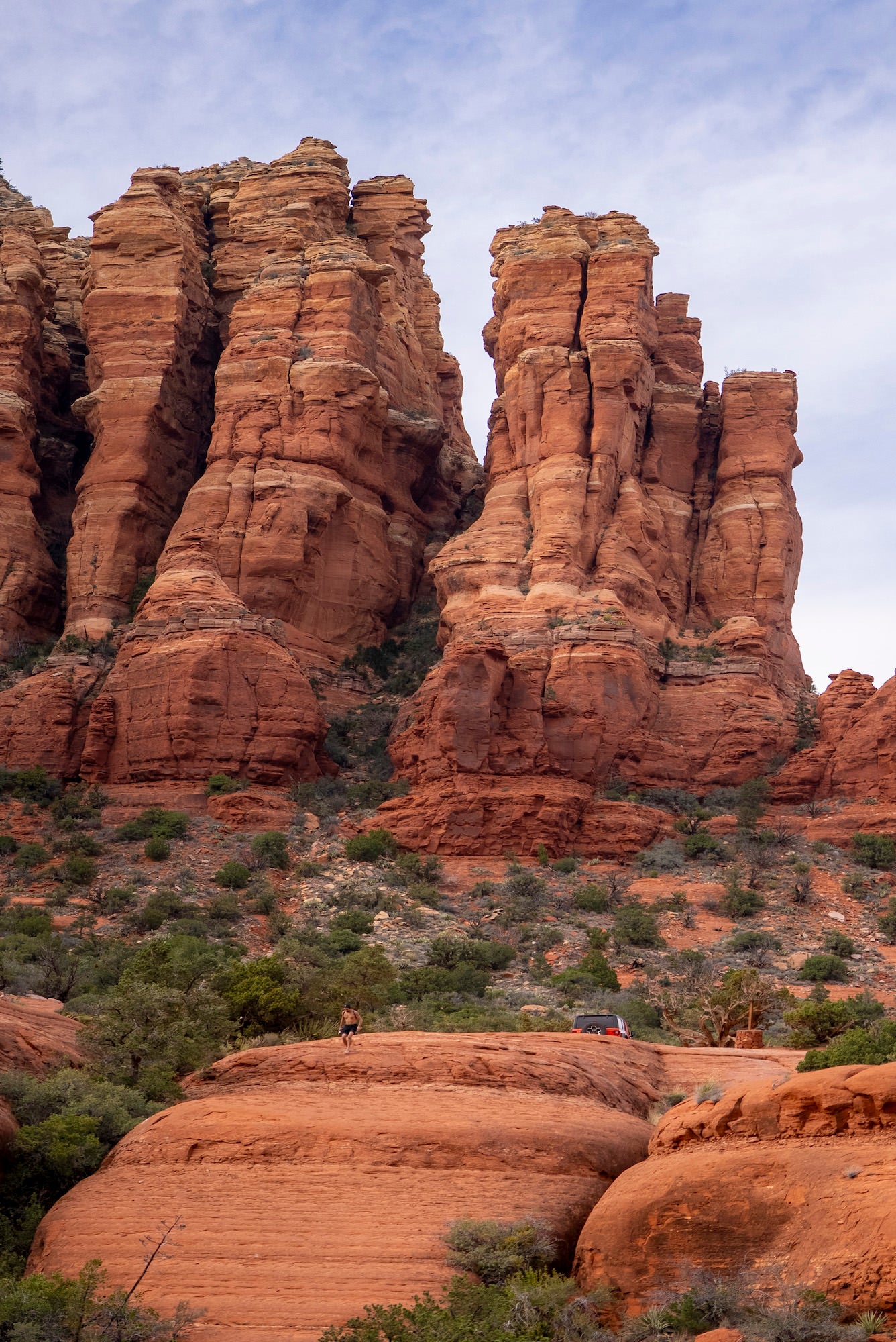
Photo by Chris Olivas. Alpha 7S III. 70-200mm f/2.8 G Master II.
Our compass readings became inconsistent, throwing off our alignment tools. Sedona is famous for its so-called “vortexes,” and while we can’t say for sure what caused the interference, it added another layer of uncertainty.
Time was running out.
Commitment: Back To Plan A
When Jakob arrived, we had to make a decision. The team needed daylight to begin the climb and set ropes. Despite the risks, we chose to commit to Plan A: Mace Tower. The climb began at sunset.
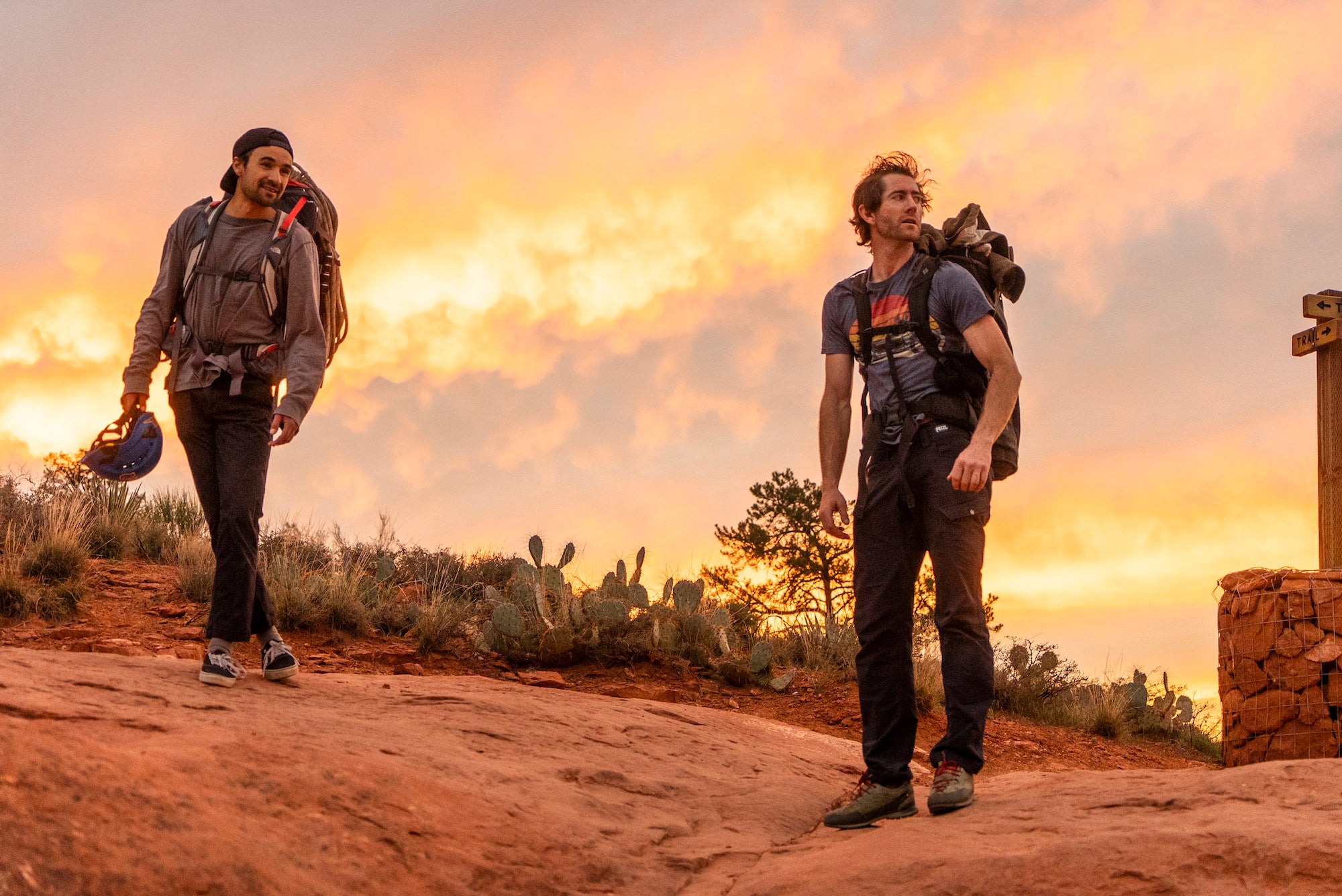
Climbers Chris Ruel and Jakob Tyler Chew, Cathedral Rock. Photo by Chris Olivas. Alpha 7S III. 24-70mm f/2.8 G Master II.
From the ground, the tower looked intimidating – steep, exposed, and unforgiving. But Jacob and Chris were fully locked in, moving upward with focus and energy. It took them about three hours to reach the summit – longer than expected, but necessary to safely rig the route for a faster ascent during the eclipse. We rested briefly at the base, setting alarms for the early morning push. At 2:00 a.m., we were back in motion. As the eclipse began, everything began to shift into place.
Go Time: Eclipse & Execution
The climbers ascended quickly using fixed lines and jugged up the tower swiftly while I moved into position. The moon dimmed, transitioning into its deep red phase. For a brief window, the light was just right – dark enough to reveal the starry sky, but bright enough to expose the climbers and rock.
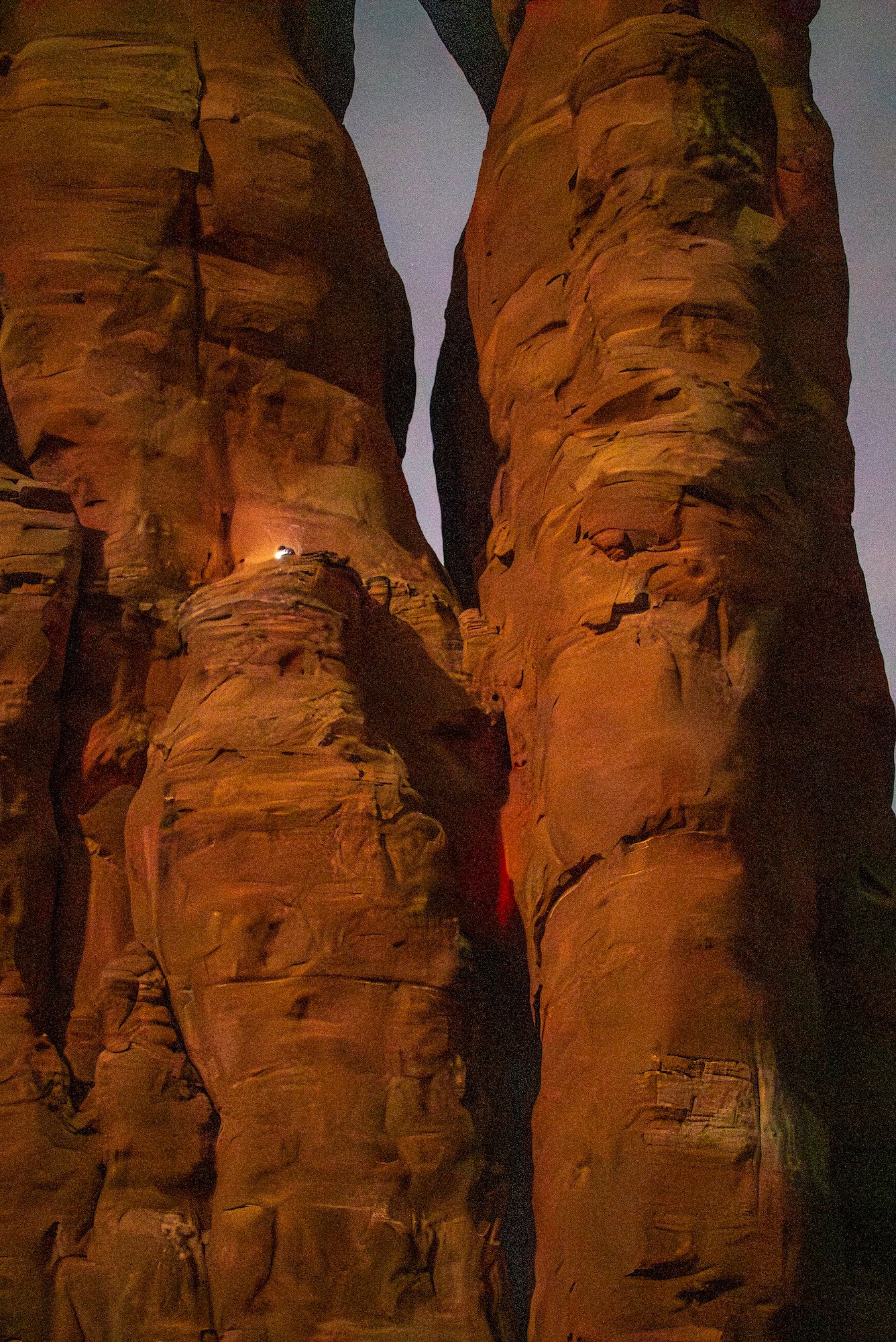
Photo by Chris Olivas. Alpha 7S III. 70-200mm f/2.8 G Master II.
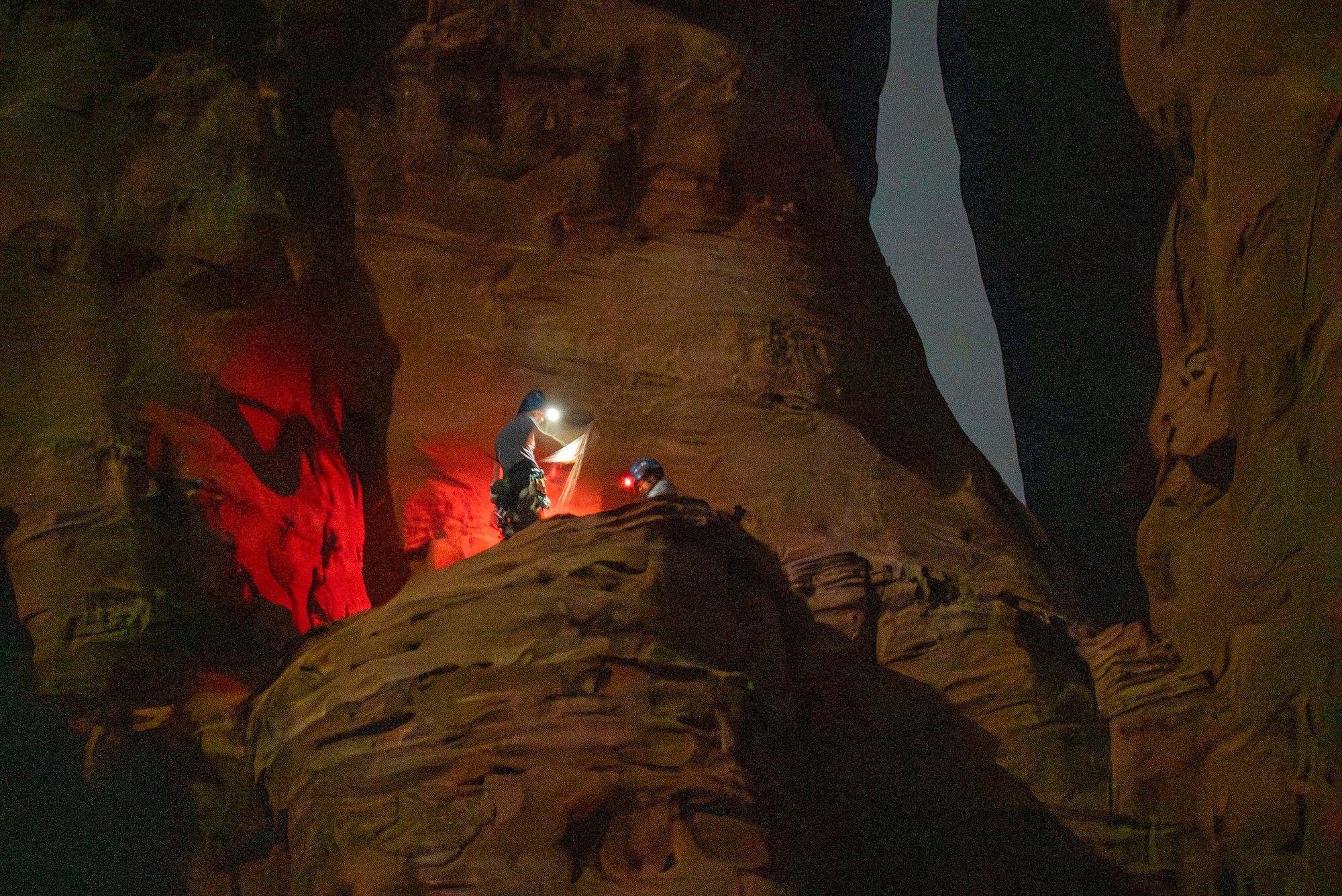
Photo by Chris Olivas. Alpha 7S III. 200-600mm f/5.6-6.3 G Master.
The moon was starting to eclipse, alignment was looking right, it was go time. There was one final hurtle(literally), in order to get a great silhouette shot they need to leap from one tower to the next. Jakob was literally jumping for joy with this challenge and made the leap. Chris soon followed. With the eclipsed moon it went into full darkness, enough to see the rising Milky Way Core but not enough to see them any longer. Shouting through our walkie talkies we coordinated.
Dialing Exposure & Focus
They got in position and I threw up the super telephoto 200-600mm f/5.6-6.3 G onto my Alpha 7S III. I counted them down for some long exposures to get a grip on the scene and settings. Starting with a 10-sec. exposure and working my way down to 1-sec., they were amazing at holding their positions absolutely still. The moon was moving fast. I toggled between focusing and exposing the moon and them until I could find the settings that matched both. It didn’t take long before the moon met them perfectly. Yewwww, ow ow owww! We all howled at the moon as our plan aligned! The deep red gave me just enough light to allow for exposing the climbers and the tower. I was far enough away from them so the parallax and focus was not that off. We just kept cycling different positions and focal lengths.
As the moon set lower I picked up my tripod and ran closer to them switching to the 70-200mm f/2.8 G Master II, then the 24-70mm f/2.8 G Master II. I loved having the ability to truly evaluate all three lenses in this adventure. Of all three, the 200mm ended up being the best for capturing the prowess of the scene and balancing the exposure. It’s a very fast lens, tack sharp, and was just enough throw to fill the frame and emphasize the moon and silhouette. We were stoked!
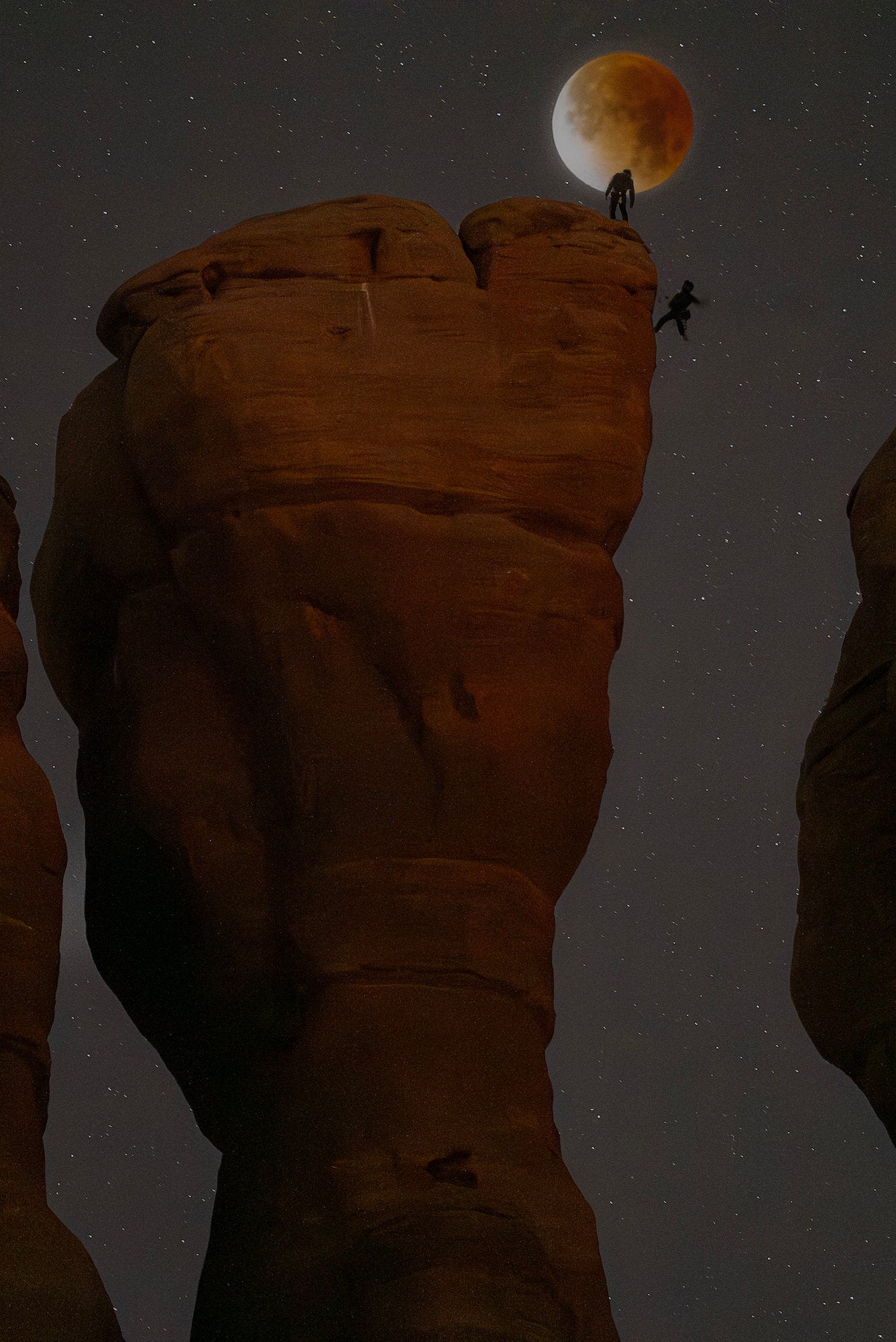
Photo by Chris Olivas. Alpha 7S III. 200-600mm f/5.6-6.3 G.
At the Summit: A Climbers’ Perspective
“A few hundred feet up at 3:00 a.m., everything felt otherworldly – wide awake despite the hour. At the top, Jake and I sat in silence, watching the moon fade into deep red. Guided by radio, we timed each movement perfectly. Cosmic climbing if I’ve ever seen it.” – Chris Ruel
What you see in the final image is just a fraction of the story. Behind it are miles of scouting, failed plans, sleepless nights, and constant recalibration. But that’s part of the draw. A true adventure that couldn’t have happened without the tools, knowledge, and comradery. I’m truly grateful for the opportunity to pull off amazing images like these.
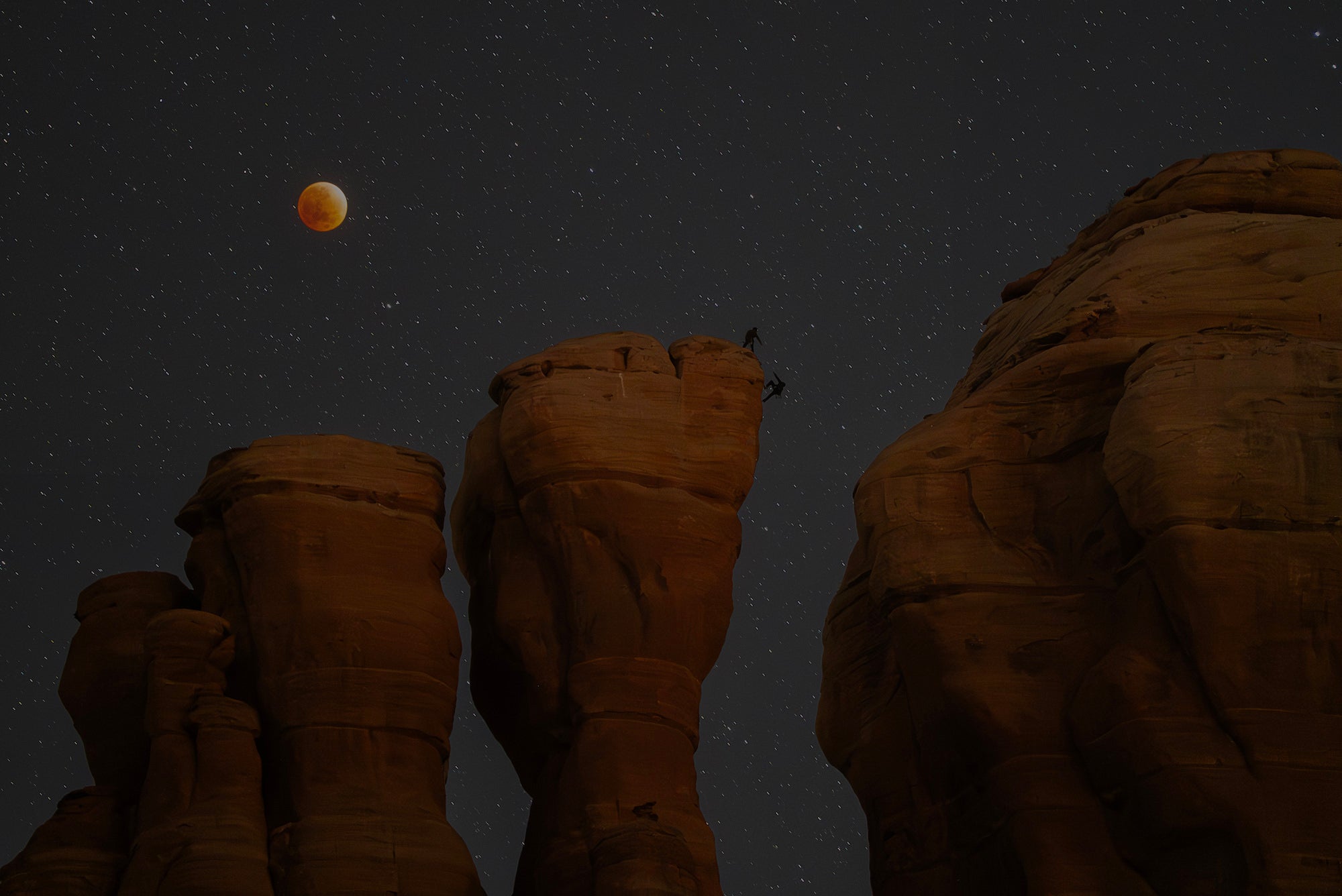
Photo by Chris Olivas. Alpha 7S III. 70-200mm f/2.8 G Master II.
“Like the moon touched by the sun, we feel the pul of this rock called Earth-humans eclipsed by stone. The summits may be temporary, but the discipline, connection, resilience, and identity we build along the way endure long after the climb fades into the past. The real reward isn’t reaching the top-it’s becoming the kind of person who refuses to quit.” – Jakob Tyler Chew
See more of Chris' work on his Alpha Universe profile and on Instagram @cholivas. Check out his photography workshops here.