Sony has added two new G Master super-telephoto primes to its E-mount lineup: the FE 400mm f/4.5 GM and the 600mm f/6.3 GM. For photographers who spend their time tracking birds, wildlife, sports or distant subjects, their shared proposition is immediately compelling: long focal lengths in unusually portable bodies.
Both lenses weigh under 1,000 grams and are compact enough to fit in a smaller camera backpack. That changes the practical equation for photographers who want reach but do not want to carry – or handhold – traditional large-format super-telephotos all day. Sony Artisan Miguel Quiles paired the new lenses with his Alpha 7R VI and Alpha 9 III cameras in the latest video on the Alpha Universe YouTube Channel. Check out some of his highlights and photos below.

Photo by Miguel Quiles. Alpha 7R VI. 600mm f/6.3 G Master. 1/3200-sec., f/6.3, ISO 4000

Photo by Miguel Quiles. Alpha 7R VI. 600mm f/6.3 G Master. 1/3200-sec., f/6.3, ISO 4000
The Headline: Compact, Balanced Reach
The 400mm f/4.5 G Master weighs 994 grams, while the 600mm f/6.3 G Master comes in at 995 grams. The one-gram difference is almost beside the point; the notable part is that Sony has kept both lenses at roughly the same lightweight, travel-friendly threshold despite their distinct focal lengths.

Photo by Miguel Quiles. Alpha 7R VI. 400mm f/4.5 G Master. 1/2500-sec., f/4.5, ISO 3200
Sony achieves that compact character in part through a single front lens-element design. The result is a more centered weight distribution, which should make the lenses easier to balance and more comfortable to use handheld. Both lenses also focus internally, so their physical length does not change as focus shifts – helping preserve that balance in use.
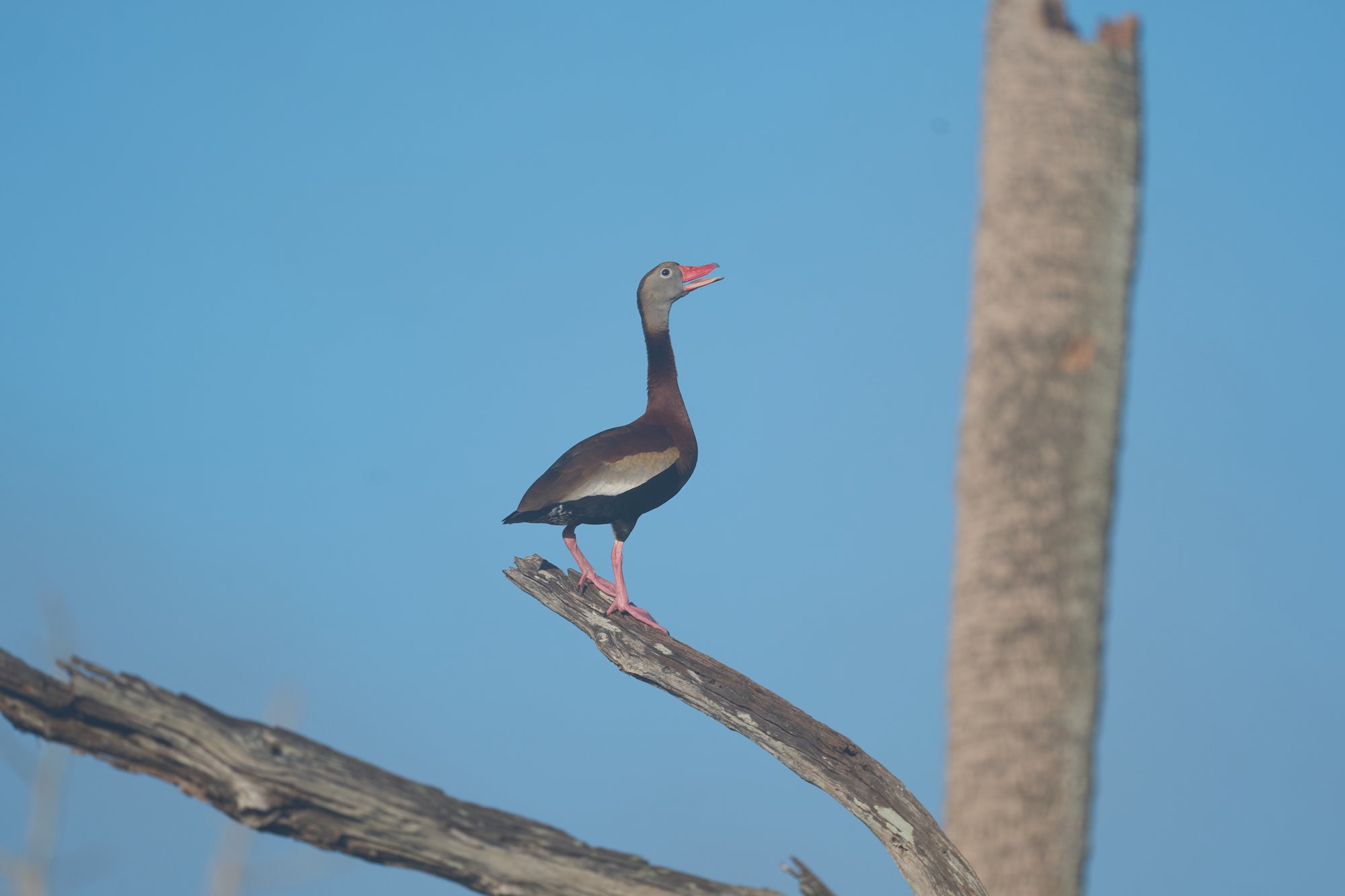
Photo by Miguel Quiles. Alpha 9 III. 600mm f/6.3 G Master. 1/1250-sec., f/6.3, ISO 250
FE 400mm F4.5 GM OSS: Fast, Bright & Ready For Action
The 400mm f/4.5 G Master combines a relatively bright maximum aperture with a compact optical design. It includes 22 elements in 16 groups, an 11-blade circular aperture and three Super ED elements. Two XD linear motors – one assigned to each focus group – drive the lens’ autofocus system.

Photo by Miguel Quiles. Alpha 9 III. 400mm f/4.5 G Master. 1/2000-sec., f/4.5, ISO 400
On the exterior, photographers get AF/MF and full-time DMF controls, a focus limiter, Optical SteadyShot controls and mode switches, plus four customizable focus-hold buttons. A customizable function ring can also be assigned to a preferred task – one useful setup is switching quickly between full-frame and APS-C crop modes. For working outdoors, the front element features Nano AR Coating II to help repel water, oil and dust. The lens is also dust- and moisture-resistant, giving it the weather-conscious build expected of a G Master optic.

Photo by Miguel Quiles. Alpha 9 III. 400mm f/4.5 G Master. 1/3200-sec., f/4.5, ISO 250
FE 600mm F6.3 GM OSS: More Reach, Nearly The Same Footprint
The 600mm f/6.3 G Master mirrors the 400mm closely in its external layout and control set, making the transition between the two straightforward for photographers who use both. Internally, it uses 24 elements in 17 groups, including one ED element, and shares the same single front lens-element approach.
That 600mm focal length is particularly attractive for small or distant subjects, including birds that are difficult to approach. Just as important, its 995-gram weight means photographers can pack meaningful reach without reserving an entire bag – or an entire day’s energy – for one lens.

Photo by Miguel Quiles. Alpha 9 III. 600mm f/6.3 G Master. 1/640-sec., f/6.3, ISO 640
Teleconverter Compatibility Extends The Range
Both lenses are compatible with Sony’s 1.4x and 2.0x teleconverters, giving photographers additional flexibility when the subject demands more magnification. The 400mm can extend to 560mm at f/6.3 with the 1.4x teleconverter or 800mm at f/9 with the 2.0x teleconverter. The 600mm becomes an 840mm at f/9 with the 1.4x teleconverter or a 1,200mm at f/13 with the 2.0x teleconverter.
Field Impressions: Built For Real Wildlife Work
In wildlife shooting, portability is not merely a convenience – it can determine whether a lens makes it into the field at all. After using both lenses in Florida’s summer heat and humidity, the reviewer found their low weight and compact size especially welcome, noting how easily they fit into a small camera bag.

Photo by Miguel Quiles. Alpha 9 III. 600mm f/6.3 G Master. 1/1000-sec., f/6.3, ISO 800
Performance was equally encouraging. Paired with Sony’s Alpha 9 III and Alpha 7R VI cameras, both lenses quickly acquired and tracked stationary and moving subjects, including at up to 120 frames per second. Even when branches sat in the foreground between the camera and a bird, autofocus remained accurate and responsive.

Photo by Miguel Quiles. Alpha 7R VI. 600mm f/6.3 G Master. 1/1250-sec., f/6.3, ISO 1600
A Welcome Shift In Super-Telephoto Primes
Sony’s new 400mm f/4.5 G Master and 600mm f/6.3 G Master are not simply new long lenses, they are a focused attempt to make high-end super-telephoto photography more mobile. With sub-1,000-gram weights, internal focusing, weather-conscious construction, extensive physical controls and teleconverter compatibility, each gives wildlife photographers a serious option for traveling light without giving up reach.

Photo by Miguel Quiles. Alpha 7R VI. 400mm f/4.5 G Master. 1/2500-sec., f/4.5, ISO 3200
The choice comes down to shooting style. The 400mm f/4.5 GM offers a brighter aperture and a versatile starting point for action and wildlife. The 600mm f/6.3 GM prioritizes native reach in an almost identical-size package. Either way, Sony’s newest G Masters point toward a welcome shift: super-telephoto primes that are easier to carry, easier to handhold and better positioned for the moments that happen far from the trailhead.
CLICK HERE to pre-order the 400mm f/4.5 G Master.
CLICK HERE to pre-order the 600mm f/6.3 G Master.
Watch the full video: