Get your cameras ready, aurora chasers! The northern lights could put on a spectacular show starting tonight (Nov. 11-12) as geomagnetic storm watches in effect may reach G4 and provide either a full or partial view to dozens of US cities. These watches are in response to potential geomagnetic storm effects related to coronal mass ejections (CME) that have erupted from the Sun over the past several days. Check out our resources below to help you photograph the phenomenon and stay up to date on the solar activity at NOAA's space weather site: swpc.noaa.gov.
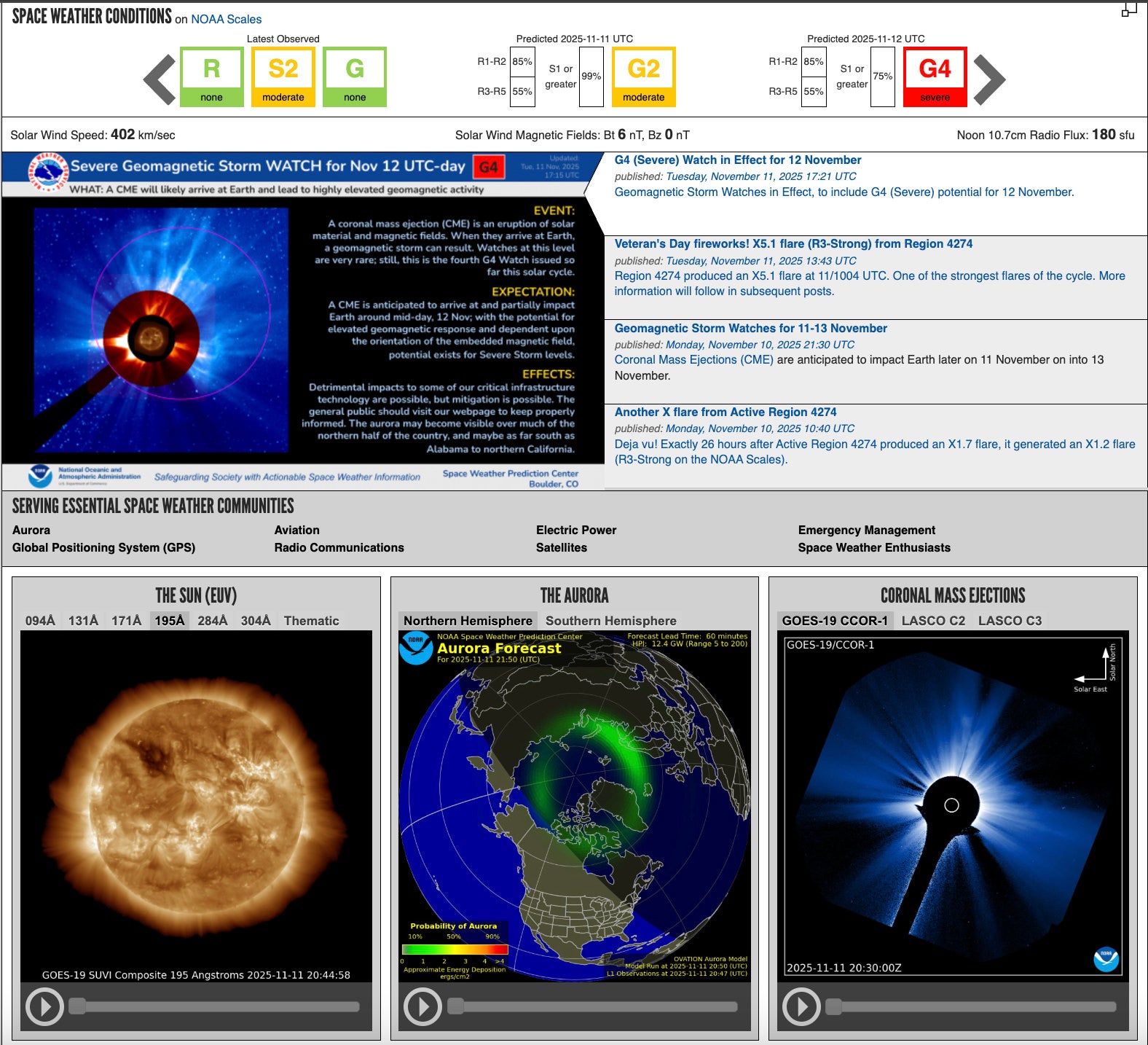
Screenshot from swpc.noaa.gov
Camera & Lens Selection For Photographing The Auroras
Alpha Collective member Rachel Jones Ross has always been inspired by the night sky and has photographed the dazzling display of the northern lights many times. “I have been shooting on Sony cameras for eight years,” she says. “In that time, I have worked with the entire Alpha line-up of cameras, and I can say without reservation that Sony cameras are the best low light cameras on the market, hands down.” The Alpha 1 II, Alpha 7 IV, Alpha 7R V, Alpha 7S III, Alpha 6700 – they're all solid options for photographing the northern lights.
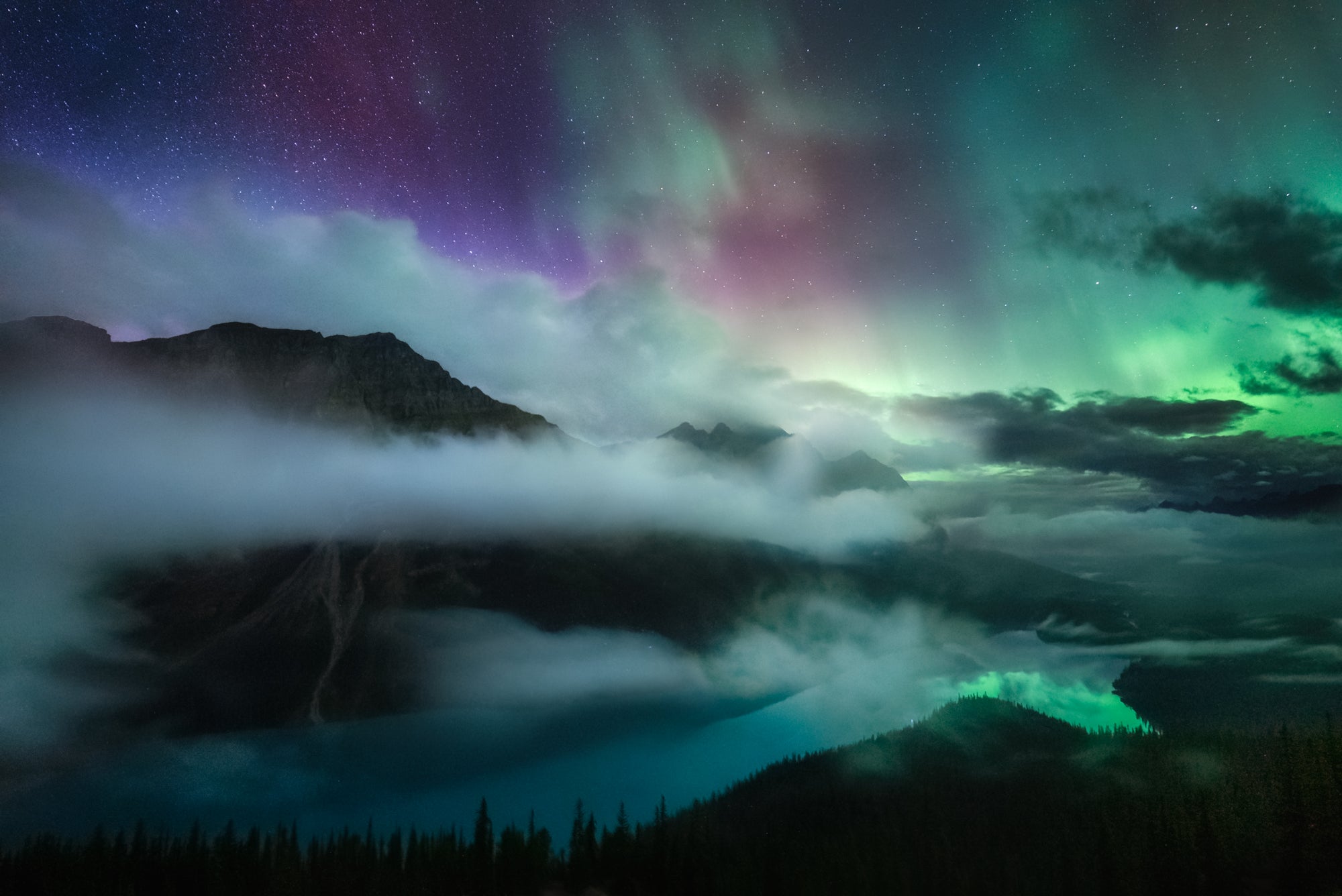
Photo by Rachel Jones Ross. Sony Alpha 7S III. Sony 12-24mm f/2.8 G Master.
Rachel’s go-to lenses include those like the 14mm f/1.8 G Master or 12-24mm f/2.8 G Master. “For aurora shooting, I tend to shoot wide, regardless of the landscape. The aurora can be difficult to capture as a lot of the drama, shape, and movement happens much higher than the horizon line where the landscape sits. I still want the landscape to be a prominent feature of the image, but I also must allow room in the composition to capture the dance of the northern lights.”
Check out more of her gear for photographing the northern lights in What’s In My Bag: How This Adventurer And Nightwatcher Gets Ready For Prime Aurora Time.
The Right Conditions To Photograph The Northern Lights
Another photographer and Alpha Collective member, Autumn Schrock, finds fascination in the night sky. She likes to photograph the dance of the auroras whenever possible, and provides a few key factors to set yourself up for success. She says:
Photographing the aurora requires several factors to perfectly align:
- First things first, you need to put yourself somewhere far north or far south—aurora only occurs near Earth’s magnetic poles. The auroras occur year-round, but are best seen in the autumn and winter months when the skies are dark.
- A solar storm to actually spawn the aurora! The lights are essentially a function of energetically charged particles from the sun being drawn down Earth’s magnetic field lines at the poles and colliding with gas atoms, which results in a release of light. When more particles are released from the sun at once it’s called a coronal mass ejection, and it’s during these solar storms when the aurora lights are strongest.
- Clear skies! Clouds will hide the beautiful aurora.
- A whole lot of patience.
- And quite frankly, pure luck.
Camera Setup: How To Photograph The Northern Lights
If everything aligns properly and key factors are in place, Autumn sets up her Alpha camera to capture it. See some of her tips below:
- I always shoot in the Adobe RGB color space, but it’s particularly important when photographing the aurora. Adobe RGB enables me to capture the aurora colors more accurately, as it records more green and blue hues than the sRGB color space.
- I select uncompressed RAW as my file type when shooting in high contrast conditions, such as at night with bright lights in the sky. Uncompressed RAW will give you more detail to work with when editing your files later. The file sizes are significantly larger, but worth the extra space when shooting in these scenarios.
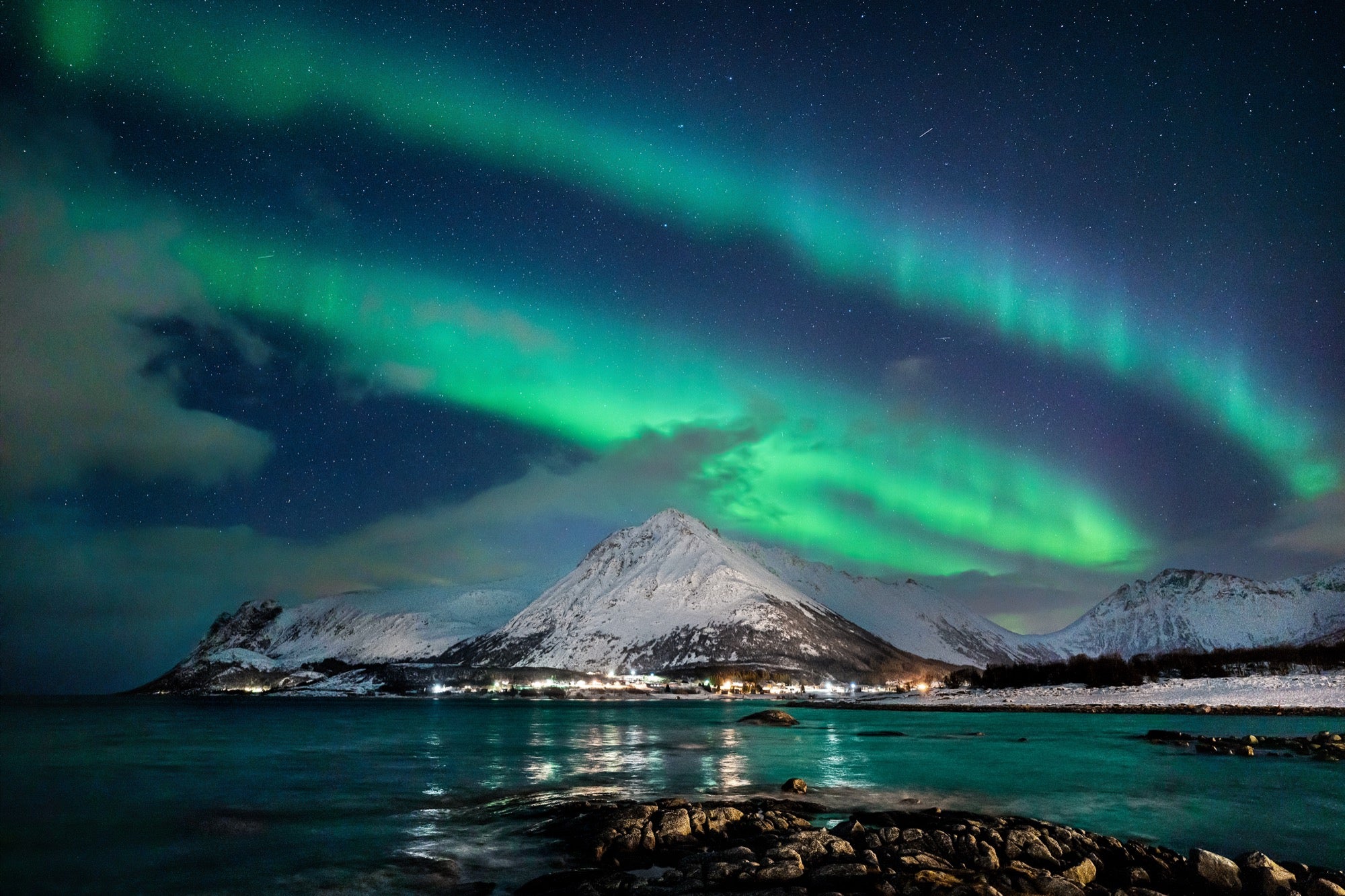
Photo by Autumn Schrock. Alpha 7R III. 20mm f/1.8 G. 3.2-sec., f/1.8, ISO 2000
- When shooting astrophotography, wide lenses with fast apertures are generally preferred. The low aperture of the 20mm f/1.8 G is key for me when shooting the fast-moving aurora, because unlike shooting the Milky Way, you most likely only get 2-4 seconds for exposure time. Not only is the aurora typically moving quickly, but it’s also easy to peak the green channel by overexposing. The aurora is constantly evolving, always ebbing and flowing darker and brighter, so it’s better to slightly underexpose rather than blow out the beautiful colors.
- Sometimes it’s difficult to detect with your eyes just how quickly the aurora is moving, so I used my camera for help. After testing out different shutter speeds, it became clear that the aurora wasn’t moving super quickly. I was able to use a slightly longer exposure at 3.2 seconds, while still being able to capture the texture as it moved across the sky. Because it’s a relatively short exposure for night photography, opening up the aperture to f/1.8 helped to keep my ISO down to 2000.
- Manually focusing can be challenging at night, especially with wide angle lenses. Thankfully Sony cameras are equipped with MF Assist, which automatically zooms in for you to get a better look once you turn the focus ring. You can zoom in even further if you press the center button inside the control wheel. Another helpful tool I use for manual focusing is Focus Peaking. It works by highlighting the in-focus elements of your frame in a specified color for better focus visibility. I use the color red when I’m photographing the night sky; the other options are white or yellow, which tend to blend in with the stars and camera noise. These focus assist settings help me tremendously as I don’t have great vision, but also because stars are tiny at 20mm!
Get more tips from Autumn in How An Astro-photographer Captures The Nighttime Dance Of The Aurora.
Photographer Jordan Herschel has also shared with us in the past how he finds and photographs the northern lights. He says, "Unlike the Milky Way or other star formations, the northern lights can vary in speed and intensity. There’s no proverbial 'set it and forget it' shutter speed that comes with traditional astrophotography, and the Aurora's ever-changing appearance will require you to change your settings on the fly."
First and foremost, Jordan says to make sure your focus on the sky is on point. He will often double-check by enabling focus-peaking, magnifying, and fine-tuning with the focus ring on the lens. Once I’ve got my focus sharp and have reviewed a few test shots to verify, I’ll turn the camera to manual focus to ensure I don’t lose it accidentally.
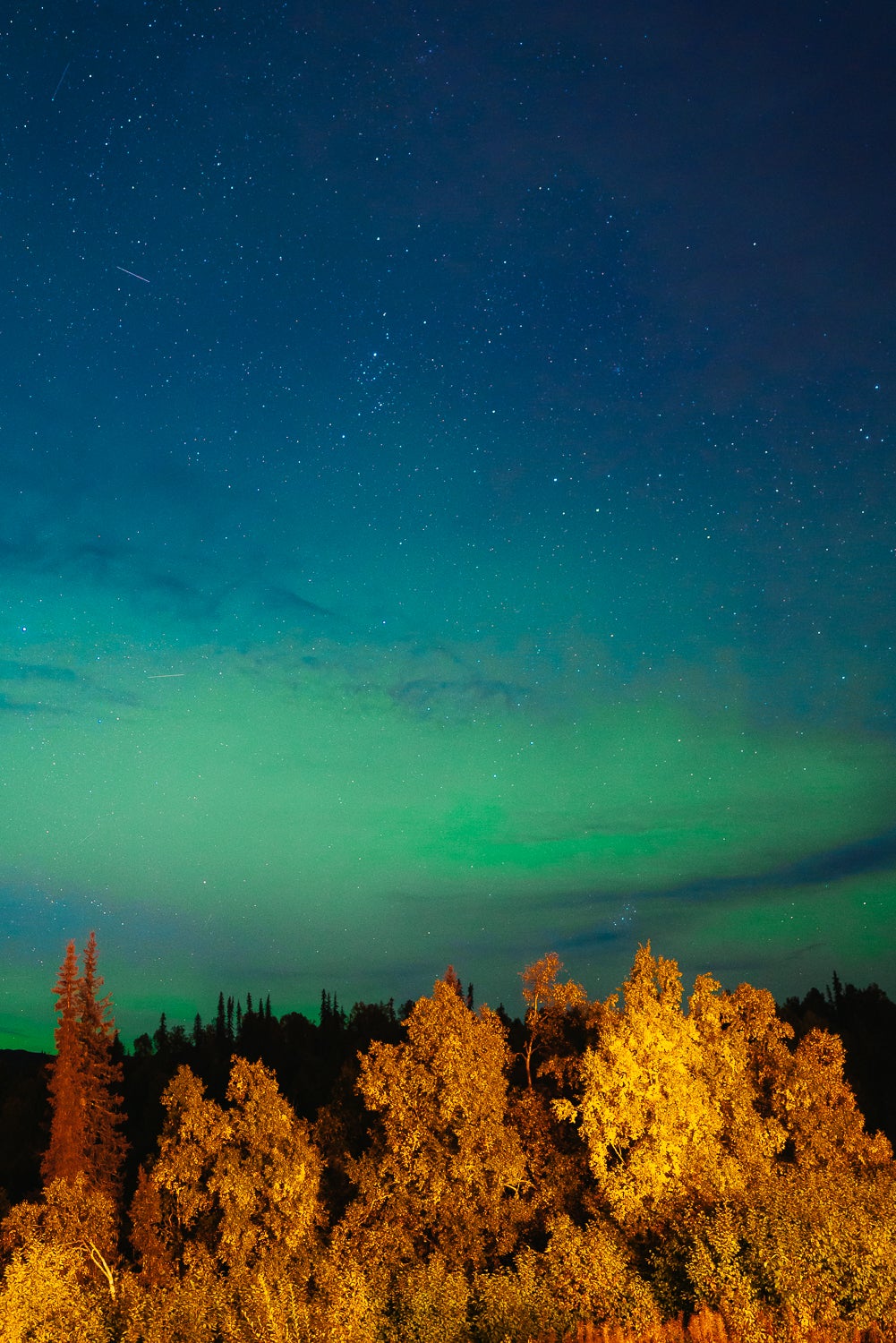
Photo by Jordan Herschel. Alpha 7R III. Sony 24mm f/1.4 G Master. 5 secs., f/1.4, ISO 2000
"If the lights are somewhat dim and difficult to see with the naked eye," Jordan explains, "I’ll use a longer shutter speed (15-25 seconds), the fastest aperture my lens allows (f/2.8 or f/1.4), and ISO to taste (usually between 800-1200). This longer shutter speed allows the glow of the aurora's colors to fill the frame. If the lights are vibrant, visible, and moving quickly, it’s important to use a quicker shutter speed to freeze their movement; the glowing, flowing streaks of the aurora can quickly become a green mush if the shutter is left open too long. In these situations I try to use a shutter speed no slower than 4 seconds, an aperture of f/2.8 or f/1.4, and an ISO between 3200 and 6000 depending on conditions. I used to be hesitant to push the ISO above 2500, but the latest Alpha bodies are capable of producing amazing results at much higher ISO settings."
Check out his guide in How To Photograph The Northern Lights: From Camera Setup To Predicting Where They'll Be.
See How These Photographers Capture The Northern Lights
Sometimes the greatest inspiration comes from seeing how other photographers have done it, and below we have a list of creators who have shared how they’ve previously captured nature’s ultimate light show.
- Behind The Shot: How To Capture An Aurora In Banff National Park
- Behind The Shot: An Arctic Moonlit Rainbow & Northern Lights Timelapse
- Behind The Shot: Luck, Preparation And Capturing An Epic Aurora
- Behind The Shot: A Time Blending Technique To Make A Dramatic Aurora Image
- Behind The Shot: Capturing A Surprise Aurora With A Fast Zoom
- Behind The Shot: A Northern Lights Moonbow
- Behind The Shot: Painting The Sky With Auroras
- Behind The Shot: Photographing An Aurora Down Under
- Photo Of The Day: An Epic Aurora Reflection With A Fast Wide-Angle Zoom